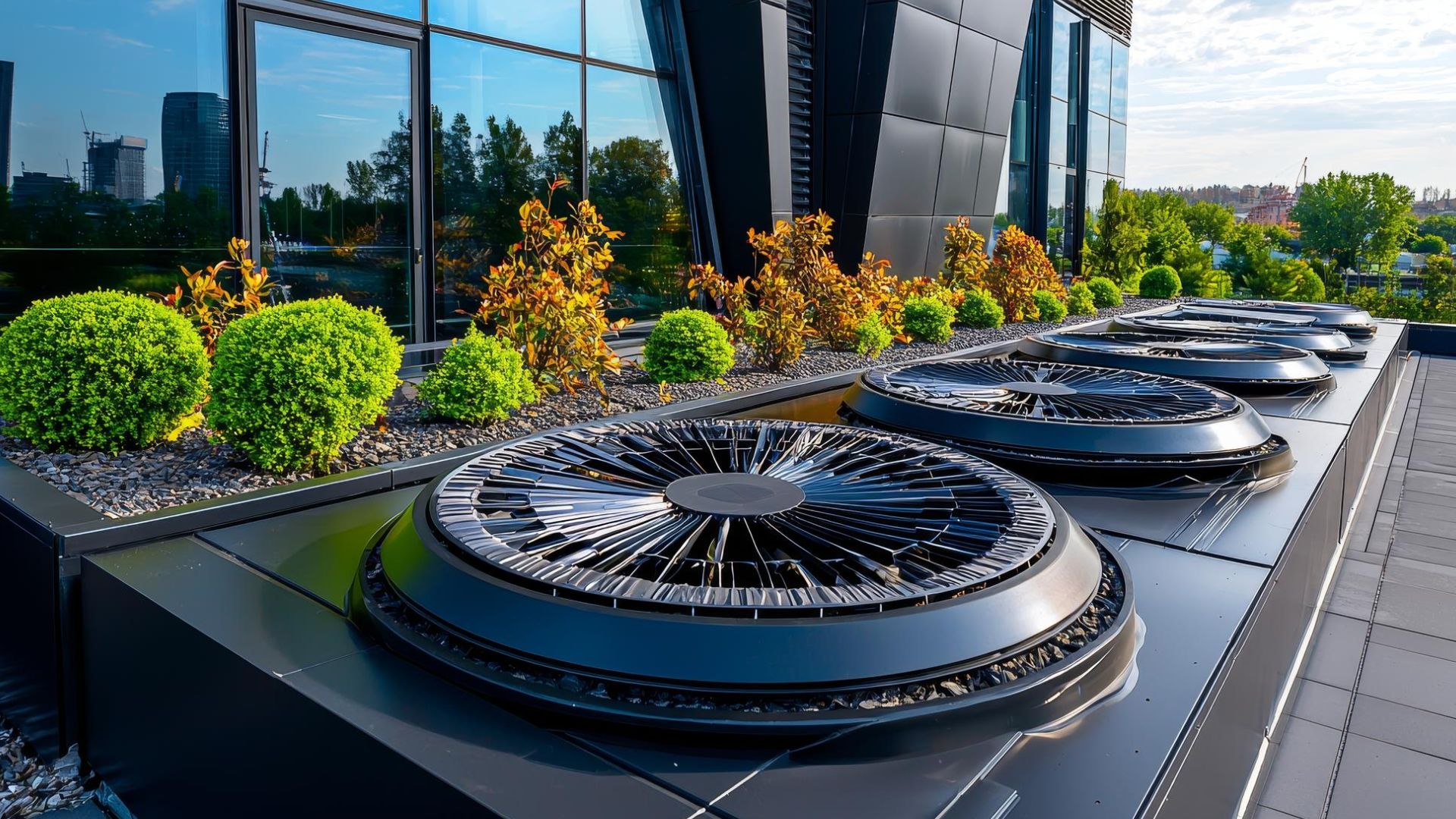
- HVAC systems account for 40 to 60 percent of commercial building energy use — making them the primary target for net-zero energy design strategies.
- All-electric heat pump HVAC systems are the foundation of net-zero design because they can be powered entirely by on-site or grid renewable electricity.
- Energy recovery ventilation reduces ventilation energy loads by 60 to 80 percent — critical in net-zero buildings where every unit of energy in the balance matters.
- Passive design (insulation, glazing, shading, orientation) reduces peak HVAC loads and is always more cost-effective than adding active system efficiency.
- Demand-controlled ventilation can reduce HVAC energy by 15 to 30 percent in intermittently occupied spaces such as offices and classrooms.
- Budlong designs energy-efficient HVAC systems for LEED, net-zero, and above-code projects throughout California.
- Net-Zero Buildings and the HVAC Challenge
- Passive Design as the HVAC Foundation
- All-Electric Heat Pump Systems
- Energy Recovery Ventilation
- Demand-Controlled Ventilation
- Radiant Heating and Cooling Systems
- Variable Speed Drives and Advanced Controls
- Ground Source Heat Pumps
- Solar PV and Battery Integration
- Who Pursues Net-Zero HVAC Design?
- Related Reading
- Frequently Asked Questions
Achieving net-zero energy performance in a commercial building is one of the most ambitious goals in contemporary building design — and HVAC systems sit at the center of that challenge. In a typical commercial building, HVAC accounts for 40 to 60 percent of total energy consumption. No amount of LED lighting or efficient plug loads can compensate for a poorly designed or oversized HVAC system when the net-zero energy balance is being tabulated at the end of the year.
At Budlong, our mechanical engineers design net-zero facilities with sustainable engineering solutions for commercial, institutional, and public sector clients throughout California. This guide presents the key HVAC design strategies that enable net-zero energy performance, from passive building design through active system selection, controls optimization, and renewable energy integration.
1. Net-Zero Buildings and the HVAC Challenge
A net-zero energy building (NZEB) produces as much energy from on-site renewable sources as it consumes over the course of a year. The net-zero equation has two sides: minimize energy consumption through efficiency, and generate energy through renewables to offset the remainder. HVAC systems are the primary battleground on the consumption side of this equation.
The most important principle in net-zero HVAC design is the load reduction hierarchy: reduce loads first through building design before sizing and selecting active systems. Every BTU of load eliminated through passive design means one less BTU the HVAC system must deliver — and one less BTU the solar PV system must generate. Sustainable design services at Budlong apply this hierarchy systematically in the MEP design process.
2. Passive Design as the HVAC Foundation
Passive design strategies reduce peak HVAC loads and annual energy consumption without active mechanical systems. They are always the most cost-effective energy efficiency investment because reducing load is cheaper than adding system capacity and then recovering it through efficiency.
Building Envelope Performance
High-performance insulation in roofs, walls, and below-grade slabs reduces conductive heat gain and loss throughout the year. In California’s climate zones, roof insulation is the highest-priority envelope measure because solar heat gain through the roof is the dominant envelope load on low-rise buildings. Wall insulation requirements under Title 24 2022 are significantly higher than previous code cycles, and continuous insulation (CI) systems that eliminate thermal bridging through framing are increasingly specified on net-zero projects.
High-Performance Glazing
Windows and glazing are the weakest thermal link in most commercial building envelopes. Net-zero buildings specify triple-pane or high-performance double-pane glazing with low SHGC (Solar Heat Gain Coefficient) values on east and west exposures to control solar gain, and slightly higher SHGC on south-facing glazing in heating-dominated climates to capture passive solar heat. Dynamic glazing (electrochromic or thermochromic) that automatically adjusts SHGC based on solar conditions is an emerging technology increasingly specified on premium net-zero projects in California. Sustainable design principles from Budlong incorporate envelope performance as the first line of HVAC load reduction.
Shading and Orientation
Exterior fixed shading — overhangs, fins, and louvers — blocks direct solar radiation from reaching glazing at peak summer sun angles while allowing lower-angle winter sun penetration for passive heating. Building orientation on the site should minimize east and west glazing exposure (where solar angles make effective shading difficult) and maximize south glazing (where overhangs can effectively shade summer sun while admitting winter sun). These architectural decisions have profound impacts on HVAC loads and are most effective when the mechanical engineer is involved before massing and orientation are finalized — making early MEP engagement a priority for net-zero projects.
3. All-Electric Heat Pump Systems
Heat pumps are the defining HVAC technology of the net-zero building era in California. They are the only heating technology that can achieve efficiencies greater than 100 percent by moving heat rather than generating it — and they run on electricity, which can be supplied entirely from renewable sources.
How Heat Pumps Enable Net-Zero
A heat pump operating in heating mode with a COP of 3.5 delivers 3.5 units of heat energy for every unit of electrical energy consumed. This means that 1 kWh of renewable electricity from solar PV powers 3.5 kWh of heating — a multiplicative effect that makes all-electric heat pump buildings far easier to bring to net-zero than gas-heated buildings. A gas heating system requires burning fossil fuel that cannot be offset by on-site renewable electricity generation, making gas heating fundamentally incompatible with true net-zero energy performance. The impact of electrification on MEP engineering is reshaping how mechanical engineers approach HVAC design for all California building types.
VRF Heat Recovery for Net-Zero Applications
Variable refrigerant flow heat recovery systems are among the most efficient HVAC options for net-zero commercial buildings because of their heat reuse capability — capturing heat rejected by cooling zones and delivering it to heating zones rather than expelling it to the outdoor air. This internal heat redistribution can achieve system COPs well above 4 in buildings with simultaneous mixed heating and cooling loads, reducing the total electrical energy required from the solar PV system. Energy-efficient MEP design for net-zero buildings consistently features VRF heat recovery as the primary space conditioning system.
Heat Pump Water Heaters
Domestic hot water (DHW) heating is the second largest energy end use in many commercial building types after HVAC. Heat pump water heaters (HPWHs) use the same refrigeration cycle as space conditioning heat pumps to heat water at COP values of 3 to 4 — far more efficiently than electric resistance or gas water heaters. In net-zero buildings, HPWHs eliminate the last significant fossil fuel energy use and reduce the solar PV system size required to achieve net-zero balance. MEP plumbing services from Budlong incorporate HPWH design as standard for net-zero projects.
Net-Zero HVAC Engineering from Budlong
Our licensed mechanical engineers design all-electric, high-efficiency HVAC systems for LEED Platinum, net-zero energy, and above-code commercial projects throughout California — from load reduction strategies through PV system coordination.
4. Energy Recovery Ventilation
Ventilation is a non-negotiable HVAC load — buildings must provide fresh outdoor air for occupant health regardless of whether that air requires heating or cooling. In California’s coastal climates, ventilation represents a relatively modest load; in inland zones with hot summers and cool winters, ventilation can be the dominant HVAC energy consumer. Energy recovery ventilation dramatically reduces this load in all climates.
Heat Recovery vs. Energy Recovery
Heat recovery ventilators (HRVs) transfer sensible heat between exhaust and supply airstreams using a plate heat exchanger or rotary wheel — recovering heat in winter and pre-cooling supply air in summer. Energy recovery ventilators (ERVs) transfer both sensible heat and latent energy (moisture) between airstreams, which is more effective in humid climates or buildings with high ventilation rates where dehumidification is a significant load. In California’s dry climates, HRVs are often sufficient; ERVs are preferred in healthcare, laboratory, and high-occupancy applications where latent load management is important.
Rotary Enthalpy Wheels
Rotary enthalpy wheels are the most efficient energy recovery device, achieving sensible effectiveness of 75 to 85 percent and total effectiveness (sensible plus latent) of 70 to 80 percent. They are used in dedicated outdoor air systems (DOAS) that handle building ventilation separately from space conditioning, allowing the space conditioning equipment to be sized purely for sensible loads. The combination of ERV/HRV with DOAS is a defining feature of net-zero commercial HVAC design in California. Enhancing indoor air quality through ERV ensures that ventilation quantity is maintained while energy recovery reduces the conditioning cost of that ventilation air.
5. Demand-Controlled Ventilation
Demand-controlled ventilation (DCV) uses real-time occupancy data — from CO2 sensors or direct occupancy counting systems — to modulate outdoor air delivery to the actual occupant load rather than the design maximum occupancy. Since most commercial buildings are occupied at less than 50 percent of design capacity for the majority of operating hours, DCV delivers significant energy savings without compromising indoor air quality.
CO2-Based DCV
CO2 sensors measure the carbon dioxide concentration in the occupied space, which rises in proportion to occupant density. When CO2 concentrations are below the setpoint (typically 1,100 to 1,200 ppm), the outdoor air damper modulates to a reduced minimum position. When occupancy increases and CO2 rises above setpoint, the damper opens to provide additional ventilation. ASHRAE 62.1 provides the theoretical basis for CO2-based DCV, and California Title 24 mandates DCV for specific space types above defined occupant density thresholds.
Occupancy Sensor Integration
Direct occupancy sensing — using people counters, IR sensors, or BMS-integrated access control data — provides more accurate occupancy information than CO2 sensing, particularly in spaces with very low occupancy where CO2 response is slow. Smart building technology implementation increasingly integrates occupancy sensors with both lighting and HVAC controls, allowing a single occupancy signal to trigger coordinated energy savings across multiple building systems simultaneously.
6. Radiant Heating and Cooling Systems
Radiant heating and cooling systems — which condition spaces primarily through radiation exchange between occupants and thermally active surfaces rather than through convection from supply air — offer significant efficiency advantages in certain net-zero building applications.
How Radiant Systems Work
Radiant systems circulate heated or chilled water through tubing embedded in floors, ceilings, or walls. The thermally active surface exchanges heat with occupants and objects through infrared radiation, which is highly efficient for occupant comfort because it directly conditions the occupant’s mean radiant temperature rather than conditioning the entire air volume of the space. Radiant cooling can maintain occupant comfort at higher air temperatures than conventional air-based cooling, reducing the building’s cooling load and the energy required to deliver it.
Radiant Cooling and DOAS
Radiant cooling systems must be paired with a DOAS that handles all ventilation requirements and, critically, all latent (dehumidification) load. If humid outdoor air is allowed to contact cold radiant ceiling panels, condensation will form — an unacceptable condition. The DOAS must deliver supply air that is dry enough to prevent condensation on the radiant surfaces, requiring precise dew point control of the DOAS supply air. When properly designed, the radiant DOAS combination achieves exceptional efficiency because the water-based radiant distribution requires far less pump energy than air-based systems, and the chilled water temperatures can be higher (58 to 65°F instead of 44°F) — allowing higher chiller COP. Mechanical engineering for modern buildings at Budlong includes radiant system design as part of our net-zero HVAC portfolio.
7. Variable Speed Drives and Advanced Controls
Variable speed drives on fans, pumps, and compressors are one of the highest-return investments in energy-efficient HVAC design. Because fan and pump power scales with the cube of speed, even modest speed reductions produce dramatic energy savings.
VFD Impact on HVAC System Energy
A supply fan operating at 80 percent of design speed consumes only 51 percent of design power. At 60 percent speed, power drops to 22 percent of design. In buildings where fans spend many hours at part-load conditions — which is most commercial buildings in California — VFDs on supply fans, return fans, exhaust fans, cooling tower fans, and chilled water pumps collectively reduce HVAC system electrical consumption by 25 to 45 percent compared to constant-speed operation. California Title 24 mandates VFDs on fans and pumps above defined horsepower thresholds for this reason. Energy-efficient MEP design practices at Budlong specify VFDs as standard on all qualifying equipment.
Advanced Setpoint Reset Controls
Beyond VFDs, advanced control sequences that reset operating setpoints based on actual building conditions — rather than maintaining fixed setpoints regardless of load — achieve additional efficiency. Chilled water supply temperature reset (raising chilled water temperature when loads are low increases chiller COP), duct static pressure reset (reducing static pressure setpoint when zones are satisfied reduces fan energy), and condenser water temperature reset (reducing cooling tower setpoint when outdoor wet bulb is low reduces chiller lift) are all high-value control strategies for net-zero HVAC. Smart MEP technology solutions from Budlong incorporate these advanced sequences as standard in our controls specifications.
8. Ground Source Heat Pumps
Ground source heat pump (GSHP) systems exchange heat with the earth through buried piping loops rather than with the outdoor air, allowing operation at consistent high efficiency regardless of outdoor temperature extremes. The stable ground temperature of 55 to 65 degrees Fahrenheit in California allows GSHPs to maintain COP values of 4 to 5 in both heating and cooling modes year-round.
GSHP System Configurations
Vertical closed-loop systems drill boreholes 200 to 400 feet deep and install U-tube heat exchanger loops in each borehole — the most space-efficient configuration and the standard choice for urban commercial sites with limited land area. Horizontal closed-loop systems bury piping in trenches at 4 to 6 foot depth — lower drilling cost but requiring significantly more land area. Open-loop systems pump groundwater directly through the heat pump and return it to an injection well or surface discharge — the highest efficiency option where suitable groundwater conditions exist.
When GSHP Is the Right Choice for Net-Zero
GSHP systems have higher first cost than air source heat pumps due to the drilling and loop field installation cost, but deliver lower operating cost and higher reliability over the system life. They are most appropriate for net-zero projects where exceptional long-term efficiency is the priority, where there is adequate site area or drilling access for the loop field, and where the project budget can accommodate the premium first cost. Net-zero facility engineering from Budlong includes GSHP feasibility analysis as part of our system selection process for applicable projects.
9. Solar PV and Battery Integration with HVAC
The generation side of the net-zero energy equation requires on-site renewable energy production — almost universally solar photovoltaic (PV) in California. The mechanical engineer plays a critical role in sizing the building’s energy loads accurately so that the PV system can be sized to offset those loads.
PV System Sizing for HVAC Offset
Whole-building energy modeling using EnergyPlus or eQUEST simulates the building’s annual HVAC energy consumption hour by hour, accounting for all efficiency measures. The resulting annual energy consumption figure drives the PV system size needed to achieve net-zero balance. All-electric HVAC systems have higher electrical consumption than partially gas-heated buildings, but the elimination of gas consumption allows all energy to be offset by PV generation — making true net-zero achievable. Budlong coordinates HVAC energy modeling with solar PV design and build projects for clients pursuing net-zero certification.
Battery Storage and Demand Response
Battery energy storage systems (BESS) store excess PV generation during the day for use at night or during demand response events. For HVAC-heavy buildings that draw significant power during morning and evening hours before and after peak PV production, battery storage closes the gap in the net-zero energy balance. Battery systems can also participate in California’s demand response programs, reducing peak demand charges while supporting grid stability — a dual financial benefit for building owners. Smart building technology integrates battery management with HVAC controls for coordinated demand management.
10. Who Pursues Net-Zero HVAC Design?
- Mission-Driven Organizations — Universities, nonprofits, and government agencies with sustainability commitments
- LEED Platinum Developers — Commercial developers targeting LEED Platinum certification and above-code energy performance
- Healthcare Systems — Healthcare facilities reducing carbon footprint to meet institutional sustainability pledges
- School Districts — Public schools pursuing net-zero to reduce operating costs and demonstrate environmental leadership
- Forward-Looking Developers — Developers choosing sustainable engineering firms to future-proof assets against tightening regulations
11. Related Reading
- Net-zero buildings eliminate fossil fuel HVAC by switching to all-electric heat pump systems powered by on-site renewable electricity.
- Passive design — insulation, glazing, shading, orientation — reduces peak HVAC loads and is always more cost-effective than adding active system efficiency.
- VRF heat recovery systems and DOAS with energy recovery ventilation are the most common HVAC configurations in California net-zero commercial buildings.
- Demand-controlled ventilation reduces HVAC energy by 15 to 30 percent in intermittently occupied spaces — mandatory under Title 24 for qualifying space types.
- VFDs on all fans, pumps, and compressors reduce HVAC electrical consumption by 25 to 45 percent compared to constant-speed operation.
- Solar PV system sizing is driven by annual HVAC energy consumption from whole-building energy modeling — accurate modeling is the foundation of net-zero PV design.
- Ground source heat pumps, radiant systems, and battery storage are advanced strategies that further improve efficiency and grid integration for net-zero buildings.
For technical reference, consult the ASHRAE 90.1 energy standard, the California Energy Commission Title 24 net-zero resources, the USGBC LEED energy and atmosphere credit framework, the New Buildings Institute Zero Net Energy commercial guidance, and EPA Energy Star Portfolio Manager benchmarking tools.
12. Frequently Asked Questions
What is a net-zero energy building?
A net-zero energy building produces as much energy from on-site renewable sources as it consumes over the course of a year. HVAC systems account for 40 to 60 percent of commercial building energy use, making them the primary target for efficiency measures. All-electric heat pump HVAC systems powered by solar PV are the defining strategy for achieving net-zero in California commercial buildings.
What HVAC systems are best for net-zero buildings?
Net-zero buildings favor all-electric systems — particularly VRF heat recovery for mid-size buildings, chilled water plants with high-efficiency heat pump chillers for large buildings, and ground source heat pumps where site conditions allow. DOAS with energy recovery ventilation handles outdoor air loads efficiently in all cases. See Budlong’s HVAC design services for a full range of net-zero system options.
What is energy recovery ventilation (ERV) and how does it contribute to net-zero performance?
Energy recovery ventilation transfers heat and moisture between exhaust air and incoming outdoor air, reducing the energy required to condition fresh air by 60 to 80 percent. In net-zero buildings where every unit of energy matters in the annual balance, ERV is a fundamental efficiency measure that enables adequate ventilation without an outsized ventilation energy penalty.
What is demand-controlled ventilation and how much energy does it save?
Demand-controlled ventilation uses CO2 or occupancy sensors to reduce outdoor air delivery when occupancy is below design levels — saving 15 to 30 percent of ventilation energy in intermittently occupied spaces. California Title 24 mandates DCV for specific space types, and net-zero buildings apply DCV broadly across all zone types to minimize ventilation energy consumption.
What is a ground source heat pump and when is it appropriate?
A ground source heat pump exchanges heat with the stable earth temperature (55 to 65°F in California) rather than outdoor air, maintaining high efficiency regardless of outdoor temperature extremes. GSHPs are appropriate for low- to mid-rise commercial buildings with adequate site area for loop fields, and on net-zero projects where exceptional long-term efficiency justifies the higher first cost of drilling and loop installation.
How does passive design reduce HVAC energy loads in net-zero buildings?
Passive design — including high-performance insulation, low-SHGC glazing on east and west exposures, exterior shading, natural ventilation design, and thermal mass — reduces peak HVAC loads before any active systems are engaged. Reducing load is always more cost-effective than adding system efficiency, making passive design the foundation of every net-zero HVAC strategy. Budlong’s sustainable design services begin with passive load reduction.
What California programs support net-zero building design?
California supports net-zero design through the CEC’s Zero Net Energy Action Plan, Title 24 performance compliance pathways that reward above-code performance, CPUC-regulated utility rebates for heat pump equipment, and net energy metering (NEM) for solar PV. Local reach codes in many California cities go beyond Title 24 to require all-electric systems in new construction, further incentivizing heat pump HVAC.
How does solar PV integration work with HVAC systems in net-zero buildings?
Solar PV generates electricity that offsets building electrical consumption including HVAC systems. PV system size is determined by annual HVAC and total building energy consumption from whole-building energy modeling. Grid-tied systems export excess generation and import electricity at night. Battery storage systems increase self-consumption of PV generation and support demand response — both financially beneficial for California commercial building owners.