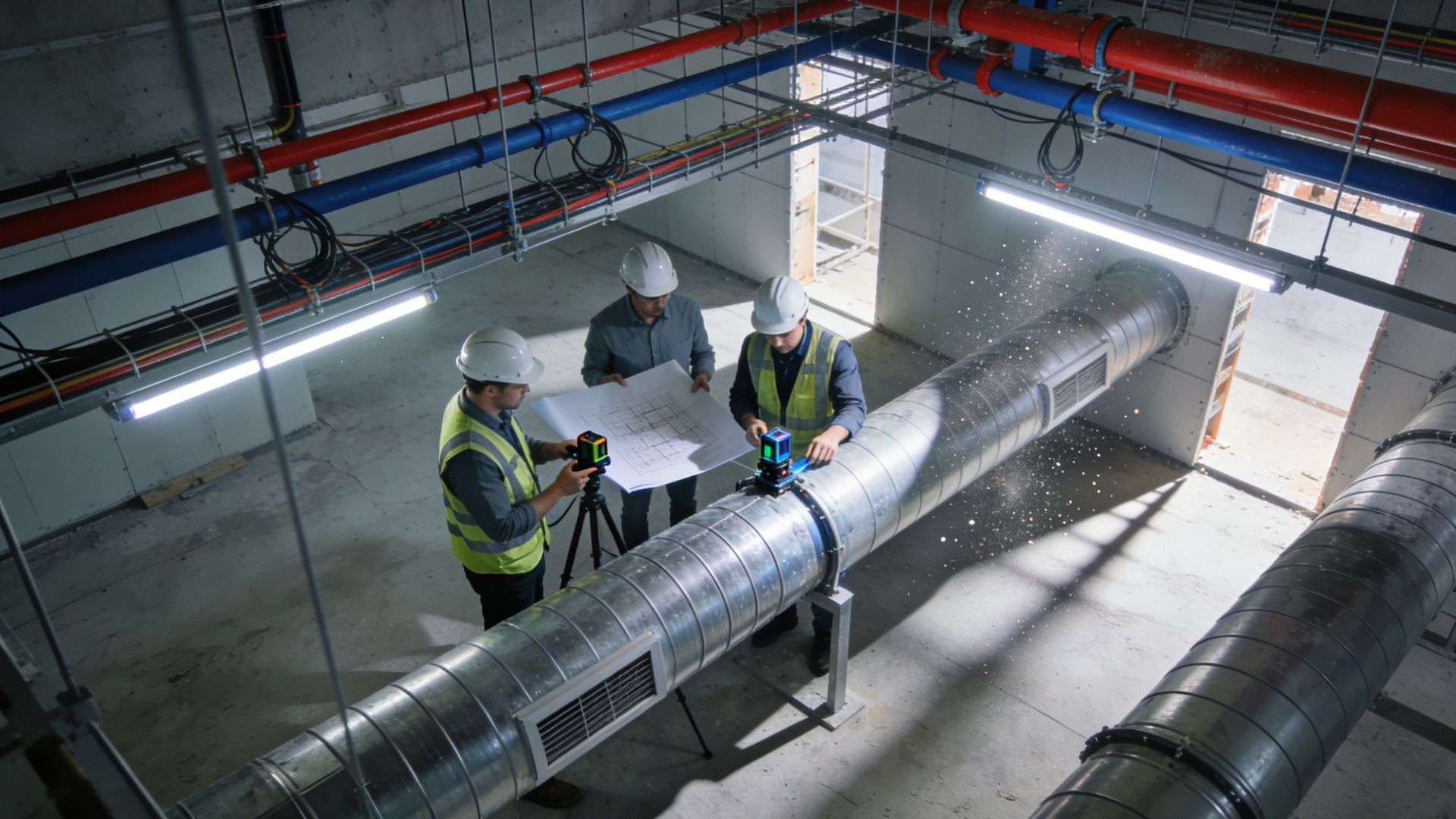
- MEP engineering covers Mechanical, Electrical, and Plumbing systems — the essential infrastructure of every building.
- Integrated MEP design reduces construction rework, lowers lifecycle operating costs, and ensures code compliance.
- Early MEP involvement (schematic design phase) prevents costly conflicts with structural and architectural elements.
- BIM coordination and clash detection are now standard practice for MEP engineers on complex projects.
- California projects must comply with Title 24, CALGreen, CMC, CEC, and CPC in addition to local jurisdictional requirements.
- Budlong provides full-service MEP engineering across commercial, healthcare, industrial, and educational sectors throughout California.
- What Is MEP Engineering?
- How MEP Systems Work Together
- Types of MEP Systems
- The MEP Design Process
- Industry Applications
- MEP Engineering and Sustainability
- BIM and Digital Coordination
- How to Select an MEP Engineering Firm
- MEP Codes and Standards in California
- Who Uses MEP Engineering?
- Related Reading
- Frequently Asked Questions
Every building you occupy depends on systems you rarely see. The air conditioning that keeps you comfortable, the electrical panel that powers your equipment, the plumbing network that delivers clean water and removes waste — all of these are the domain of MEP engineering. Understanding what MEP engineering is and how it shapes building performance is essential knowledge for architects, developers, facility managers, and project owners.
At Budlong, our licensed MEP engineers have delivered building systems design for commercial offices, healthcare facilities, schools, government buildings, and industrial plants across California for decades. This guide provides a technically grounded overview of what MEP engineering involves, how each discipline functions, and why integrated MEP design is one of the most consequential decisions you can make for any construction project.
1. What Is MEP Engineering?
MEP engineering is the branch of building engineering responsible for designing and coordinating three major building service systems: Mechanical (M), Electrical (E), and Plumbing (P). These systems collectively make a building habitable, functional, safe, and energy-efficient. While architectural design defines the appearance and spatial layout of a building, MEP engineering determines how it breathes, how it is powered, and how water moves through it.
The discipline spans the entire project lifecycle from feasibility and schematic design through construction administration and commissioning. MEP engineers work in close collaboration with architects, structural engineers, and general contractors to ensure all systems are coordinated, properly sized, and code-compliant before construction begins.
The Three Disciplines Defined
Mechanical engineering in buildings primarily focuses on HVAC (Heating, Ventilation, and Air Conditioning) systems. This includes equipment selection, ductwork design, refrigerant piping, controls integration, and compliance with energy codes such as California Title 24.
Electrical engineering covers power distribution from the utility service entrance through switchgear, panelboards, branch circuits, lighting systems, emergency power, telecommunications, and low-voltage systems. Electrical engineers ensure that a building receives, distributes, and uses electricity safely and efficiently.
Plumbing engineering designs domestic water systems, sanitary drainage, storm drainage, natural gas piping, medical gas systems (in healthcare facilities), and specialty process piping. Plumbing engineers must account for pressure, flow rates, fixture unit loads, and applicable health and safety codes.
2. How MEP Systems Work Together
MEP systems are deeply interdependent. An HVAC system requires electrical power for fans, compressors, and controls. Plumbing systems require pressure from pumps that need electrical circuits. Chilled water systems for HVAC need both mechanical piping and electrical power. Fire suppression systems integrate with plumbing and are monitored by electrical fire alarm panels.
This interdependence is why integrated MEP services delivered by a single coordinated team produce better outcomes than siloed discipline-by-discipline design. When mechanical, electrical, and plumbing engineers share models, coordinate routing, and review each other’s drawings, conflicts are resolved at the design stage rather than during construction — where changes are far more expensive.
Studies by the Construction Industry Institute indicate that design coordination errors and omissions account for up to 52 percent of all construction rework. Early MEP coordination using BIM tools directly addresses this root cause.
The Role of Systems Integration
Modern buildings increasingly rely on building automation systems (BAS) that monitor and control HVAC, lighting, and electrical systems from a central interface. MEP engineers must specify the sequences of operation, sensors, control points, and communication protocols that enable these intelligent systems to function correctly. Smart MEP technology solutions now form a critical layer of the building design process.
3. Types of MEP Systems
MEP engineering covers a broad range of system types. The specific systems required for any project depend on building type, occupancy, climate zone, and owner requirements.
| Discipline | System Type | Common Applications |
|---|---|---|
| Mechanical | HVAC (split, packaged, VRF, chilled water) | Commercial offices, healthcare, schools, industrial |
| Mechanical | Ventilation and exhaust systems | Laboratories, kitchens, parking structures, cleanrooms |
| Mechanical | Hydronic heating and cooling | High-rise, large commercial, campuses |
| Electrical | Power distribution (MV and LV) | All building types, data centers, industrial |
| Electrical | Lighting design (interior and exterior) | Offices, retail, hospitality, municipal |
| Electrical | Emergency and standby power | Healthcare, data centers, government, high-rise |
| Plumbing | Domestic water (hot and cold) | All occupied buildings |
| Plumbing | Sanitary and storm drainage | All building types |
| Plumbing | Medical gas systems | Hospitals, clinics, surgical centers |
| Plumbing | Process and specialty piping | Laboratories, industrial facilities, food service |
4. The MEP Design Process
MEP design follows a structured progression aligned with standard architectural project phases. Understanding these phases helps project owners and architects know what to expect and when to make key decisions.
Schematic Design (SD)
During schematic design, MEP engineers define the overall approach to each building system. This includes identifying utility service locations, establishing preliminary equipment sizes and locations, and confirming that the architectural layout can accommodate the required mechanical rooms, electrical rooms, and vertical shaft space. This is when critical coordination with the structural engineer also begins.
Design Development (DD)
Design development refines the SD concepts into more detailed system layouts. Equipment schedules are prepared, major ductwork and piping routes are established, and electrical single-line diagrams are developed. Load calculations are performed to confirm equipment sizing meets code requirements and performance targets.
Construction Documents (CD)
Construction documents are the complete set of drawings and specifications from which contractors build. MEP CDs include fully coordinated plans, sections, details, equipment schedules, and specifications. For larger projects, MEP drafting services and BIM modeling are integral to producing accurate and buildable documents.
Construction Administration (CA)
During construction, MEP engineers review submittals and shop drawings, respond to requests for information (RFIs), conduct site observations, and support the commissioning process. This phase ensures that what is built matches what was designed and that systems perform as specified.
5. Industry Applications of MEP Engineering
MEP engineering serves virtually every building sector. The systems required, the codes that apply, and the performance expectations vary significantly by building type.
Commercial and Office Buildings
Commercial office projects require flexible HVAC systems that can adapt to tenant configuration changes, robust electrical infrastructure for high plug-load densities, and plumbing systems designed for both office and retail occupancies. MEP upgrades in commercial buildings are also a growing area as existing building stock is retrofitted for energy efficiency and improved occupant comfort.
Healthcare Facilities
Healthcare MEP design is among the most complex in the industry. Hospitals and clinics require HVAC systems that maintain precise pressure relationships between spaces to control infection, medical gas systems, redundant electrical systems with emergency power, and plumbing systems with special provisions for hot water temperature control and cross-connection prevention. Healthcare MEP design is a specialized discipline governed by FGI Guidelines and NFPA 99.
Educational Institutions
Schools and universities demand high-performing ventilation systems to support learning outcomes, efficient lighting that meets California Title 24 standards, and plumbing systems sized for large occupancy peaks during class changes. MEP design for schools and universities must also incorporate fire and life safety systems that meet California DSA requirements.
Ready to Discuss Your MEP Engineering Needs?
Budlong’s licensed MEP engineers provide full-service design from schematic design through construction administration. Let us help you deliver a project that performs.
6. MEP Engineering and Building Sustainability
MEP systems are at the heart of sustainable building design. The largest opportunities to reduce a building’s carbon footprint, energy consumption, and water use all fall within the MEP scope. Sustainable MEP design services from Budlong integrate energy modeling, passive design strategies, and high-efficiency equipment selection to help clients meet LEED, CALGreen, and net-zero energy targets.
Energy Efficiency in Mechanical Systems
High-efficiency HVAC systems, heat recovery ventilation, variable frequency drives (VFDs) on fans and pumps, and demand-controlled ventilation are among the mechanical strategies that significantly reduce energy consumption. Energy-efficient MEP design directly reduces operating costs over the building’s lifecycle.
Electrical Efficiency and Renewables Integration
LED lighting systems, smart lighting controls, power factor correction, and integration with solar photovoltaic systems are key electrical strategies for sustainable buildings. Budlong’s engineering team coordinates MEP design with solar PV design and build projects to create comprehensive, low-carbon building systems.
Water Conservation in Plumbing Design
Low-flow fixtures, greywater reuse systems, and efficient domestic hot water distribution strategies reduce water consumption and the energy required to heat water. MEP plumbing services focused on water conservation are increasingly required for projects pursuing LEED credits and CALGreen compliance.
7. BIM and Digital Coordination in MEP Engineering
Building Information Modeling (BIM) has fundamentally transformed how MEP engineers design, coordinate, and document building systems. Rather than producing 2D drawings that are difficult to spatially coordinate, MEP engineers now build intelligent 3D models that contain geometric and data-rich representations of every duct, pipe, conduit, and piece of equipment in the building.
Clash Detection
BIM software such as Autodesk Revit and Navisworks enables automated clash detection, identifying where MEP systems conflict with structural elements, architectural features, or each other. Resolving these conflicts in the model rather than in the field eliminates costly field changes and schedule delays. Advancements in BIM for MEP coordination continue to improve coordination accuracy and reduce project risk.
5D BIM for Cost Management
Advanced BIM workflows link design geometry to cost and schedule data, enabling more accurate quantity takeoffs and project cost forecasting. 5D BIM for MEP project management is an emerging capability that provides owners and contractors with greater financial predictability.
8. How to Select an MEP Engineering Firm
Selecting the right MEP engineering firm is a critical decision that affects project quality, schedule, and lifecycle performance. The following criteria should guide your evaluation.
Relevant Project Experience
Look for firms with demonstrated experience in your specific building type. Healthcare MEP, laboratory MEP, and industrial MEP each require specialized knowledge that general practitioners may lack. Review the firm’s MEP project portfolio for projects similar in size, type, and complexity to yours.
Integrated Service Capability
Firms that offer all three MEP disciplines under one roof provide better coordination and a single point of accountability. Integrated MEP services eliminate the interface problems that arise when mechanical, electrical, and plumbing engineers work for different firms with different priorities.
Technology and BIM Capability
Confirm that the firm works in current BIM authoring tools, has established clash detection workflows, and can deliver models that are usable by contractors for fabrication and coordination. Accurate MEP drafting services and robust BIM capability are non-negotiable on complex projects.
9. MEP Codes and Standards in California
California has among the most stringent building codes in the United States. MEP engineers working in California must be thoroughly familiar with the following regulatory framework.
Title 24 Energy Code
California’s Title 24, Part 6 establishes energy efficiency requirements for all new construction and significant alterations. It covers HVAC system efficiency, lighting power density, envelope performance, and renewable energy integration. Compliance documentation and energy modeling are required for most commercial projects.
CALGreen
The California Green Building Standards Code (CALGreen) establishes mandatory baseline requirements and voluntary tier levels for water efficiency, indoor air quality, and construction waste management. MEP engineers play a central role in meeting CALGreen requirements. Sustainable design principles embedded in MEP design are key to CALGreen compliance.
California Mechanical, Electrical, and Plumbing Codes
The California Mechanical Code (CMC), California Electrical Code (CEC), and California Plumbing Code (CPC) are adopted from their national model codes with California amendments. Local jurisdictions may adopt additional amendments, and MEP engineers must be current on the applicable edition for each project jurisdiction.
10. Who Uses MEP Engineering?
MEP engineering serves a broad range of clients and project types across California and beyond. Understanding which sectors rely on MEP expertise helps frame the scope and importance of the discipline.
- Commercial Developers — Ground-up office buildings, mixed-use, retail, and tenant improvement projects
- Healthcare Organizations — Hospitals, outpatient clinics, surgical centers, and medical office buildings
- Educational Institutions — K-12 schools, community colleges, and universities
- Government and Municipal — City halls, libraries, fire stations, and public facilities
- Industrial and Manufacturing — Processing facilities, warehouses, and specialized industrial plants
- Hospitality — Hotels, resorts, and food service facilities
11. Related Reading
- MEP engineering encompasses Mechanical (HVAC), Electrical (power and lighting), and Plumbing (water and drainage) systems.
- Integrated MEP design from a single coordinated team reduces conflicts, rework, and cost overruns.
- MEP engineers are involved from schematic design through construction administration and commissioning.
- BIM coordination and clash detection are standard tools for managing MEP system complexity.
- California projects require compliance with Title 24, CALGreen, CMC, CEC, and CPC.
- Sustainability, energy efficiency, and net-zero design goals are now central to MEP engineering practice.
- Selecting an MEP firm with relevant sector experience, integrated capabilities, and strong BIM workflows is critical to project success.
For further technical context, see the ASHRAE standards library, the NFPA code repository, the California Energy Commission Title 24 resources, the USGBC LEED framework, and the CSE Magazine MEP engineering resource center.
12. Frequently Asked Questions
What does MEP stand for in engineering?
MEP stands for Mechanical, Electrical, and Plumbing. These three disciplines collectively cover all building service systems including HVAC, power distribution, lighting, water supply, drainage, and fire protection.
What does an MEP engineer do?
An MEP engineer designs, coordinates, and documents the mechanical, electrical, and plumbing systems of a building. Their work includes load calculations, system selection, equipment specifications, code compliance review, and production of construction documents.
Why is MEP engineering important in construction?
MEP engineering ensures that a building is safe, functional, energy-efficient, and code-compliant. Poor MEP coordination is one of the leading causes of construction rework, budget overruns, and building performance failures. Engaging qualified MEP services early in the project prevents these costly problems.
When should MEP engineers be brought into a project?
MEP engineers should be engaged during the schematic design phase, ideally before architectural finalization. Early involvement allows system space requirements, structural penetrations, and utility connections to be coordinated before conflicts become costly to resolve. Read more about engaging HVAC engineers before architectural finalization.
What is the difference between MEP design and MEP drafting?
MEP design involves engineering analysis, system selection, load calculations, and professional engineering decisions. MEP drafting converts those engineering decisions into construction drawings and BIM models. Design requires licensed engineers; drafting supports the documentation process. Learn more at our MEP drafting services page.
How long does MEP design take for a commercial project?
The timeline depends on building type, size, and complexity. A straightforward tenant improvement may take four to eight weeks. A large ground-up commercial or healthcare facility can take six to eighteen months from schematic design through construction documents.
What codes govern MEP engineering in California?
California MEP projects are governed by the California Mechanical Code (CMC), California Electrical Code (CEC), California Plumbing Code (CPC), California Energy Code (Title 24), and CALGreen. Federal facilities may also be subject to ASHRAE standards and UFC criteria.
What is BIM coordination in MEP engineering?
BIM (Building Information Modeling) coordination uses 3D digital models to detect and resolve spatial conflicts between MEP systems and structural or architectural elements before construction begins. This process significantly reduces field rework and change orders. Explore advancements in BIM for MEP coordination on our blog.