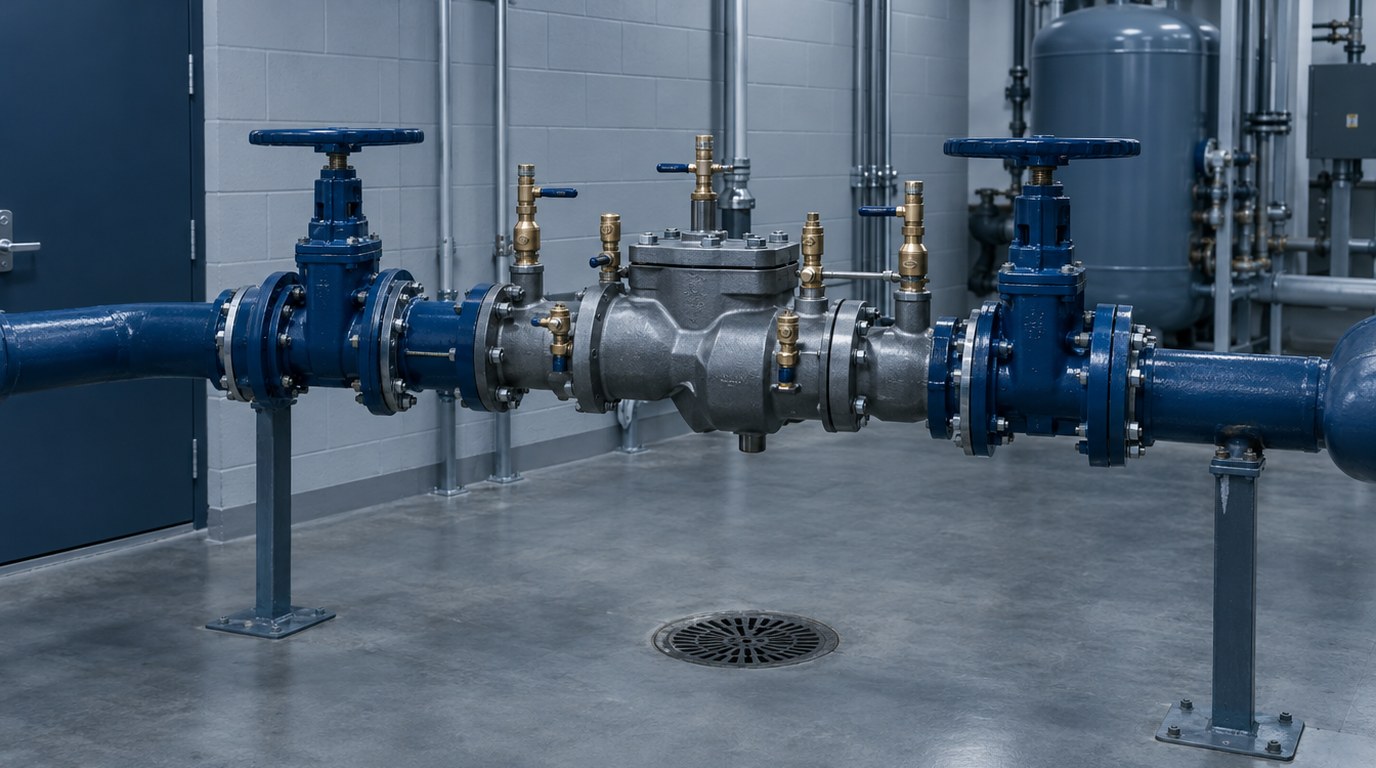
- Backflow protection is chosen by the degree of hazard downstream, not by pipe size or convenience.
- Air gaps are the most reliable protection, and assemblies are the practical alternative when an air gap cannot be built.
- California water suppliers enforce cross-connection control at the service connection under Title 17.
- Inside the building, the plumbing code protects individual fixtures and equipment.
- Reduced pressure assemblies need drainage and space that must be planned early.
- Annual testing by a certified tester is part of owning any testable assembly.
- What Is Backflow and Cross-Connection Control?
- How Backflow Happens
- Types of Protection and Assemblies
- Codes, Standards and Regulators
- Applications by Building Type
- Design Process and Deliverables
- Special Cases and Hard-to-Protect Systems
- Selecting Assemblies and Understanding Cost
- Best Practices, Testing and Key Takeaways
- Where Budlong Delivers This
- Related Reading
- Frequently Asked Questions
Drinking water leaves the treatment plant clean and arrives at a commercial building under pressure. What happens inside that building decides whether it stays clean. A single hose, boiler feed or chemical injector can turn the plumbing into a path back into the public system. Our plumbing engineering team identifies these paths during design and selects the protection that the water supplier and the code will accept.
This guide explains how backflow occurs, how engineers rate hazards, which devices fit which hazards, and how California rules shape the work. It is written for owners, architects, developers and facility managers who need to plan space, budget and maintenance. For the company behind the advice, see our story, and for the wider service range, our MEP engineering services.
1. What Is Backflow and Cross-Connection Control?
Backflow is the unwanted reversal of flow in a piping system. A cross-connection is any actual or potential link between drinking water and something that is not drinking water. Cross-connection control is the set of design measures, devices and inspection routines that keep those links from ever carrying contaminated water back into the supply.
Pollution and contamination
Codes distinguish between two levels of hazard. A pollutant affects the taste, color or odor of water without threatening health. A contaminant can cause illness or death. That distinction drives the choice of protection, since a health hazard needs the strongest device while a nuisance may allow a simpler one.
Why it matters to a building owner
Backflow events can injure occupants, close a building and expose the owner to liability. They also draw regulators, because contamination of a public main affects entire neighborhoods. Most water suppliers will refuse service, or shut it off, if a required assembly is missing or fails a test. Protection is therefore part of occupancy, not an optional extra.
An open connection does not have to be dramatic. A garden hose submerged in a mop sink, a chemical feeder tied to a water line or a boiler fill without a check can each be enough to put a health hazard on the wrong side of the meter.
Also Read: Laboratory Plumbing System Design
2. How Backflow Happens
Backsiphonage
Backsiphonage occurs when the supply pressure falls below atmospheric pressure, creating a partial vacuum. A water main break, heavy fire flow demand or a pump shutdown can trigger it. Anything connected to the system at a lower elevation, such as an open tank or a hose, can then be drawn into the pipe.
Backpressure
Backpressure occurs when the pressure on the downstream side rises above the supply pressure. Boilers, pumps, elevated tanks and pressurized process systems can all do this. The result is flow in the wrong direction, even when the supply is perfectly healthy. Because backpressure does not depend on the supply failing, vacuum breakers alone cannot protect against it.
Why check valves alone are not enough
A simple check valve can fail from debris or wear, and it gives no indication that it has failed. Testable assemblies add a second check, test cocks and in some cases a relief valve so that failures are visible and repairable. That is why the regulations specify listed assemblies rather than any valve with a check inside it.
3. Types of Protection and Assemblies
Protection methods fall into two groups: physical separation and mechanical devices.
Air gap
An air gap is a vertical space between the outlet of a supply pipe and the flood rim of a receiving fixture. It has no moving parts and cannot fail mechanically. It is the preferred method wherever the geometry allows it, and it is mandatory in some high-hazard cases. Standards for the gap size depend on pipe diameter and nearby walls.
Vacuum breakers
Atmospheric vacuum breakers protect against backsiphonage only and must sit above the highest point they protect with no downstream shutoff. Pressure vacuum breakers add a spring-loaded check and test cocks so they can be used where a shutoff exists, which makes them common for irrigation. Spill-resistant versions limit discharge when the unit is disturbed.
Double check assemblies
A double check valve assembly has two checks in series with shutoff valves and test cocks. It protects against both backsiphonage and backpressure but is generally accepted only for low hazards.
Reduced pressure principle assemblies
A reduced pressure assembly has two checks with a relief valve between them. The relief valve keeps the zone between the checks at a lower pressure than the supply, and it dumps water to a drain if either check leaks. This design is accepted for health hazards, and it is the standard choice for hospitals, laboratories and chemical systems. It needs a drain that can carry a full discharge and clearance for testing.
Detector assemblies for fire lines
Fire services often use double check detector or reduced pressure detector assemblies. They include a small meter on a bypass so unauthorized flow, such as a leak or theft, can be spotted.
| Protection | Guards against | Typical hazard level | Notes |
|---|---|---|---|
| Air gap | Backsiphonage and backpressure | Low to high | No moving parts, needs vertical clearance |
| Atmospheric vacuum breaker | Backsiphonage only | Low to high, if no backpressure | No downstream shutoff allowed |
| Pressure vacuum breaker | Backsiphonage only | Low to high, if no backpressure | Common for irrigation, above grade |
| Double check assembly | Both | Low | Testable, lower pressure loss |
| Reduced pressure assembly | Both | High, health hazard | Needs drain and clearances |
4. Codes, Standards and Regulators
Water supplier rules at the service connection
In California, water suppliers must operate cross-connection control programs under Title 17 of the California Code of Regulations, which is overseen by the State Water Resources Control Board. The supplier surveys premises, rates hazards and requires assemblies at the service connection for higher hazards. This is called containment, and it protects the public main. The supplier is the final authority on the type and location of assemblies at the meter.
Plumbing code rules inside the building
The California Plumbing Code, adopted through the process described by the California Building Standards Commission, requires protection at individual fixtures and equipment. This is called isolation, and it protects occupants inside the building. Model code families from the International Code Council and IAPMO take similar approaches with different text, so projects outside California should follow the adopted local edition.
Product standards and testing
Assemblies are manufactured and tested to consensus standards, many of them developed through the American National Standards Institute process, with listings and field test procedures that water suppliers recognize. Specify listed assemblies and list the standard in the project specifications so substitutions are reviewed.
Federal and health guidance
The U.S. Environmental Protection Agency publishes guidance on cross-connection control under the Safe Drinking Water Act framework, and the Centers for Disease Control and Prevention documents outbreaks traced to plumbing hazards. Workplace safety rules from OSHA also address potable water separation from non-potable sources in workplaces.
Containment and isolation together
A good design uses both. Containment at the meter protects the public system from the building. Isolation at each hazard protects occupants and other tenants. Relying on only one leaves gaps, especially in multi-tenant buildings where one tenant’s process can affect everyone.
5. Applications by Building Type
Hospitals and clinics
Healthcare buildings combine many hazards, including sterilizers, dialysis equipment, laboratories, cooling towers, boilers and medical gas systems. Reduced pressure assemblies at the service connection are typical, along with isolation at individual equipment. Review the health facilities page, the OSHPD and HCAI guide and the Cedars-Sinai Medical Center project.
Laboratories and industrial plants
Research and manufacturing facilities use chemicals, solvents and process water. Hazard ratings are usually high, and equipment such as autoclaves, glass washers and reverse osmosis systems need individual protection. See industrial laboratories, the guide to MEP engineering for industrial facilities and the Amgen project.
Restaurants and food service
Carbonated beverage dispensers use carbon dioxide, which can push acidic water back into copper piping if the equipment lacks proper protection. Dishwashers, hose stations, grease interceptor flushing and mop sinks add more risk. Our Los Agaves restaurant project is one example of food service plumbing coordinated with backflow protection.
Offices, schools and mixed-use
Typical hazards in these buildings are irrigation, cooling tower makeup, boiler feeds and fire lines. Landscaping often drives the first requirement, because irrigation systems carry fertilizers and soil contact. See our commercial projects and the best practices for large-scale MEP plumbing.
Central plants and cooling systems
Cooling towers and hydronic loops use makeup water and chemical treatment. Their makeup lines usually need an air gap or a high-level assembly. Treatment chemicals and high temperatures make these loops a frequent source of hazard ratings that surprise owners late in design.
Not sure which assembly your building needs?
Our engineers can review your service connection, rate the hazards and prepare drawings that your water supplier will approve.
6. Design Process and Deliverables
Step 1: Survey hazards
We walk the program with the owner and architect and list every connection between potable water and anything else. This includes process equipment, cooling systems, irrigation, fire lines, wash stations and future tenant needs. Missing items at this stage become change orders later.
Step 2: Rate each hazard
Each item is rated as a health or non-health hazard, and we note whether the risk is backsiphonage, backpressure or both. We compare the ratings against the water supplier’s requirements and the plumbing code.
Step 3: Choose containment and isolation
We select the assembly at the meter and the devices at each hazard. Where an air gap is possible, we prefer it. We then check the pressure budget, since reduced pressure assemblies introduce a noticeable pressure loss that can affect upper floors and fire flow.
Step 4: Coordinate space and drainage
Assemblies need clear space for testing and a drain for relief discharge. They also need protection from freezing, flooding and vandalism. We coordinate these needs with the architect and civil engineer so that the enclosure and drain are shown early, a habit supported by early MEP coordination.
Step 5: Document and approve
The drawings show assembly types, sizes, locations, drain routes and test requirements. Details show clearances and mounting heights. The submittal is reviewed by the water supplier, who may require its own application form. Our plumbing design services include these deliverables.
Also Read: Fire Sprinkler System Design Under NFPA 13
7. Special Cases and Hard-to-Protect Systems
Fire protection systems
Fire lines are connected to the public main and are often filled with water that sits for years. Systems with antifreeze or additives raise the hazard rating. Coordinate the assembly type with the fire protection designer and the local fire authority, as covered in our article on how fire safety engineering integrates with MEP systems. See also our fire and life safety services.
Recycled water and rainwater systems
Reclaimed water, rainwater and graywater systems must be physically separated from drinking water, and cross-connections between them are among the most serious hazards in a building. Marking, color coding and separation distances are all required. Read our guide to stormwater and graywater reuse system design.
Thermal expansion
Adding a backflow assembly to a service often closes a system that used to expand backward into the main. Hot water heating in a closed system then needs an expansion tank, or relief valves will weep. This is the most frequent surprise on retrofits.
Multi-tenant and campus buildings
When tenants share a service, one tenant’s process can affect everyone. We recommend isolation at each tenant with a record of the hazard rating in the lease or the building rules. Campus projects may require both a master assembly and building-level assemblies.
Pits, vaults and flood exposure
Placing assemblies below grade increases the chance of submergence. If a vault is unavoidable, the design needs a drain that can handle full relief discharge and a way to prevent flooding from stormwater or groundwater.
A relief valve discharge from a reduced pressure assembly can reach many gallons per minute during a failure. Always ask where that water goes, and make sure the answer is not a finished floor or a mechanical room.
Also Read: Stormwater and Graywater Reuse System Design
8. Selecting Assemblies and Understanding Cost
Selection factors
Selection starts with the hazard rating and the supplier’s approval list. Then consider the available pressure, flow range, size, orientation, maintenance access, climate and noise. For example, a reduced pressure assembly may be mounted in a heated enclosure in cold climates, while a coastal site may need corrosion-resistant bodies.
Cost drivers
The assembly itself is only part of the cost. Enclosures, concrete pads, drains, heating, electrical power for heated enclosures and tester access all add to the total. The need for larger service lines to offset pressure loss can add more. Annual testing and repair are recurring costs for the owner. For wider cost thinking, see our guide on how to estimate MEP engineering costs.
| Decision | Option A | Option B | Deciding factor |
|---|---|---|---|
| Meter protection | Double check assembly | Reduced pressure assembly | Hazard rating set by the supplier |
| Irrigation | Pressure vacuum breaker | Reduced pressure assembly | Chemical injection or backpressure risk |
| Cooling tower makeup | Air gap at the basin | Assembly on makeup line | Space and water treatment method |
| Location | Indoor heated room | Outdoor enclosure | Climate, drainage and security |
Long-term value
A well planned installation is easier to test, which reduces service calls. Choosing a standard model across the portfolio also helps maintenance teams keep spare parts. Our article on MEP plumbing services and water conservation explains how to tie protection and efficiency together.
9. Best Practices, Testing and Key Takeaways
Best practices
- Start the hazard survey in schematic design and update it when tenants change.
- Prefer air gaps and avoid threaded hose connections at sinks where practical.
- Locate assemblies above grade with space for service and test equipment.
- Pipe relief discharge to a drain sized for full flow through an air gap.
- Protect assemblies from freezing, flooding and vandalism.
- Record each assembly’s location, size and test dates in the owner’s maintenance system.
Common mistakes
The most common errors are forgetting equipment added late in design, installing assemblies where they cannot be tested, piping the relief valve directly to a drain, ignoring thermal expansion and leaving no record of the hazard survey. Our article on commercial plumbing design mistakes covers related issues.
Testing and commissioning
Assemblies are tested after installation, after any repair and on a recurring schedule, normally once a year, by a certified tester. Results go to the water supplier. Commissioning teams verify that devices match the schedule, that drains work and that drawings reflect the final build. See our commissioning services.
- Rate every connection by hazard, then choose protection that matches the rating.
- Use containment at the meter and isolation at each hazard.
- Prefer air gaps, and use reduced pressure assemblies for health hazards.
- Plan drainage, space and thermal expansion before construction starts.
- Test annually and keep records.
- Involve the plumbing engineer and the water supplier early.
10. Where Budlong Delivers This
Budlong has served California clients since 1958 from offices in Glendale, downtown Los Angeles, Camarillo and Fremont, covering Los Angeles, Ventura, Orange, San Bernardino, Riverside and Santa Barbara counties. Water suppliers differ in their rules, and we know how to coordinate with the local agencies for each project.
11. Related Reading
12. Frequently Asked Questions
What is a cross-connection?
A cross-connection is any actual or potential link between the potable water supply and a source of contamination or pollution. Examples include a hose left in a bucket of chemicals, a boiler feed line, an irrigation system or a fire sprinkler system treated with additives.
What is the difference between backsiphonage and backpressure?
Backsiphonage happens when pressure in the supply drops below atmospheric pressure and pulls water backward, for example during a main break. Backpressure happens when pressure downstream rises above the supply pressure and pushes water the wrong way, for example from a boiler or a pump.
When is a reduced pressure assembly required instead of a double check?
A reduced pressure assembly is generally used where the downstream hazard is a health hazard, meaning a substance that could cause illness or death. A double check assembly is generally limited to lower hazards that affect only taste, color or appearance. The water supplier decides the required protection at the service connection.
Who regulates backflow prevention in California?
Water suppliers must run cross-connection control programs under California Code of Regulations Title 17, and the State Water Resources Control Board oversees them. Inside the building, the California Plumbing Code sets requirements for protecting fixtures and equipment. Local building and health departments enforce both.
How often must backflow assemblies be tested?
Testing is typically required at installation and then at least once a year by a certified tester, and again after any repair or relocation. The local water supplier usually sets the exact schedule and the reporting method, so owners should confirm the requirements for their service address.
Can a reduced pressure assembly be installed in a pit?
This is usually discouraged and often prohibited. The relief valve can discharge during a failure, and a flooded pit could submerge the assembly and create the very cross-connection it was meant to prevent. Designers normally install these assemblies above grade with a properly sized drain.
Do fire sprinkler systems need backflow prevention?
Most fire sprinkler connections to a public main require a backflow assembly, and the type depends on the hazard rating of the system. Systems with antifreeze or chemical additives need a higher level of protection. The fire protection engineer and the water supplier should agree on the assembly early.
What causes backflow assemblies to fail?
Common causes include debris fouling check valves, worn seats, freezing, poor installation and lack of maintenance. Pressure surges and fluctuating supply pressure also stress the relief mechanism. Annual testing and routine inspection catch most problems before they become a public health event.
Who designs and specifies backflow prevention on a project?
The plumbing engineer identifies hazards, selects assemblies and shows them on the drawings. For fire lines the fire protection designer also takes part. The architect provides space, the civil engineer coordinates the service connection and the water supplier approves the final type and location.