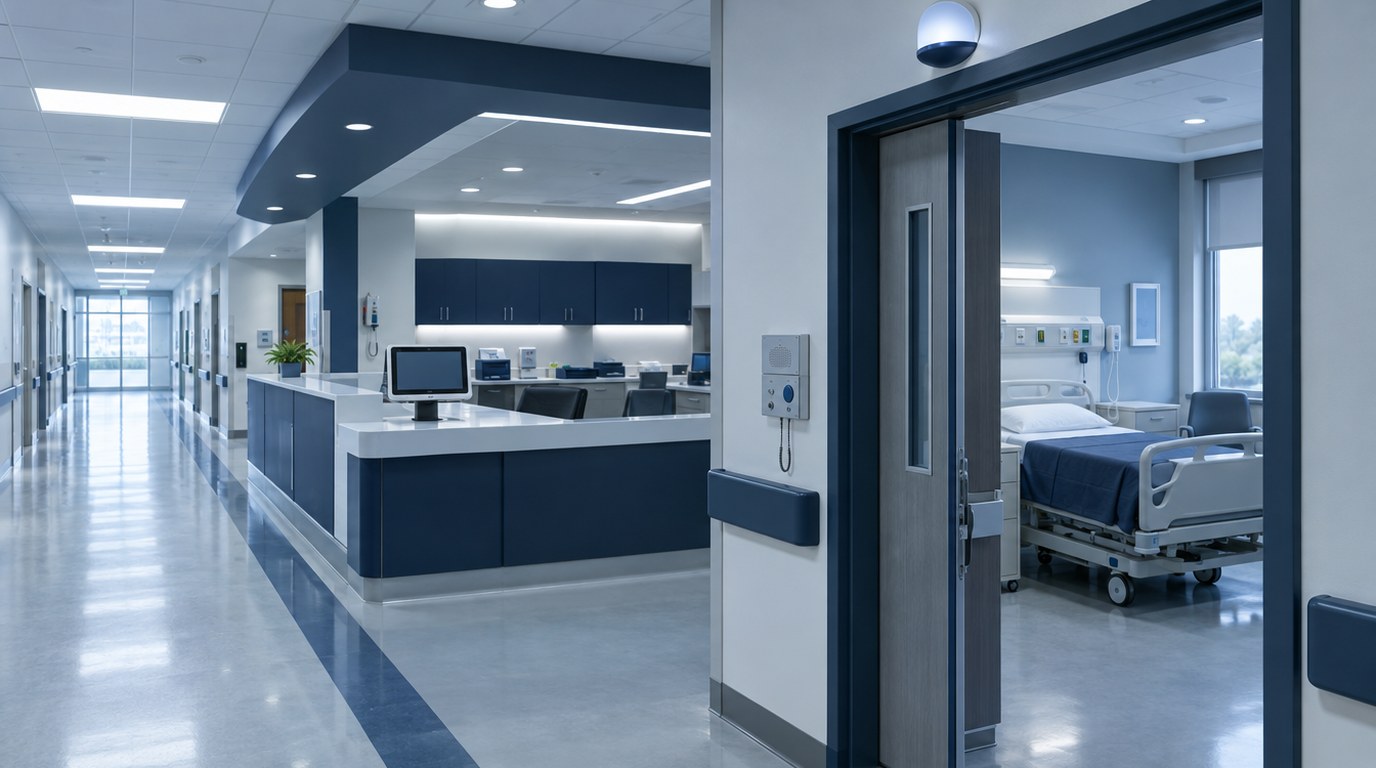
- Nurse call is the clinical backbone of low-voltage design in any patient care building, linking patients, staff and records.
- Equipment listing, essential electrical power and fire alarm interfaces are the heart of the code review.
- Modern projects choose between hardwired, IP-based and hybrid platforms, each with different integration and cyber risk profiles.
- Behavioral health, isolation and imaging areas change which devices and mounting methods are acceptable.
- Network design, power and pathways must be coordinated with the other healthcare low-voltage systems from schematic design on.
- Structured testing, training and an independent review protect patient safety on opening day and afterward.
- What Is a Nurse Call System?
- How the System Works
- Platform Types and Related Low-Voltage Systems
- Requirements, Codes and Standards
- Applications by Care Setting
- The Design Process and Deliverables
- Special Cases and Renovations
- How to Choose and Specify a Platform
- Best Practices, Testing and Maintenance
- Where Budlong Delivers This
- Related Reading
- Frequently Asked Questions
When a patient presses a call button, an entire chain of cables, controllers, network switches and handheld devices has to work within seconds. The design of that chain is a specialty within MEP design services for healthcare, because the consequences of a missed call are clinical rather than merely inconvenient. A well-designed nurse call platform also sets the pattern for every other low-voltage system in the hospital.
This article walks through how these systems work, the codes that govern them, and the decisions owners and design teams face. It draws on the way our technology services group coordinates low-voltage scopes with electrical engineering and fire and life safety teams, and it is written for hospital owners, architects, developers and facility managers.
1. What Is a Nurse Call System?
A nurse call system is a signaling and communication network that allows patients to request assistance and allows caregivers to summon each other. At its simplest it connects a bedside button to a light over the door. At its most advanced it connects every bed, bath, staff station and mobile device to a central server that decides who should respond and when.
Why healthcare low-voltage design is different
In an office, a failed network port is an irritation. In a patient room, a failed call station may delay treatment. Healthcare low-voltage systems are therefore designed with redundancy, supervision and clear fallback procedures, and they are tested more rigorously than commercial equivalents.
The family of systems
Nurse call is only one member of a family that includes structured cabling, wireless networks, voice and paging, security, access control, video, real-time location, entertainment and clinical device connectivity. The platform choice for one often constrains the others, so a unified low-voltage strategy produces better outcomes than buying each system in isolation.
Ask one question about every low-voltage device in a patient area: what happens to the patient if this stops working at three in the morning? The answer decides the level of redundancy, power backup and testing.
Also Read: Healthcare MEP Design
2. How the System Works
Every nurse call platform follows the same logical flow, whatever the manufacturer: a call is originated, classified, routed, announced, answered and logged.
Call origination
Calls start at devices with different priorities. A routine patient request comes from a bedside station or pillow speaker. A bathroom emergency comes from a pull station near the toilet and shower. A staff assist or code call originates from a staff station or a worn badge. Each device carries a unique address so the system knows exactly where the call came from.
Classification and routing
Controllers assign priority and send the call to assigned caregivers. Rules can escalate a call to a charge nurse or to a wider group if it is not answered within a set time. Good rules reflect real unit workflows and are written with nursing leadership rather than left at factory defaults.
Annunciation
Annunciation means telling someone. It can occur through dome lights above the door, corridor displays, desk consoles, wireless handsets and messages on staff phones. Audible tones are used sparingly in healing environments, which is one reason mobile alerts have become popular.
Voice and data paths
Many systems support two-way voice between the patient and a nurse station. Newer platforms add integration with electronic records, bed status, and patient identification so that the system can show who is in the room and what care is needed.
Reporting
The logged data supports review of call frequency and response duration by unit and shift. Leaders use this information for staffing and workflow decisions, and surveyors may ask to see it.
3. Platform Types and Related Low-Voltage Systems
Facilities today choose from several platform families. The comparison below summarizes how they differ in practice.
| Platform | Architecture | Strengths | Cautions |
|---|---|---|---|
| Legacy hardwired | Dedicated wiring from each device to room and zone controllers | Simple, proven and independent of the business network | Limited integration, proprietary parts and costly to expand |
| Digital hardwired | Addressable devices on a dedicated cable loop with a central controller | Reliable with richer features and good supervision | Still vendor specific, with integration through gateways |
| IP-based | Devices and servers communicate over a managed Ethernet network | Flexible integration, remote management and scalable | Depends on network health, cybersecurity and power over Ethernet capacity |
| Hybrid | Wired patient and bath stations with IP servers and wireless staff devices | Balances dependable bedside devices with modern mobile response | More interfaces to design, test and support |
The wider low-voltage landscape
A typical hospital also includes:
- Structured cabling and telecommunications rooms on every floor.
- Wireless networks for staff devices, medical equipment and guests.
- Telephone, overhead paging and mass notification.
- Access control, video surveillance and infant or patient protection.
- Real-time location services for equipment and staff.
- Television, education and patient engagement systems.
- Clinical device integration that sends data from monitors to records.
Our related guides on low voltage design best practices and on integrating smart building technology describe the general principles that apply here with a higher standard of care.
Also Read: Navigating the Complexities of Low Voltage Design in Modern Buildings
4. Requirements, Codes and Standards
Healthcare low-voltage design sits at the intersection of electrical codes, health care facility codes, product listings, accreditation requirements and state agency review. Editions and amendments change, so each project should confirm the adopted versions with the reviewing authority.
Equipment listing
Nurse call devices are commonly evaluated to UL 1069, the standard for hospital signaling and nurse call equipment, published by UL. Specifications should require listed components and a manufacturer statement of compliance.
Electrical and health care facility codes
The National Fire Protection Association publishes the Health Care Facilities Code and the National Electrical Code, including its article on health care facilities. Together they define essential electrical systems, branch circuit practices and the performance expectations that shape how call systems are powered and wired. The nurse call platform is commonly served from the critical branch of the essential electrical system, though the exact branch depends on the adopted edition and facility type.
Fire alarm interfaces
Where a nurse call or paging system interacts with fire alarm functions, such as muting audio during an alarm, the interface must be supervised and designed so that fire alarm performance is never compromised. Our overview of fire and life safety compliance explains how those reviews work.
California agency review
Acute care hospitals in California are reviewed by the Department of Health Care Access and Information, which publishes its programs and plan review guidance at hcai.ca.gov. Other facilities, such as clinics and skilled nursing buildings, may fall under different review paths. See our OSHPD and HCAI guide for the plan review process.
Cabling and wireless standards
The Telecommunications Industry Association publishes a healthcare facility telecommunications infrastructure standard that organizes cabling, rooms and pathways for these buildings. Wireless networks draw on technical standards from the IEEE.
Infection control during construction
The Centers for Disease Control and Prevention provides guidance on environmental infection control in health care facilities at cdc.gov. Ceiling access, cable pulling and device installation in patient areas should follow the project’s infection control risk assessment.
5. Applications by Care Setting
The right design depends on who uses the system and how they work. Each setting below stresses a different part of the platform.
Medical and surgical units
These units depend on dependable bedside stations, bathroom emergency stations and clear corridor signaling. Most hospital square footage is of this type, so standardizing the room layout reduces cost and errors. The Providence Holy Cross Medical Center project shows the scale of work involved in an active hospital campus.
Critical care and emergency departments
Intensive care rooms integrate call functions with monitors, code alerts and staff location. Emergency departments add security duress devices and rapid escalation. Pediatric facilities, such as the CHOC Children’s Hospital of Orange County, add specialized parent and family communication needs.
Academic and teaching hospitals
Large medical centers combine every unit type with research, imaging and education space. Systems must scale and tolerate continuous change, a reality visible in work such as the UC Irvine Medical Center.
Senior living and skilled nursing
Residents need simple, dependable call devices, often with pendants worn all day and fall detection or door alerts. Wandering management and resident check-in features are common. Our assisted living practice plans these systems for projects like Belmont Village.
Outpatient and specialty clinics
Clinics need exam-room signaling, staff alerts and simple integration with scheduling, usually at lower cost than inpatient systems. Our health facilities team scales the platform to the care model.
Planning a hospital, clinic or care facility?
Our engineers coordinate nurse call, networks, power and life safety so clinical teams get a system that works from day one.
6. The Design Process and Deliverables
The process begins with people, not products. Clinical workflows determine the system, and the system then determines the infrastructure.
Programming and workflow interviews
Designers meet with nursing leaders, biomedical engineering, information technology and security to document how calls are made and answered, who carries which device and how alarms are escalated. These interviews produce the functional program that guides every later decision.
Infrastructure planning
From the program, the team defines telecommunications rooms, risers, pathways, device quantities and power. The plan must reserve capacity for growth in connected devices, since healthcare networks nearly always grow after opening.
Construction documents
Typical deliverables include device legends, room-by-room layouts, riser and system diagrams, schedules for stations and dome lights, network and power-over-Ethernet budgets, interface matrices that list every connection to other systems, and specifications that call for listed equipment and defined testing. Our BIM coordination process helps place devices in headwalls and ceilings without conflicts.
Agency submittal and review
For projects under state agency review, submittals must be consistent across disciplines. A call device shown on an electrical drawing should match the architectural headwall detail and the equipment schedule.
Construction administration
During construction, the engineer reviews submittals, responds to requests for information and observes critical installation steps. Close coordination avoids the late discovery that a headwall cannot hold the devices on the drawings, a theme we explore in early MEP coordination.
Commissioning and training
Independent commissioning services verify that call routing, interfaces and failure modes work as designed. The building commissioning process gives owners a structured way to confirm that clinical requirements were met before patients arrive.
7. Special Cases and Renovations
Some spaces and conditions need design attention that goes beyond the standard patient room.
Behavioral health
Where patients may be at risk of self-harm, devices must resist tampering and ligature attachment. Flush-mounted or tamper-resistant stations replace cords and pull handles, and staff often rely on worn alert devices. These decisions should follow the facility risk assessment.
Isolation and negative pressure rooms
Staff outside an isolation room need to communicate without entering. Anterooms, intercom stations and visual alerts are common. These rooms also depend on the ventilation strategies described in our guide to ASHRAE 170 healthcare ventilation design.
Imaging suites
Magnetic resonance rooms limit the ferromagnetic materials and radio frequency sources allowed near the scanner, so call devices and cabling must be specified accordingly, and the equipment vendor should approve the layout.
Renovations in occupied buildings
Most healthcare projects are renovations, which means the new system must coexist with the old one. Phase the work by unit, provide temporary call devices where a unit changes over, and protect patients through interim life safety measures. Gateways can bridge old and new platforms during transition.
Cybersecurity and network separation
An IP-based platform joins the clinical network and must be protected. Segmentation, access control and patching responsibilities should be written into the specification. The National Institute of Standards and Technology maintains a widely used cybersecurity framework at nist.gov.
Power and resilience
Power over Ethernet devices depend on switches that need uninterruptible and essential power. Our guide to electrical engineering for safety, reliability and efficiency covers the general principles behind this kind of design.
Renovation is where most healthcare low-voltage risk lives. A cutover plan that names the temporary call method for every unit is as important as the new design itself.
Also Read: Healthcare MEP Design: Safe and Sustainable
8. How to Choose and Specify a Platform
Platform selection should balance clinical needs, existing infrastructure, integration goals and lifecycle cost. The table sets out the key criteria and what to check.
| Criterion | What to evaluate | Typical consequence of ignoring it |
|---|---|---|
| Clinical workflow fit | Escalation rules, mobile alerting and unit-specific needs | Staff work around the system and call response suffers |
| Integration scope | Phones, badges, location, records and bed management | Costly custom interfaces added after award |
| Network demands | Bandwidth, switch capacity, redundancy and power over Ethernet | Outages tied to switch or power faults |
| Cybersecurity | Segmentation, patching, remote access and vendor support terms | Exposure of the clinical network |
| Lifecycle support | Product roadmap, service coverage and spare parts | Obsolete equipment and unplanned replacement |
| Installation method | Headwall design, cabling count and phasing plan | Rework in finished rooms and delays to opening |
What drives cost
Device count is the first driver, followed by integration depth, network and power infrastructure, interface licensing, installation complexity in renovations and the length of testing and training. Owners often underestimate the cost of integration and of the support contract that follows. For help framing these budgets, see our guide on how to estimate MEP engineering costs.
Writing a performance specification
Describe required functions, priority levels, integration points, listing, power class, response targets, cybersecurity expectations, training hours, warranty and documentation. Require the vendor to submit a point-to-point interface plan and to demonstrate the system before acceptance.
9. Best Practices, Testing and Maintenance
Most problems in completed projects trace back to decisions made long before installation.
Best practices
- Involve nursing and biomedical staff in design, not just at demonstration.
- Standardize room types and device locations across units.
- Reserve spare capacity in cabling, switches and power.
- Keep wired bedside and bath stations as the dependable foundation.
- Document every interface in a matrix with a named owner.
- Plan for phased cutovers with temporary protection for patients.
Common mistakes
- Treating nurse call as a purchase from a catalog instead of a design.
- Letting information technology and clinical teams meet only at startup.
- Omitting power for network switches from the electrical design.
- Choosing devices that cannot be cleaned or disinfected on the unit’s schedule.
- Failing to test failure modes such as network loss or controller failover.
Testing
Test every device individually, then test the unit as a whole. Verify routing and priority, escalation timers, voice paths, dome light and display behavior, interface signals and recovery after simulated power or network faults. Record results by room and have nursing representatives sign off.
Maintenance and lifecycle
Plan routine testing of stations, cords and batteries, software update procedures and spare device stock. Agree who handles service calls, whether biomedical engineering, information technology or the vendor. Include a refresh plan, because software platforms usually age faster than cable.
- Start with clinical workflow and let it define the technology.
- Specify listed equipment and confirm power branch, interface and agency requirements.
- Coordinate nurse call with every other healthcare low-voltage system from the start.
- Treat network design and cybersecurity as patient safety issues.
- Commission the system independently and train staff before opening.
10. Where Budlong Delivers This
Budlong has engineered healthcare facilities across California from offices in Glendale, Downtown Los Angeles, Camarillo and Fremont. Our teams serve Los Angeles, Ventura, Orange, San Bernardino, Riverside and Santa Barbara counties and know the local review practices.
11. Related Reading
12. Frequently Asked Questions
What is a nurse call system?
A nurse call system lets patients and staff summon help from bedsides, bathrooms and work areas, and routes each call to the right caregiver through room lights, corridor displays, consoles or mobile devices. It also records call times so a facility can review response performance.
Which standard governs nurse call equipment?
Equipment is commonly evaluated to UL 1069, the standard for hospital signaling and nurse call equipment. Installation also falls under the electrical and health care facility codes adopted by the state, so the design team should confirm the adopted editions and any local or agency amendments.
Does a nurse call system need emergency power?
In most hospitals it is expected to stay operational during a utility outage, and the health care electrical provisions generally place it on an essential electrical branch. The exact branch and any battery backup depend on the facility type and adopted code edition, so confirm them during design.
What is the difference between a legacy and an IP-based system?
Legacy systems use dedicated wiring and proprietary controllers for each function. IP-based systems carry call data over a managed network, which simplifies integration with phones, badges and records systems but demands careful network design, cybersecurity and power planning.
Can wireless devices replace wired call stations?
Wireless pendants, badges and phones extend a nurse call system, but code and accreditation expectations generally keep wired patient stations and bathroom emergency stations as the dependable core. Wireless coverage must be surveyed and supervised to the same standard as the rest of the system.
How are nurse call systems handled in behavioral health units?
Behavioral health units use ligature-resistant call devices, flush or tamper-resistant fixtures and often staff-worn alert devices rather than cords or pull handles. The design should follow the facility risk assessment and be reviewed with clinical leadership before devices are selected.
What other low-voltage systems appear in a healthcare building?
Typical systems include structured cabling, wireless networks, telephone and paging, public address, access control, video surveillance, infant and patient security, real-time location, television and media, and clinical device integration. Each needs pathways, power and cybersecurity planning.
How should construction in an occupied hospital protect nurse call service?
Phase the work so that each occupied unit keeps a working system, provide temporary stations or portable alerts when a unit is cut over, and coordinate shutdowns with nursing leadership. Infection control and interim life safety measures run alongside this plan.
How is a nurse call system tested before occupancy?
Testing includes verifying every device and cable, confirming call routing and priority, checking dome lights and consoles, simulating power loss and network failure, and recording the results. Facility staff are trained, and an independent commissioning review is a sound way to catch routing and integration errors.