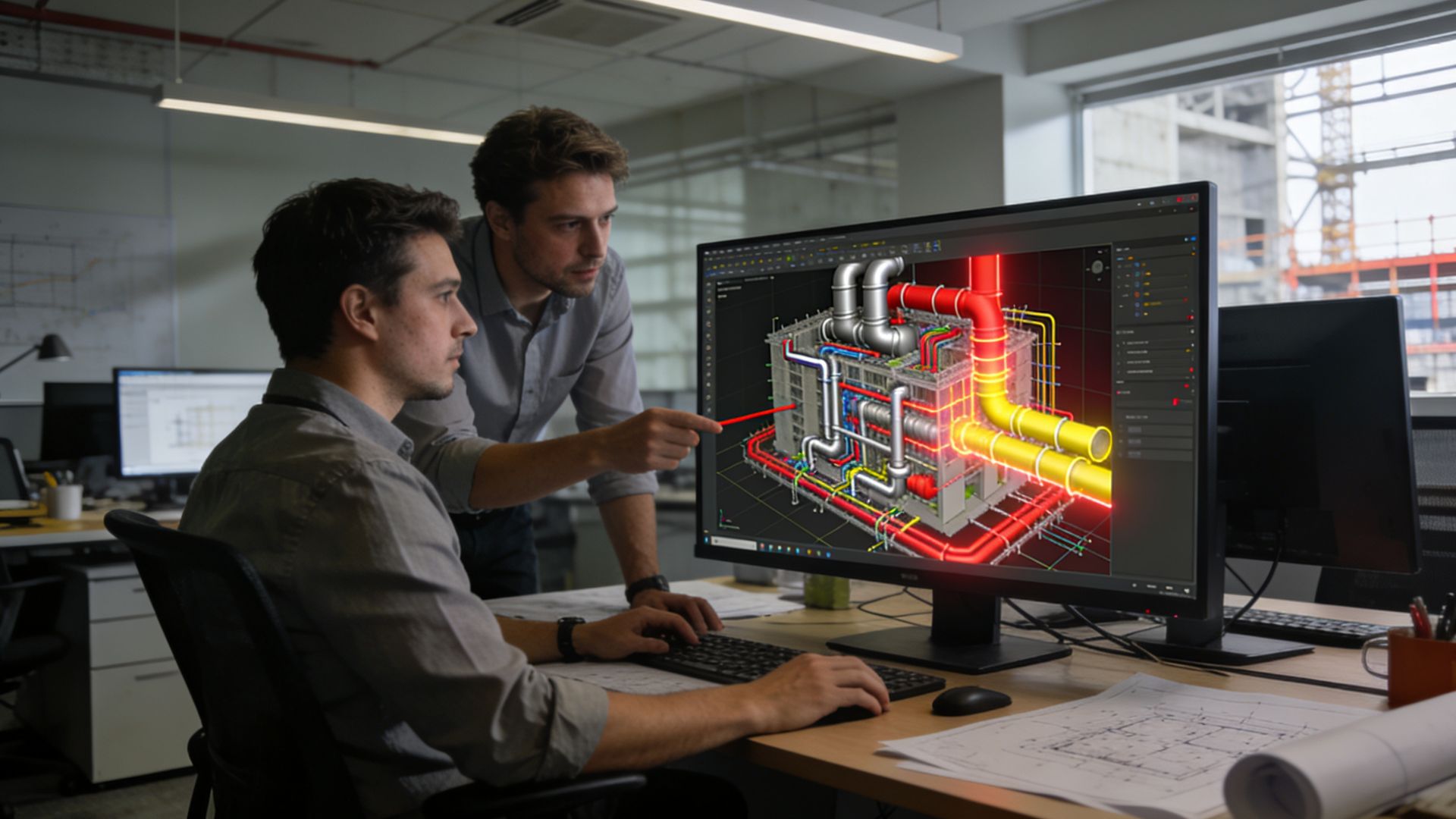
- MEP BIM coordination uses intelligent 3D models to identify and resolve spatial conflicts between building systems before construction begins.
- Clash detection with tools like Autodesk Navisworks finds hard clashes (physical intersections) and soft clashes (clearance violations) automatically.
- Industry research shows BIM coordination reduces construction rework by 40 to 60 percent on complex projects.
- Coordination occurs in design phases but continues through construction with contractor-led fabrication coordination models.
- 5D BIM links design geometry to cost and schedule data, enabling more accurate quantity takeoffs and project forecasting.
- Budlong uses current BIM authoring and coordination tools across all MEP disciplines for projects throughout California.
- What Is MEP BIM Coordination?
- How Clash Detection Works
- BIM Tools Used in MEP Engineering
- Types of Clashes and How They Are Resolved
- The MEP BIM Coordination Workflow
- Cost and Schedule Benefits of BIM Coordination
- Design-Phase vs. Construction-Phase BIM Coordination
- 5D BIM: Linking Models to Cost and Schedule
- When Is Full BIM Coordination Warranted?
- Who Uses MEP BIM Coordination?
- Related Reading
- Frequently Asked Questions
Construction rework is one of the most damaging forces in commercial building projects. When a mechanical duct run collides with a structural beam that nobody caught on the drawings, the result is a work stoppage, an emergency redesign, costly demolition and reinstallation, and — often — a cascade of schedule impacts that ripple through the entire project. MEP BIM coordination exists specifically to prevent this category of problem.
At Budlong, BIM coordination is a core component of our MEP engineering services. Our team uses Autodesk Revit and Navisworks to build fully coordinated MEP models for every discipline, resolve conflicts digitally before construction begins, and deliver clash-free construction documents that contractors can build from with confidence. This guide explains exactly how MEP BIM coordination works and why the investment consistently pays for itself many times over.
1. What Is MEP BIM Coordination?
Building Information Modeling (BIM) coordination is the process of designing MEP systems in intelligent 3D digital models and then checking those models against each other — and against the structural and architectural models — to detect and resolve spatial conflicts before any materials are fabricated or installed.
Unlike traditional 2D CAD drawings, BIM models contain geometric data (the exact size, shape, and location of every duct, pipe, conduit, equipment item, and structural member), as well as attribute data (material type, system designation, manufacturer, installation date, and other properties). This richness of data enables automated conflict detection that would be impossible to perform reliably on flat drawings.
The result of a successful BIM coordination process is a set of construction documents that represent a conflict-free design — one that can be built in the field without unexpected clashes requiring field-discovered redesign. Advancements in BIM for MEP coordination continue to make this process faster, more accurate, and more accessible across project sizes.
2. How Clash Detection Works
Clash detection is an automated computational process performed using software that aggregates models from all design disciplines into a single federated model and then checks every element against every other element for geometric conflicts.
The Federated Model
Each design discipline — architectural, structural, mechanical, electrical, plumbing — maintains its own authoring model (typically in Autodesk Revit). These individual models are linked together into a federated model that contains all disciplines simultaneously. The federated model does not merge the individual models; it references them, allowing each discipline to maintain ownership and control of its own content.
Automated Clash Checking
Clash detection software (most commonly Autodesk Navisworks) runs automated checks against the federated model using rules defined by the coordination team. Rules specify which element categories to check against which others, and what clearance distances to apply. A typical MEP coordination run checks mechanical ductwork against structural framing, electrical conduit against mechanical equipment, plumbing pipes against ductwork, and so on — potentially generating thousands of conflict reports in a single run.
Clash Reports and Resolution
Clash reports are reviewed by the coordination team in regular coordination meetings. Each clash is reviewed to determine its severity, which discipline is responsible for resolution, and what the resolution will be. Clashes are assigned to the responsible discipline for model correction, and the clash is marked as resolved once the correction has been verified in an updated model run.
Not all clashes detected by software require field correction — some are false positives from modeling conventions, shared space allocations, or intentional overlaps. The skill of an experienced MEP BIM coordinator lies in distinguishing meaningful clashes from noise and prioritizing resolution effort on the conflicts that would actually cause field problems.
3. BIM Tools Used in MEP Engineering
The BIM tool ecosystem for MEP engineering has matured considerably over the past decade. The following tools form the core of most professional MEP BIM workflows.
| Tool | Primary Use | Key MEP Capability |
|---|---|---|
| Autodesk Revit MEP | Model authoring | Duct, pipe, conduit modeling with system data |
| Autodesk Navisworks | Clash detection and coordination | Automated clash checking, clash reporting, 4D scheduling |
| Autodesk BIM 360 / ACC | Cloud collaboration | Shared model access, issue tracking, RFI management |
| Trimble Nova / SysQue | MEP fabrication modeling | Detailed fabrication-ready duct and pipe modeling |
| Solibri Model Checker | Model quality assurance | Rule-based model checking, code compliance review |
| Bluebeam Revu | Document coordination | Markup, review, and issue tracking on 2D exports |
Budlong’s MEP team works in current versions of Autodesk Revit and Navisworks, with cloud collaboration through Autodesk Construction Cloud. Our MEP drafting services and BIM modeling workflows are maintained to current industry standards for all project types.
4. Types of Clashes and How They Are Resolved
Clash detection software identifies two primary categories of conflicts, each with different resolution approaches.
Hard Clashes
Hard clashes are physical intersections — situations where two elements occupy the same space. A hard clash between a duct and a structural beam means the duct, as currently modeled, would pass directly through the beam if built as designed. Hard clashes are always genuine conflicts that require resolution. Resolution options include rerouting the duct, raising or lowering the beam (if structurally feasible), or installing a duct penetration through the beam with structural engineer approval. Proper duct sizing also helps ensure that coordinated duct routes can fit within the available ceiling space.
Soft Clashes (Clearance Violations)
Soft clashes occur when two elements come within a defined clearance distance of each other without physically intersecting. Clearance requirements exist for maintenance access to equipment, code-required separation between electrical conduit and plumbing pipes, insulation thickness allowances, and seismic bracing space. Soft clash tolerances are set by the coordination team based on the specific requirements of each system pairing.
Workflow Clashes
Some coordination tools also check for workflow or sequencing clashes — situations where installation sequences conflict, such as where one element must be installed before another but is physically located in a position that makes that sequence impossible. These are more complex to detect and resolve but can prevent significant field coordination problems on congested projects.
5. The MEP BIM Coordination Workflow
A successful MEP BIM coordination workflow follows a defined sequence of activities from model setup through final coordination sign-off.
BIM Execution Plan (BEP)
Every BIM-coordinated project should begin with a BIM Execution Plan (BEP) that defines model authoring responsibilities, software versions and settings, model sharing protocols, clash detection rules and tolerances, coordination meeting cadence, and the definition of a “coordinated” model for the purposes of the project. A well-written BEP prevents the confusion and inconsistency that causes coordination workflows to break down mid-project.
Design Development Coordination
Initial coordination runs are performed at the design development milestone. At this stage, major routing paths are established, equipment locations are set, and major structural penetrations are identified. DD coordination is less detailed than CD coordination but catches the most significant routing conflicts before detailed design work proceeds. Early MEP coordination at the DD phase is one of the highest-value activities in the entire project workflow.
Construction Document Coordination
CD coordination is the most detailed and intensive phase. Clash runs are conducted at 50 percent and 100 percent CD milestones, with formal coordination meetings held after each run to review and assign resolution responsibility for all identified clashes. The goal is to reach a state where zero unresolved hard clashes exist in the federated model before documents are issued for permit and bidding.
BIM Coordination Built Into Every Budlong Project
Our MEP engineers work in Revit and Navisworks on every qualifying project, delivering clash-free construction documents that contractors can build from with confidence.
6. Cost and Schedule Benefits of BIM Coordination
The business case for MEP BIM coordination is well established by industry research and real project data. The investment in BIM coordination consistently delivers a return that far exceeds its cost on projects of appropriate complexity.
Reduction in Field Change Orders
Field change orders driven by design conflicts are among the most expensive construction events. A single change order to reroute a major duct run in a congested mechanical room can cost $30,000 to $150,000 in additional labor, materials, and delay costs. BIM coordination eliminates the majority of these conflict-driven change orders before they have a chance to occur in the field.
Shorter RFI Cycles
When contractors build from coordinated BIM models, the volume of field-generated RFIs (Requests for Information) drops significantly. Every RFI costs time — typically 1 to 3 weeks for complex technical responses — and delays can cascade through the construction schedule. Fewer RFIs mean faster, more predictable construction progress.
More Accurate Bidding
Contractors bidding from coordinated BIM models can produce more accurate quantity takeoffs and labor estimates because the model reflects the actual routing that will be installed. This reduces the contingency premiums that contractors add to cover uncertainty in un-coordinated drawings, resulting in lower and more competitive bids. 5D BIM for MEP project management takes this further by directly linking model geometry to cost data.
7. Design-Phase vs. Construction-Phase BIM Coordination
BIM coordination is not a single event — it occurs across both the design and construction phases of a project, with distinct goals and levels of detail at each stage.
Design-Phase BIM Coordination
Design-phase coordination, performed by the MEP engineering firm, focuses on confirming that systems fit in the available space, resolving routing conflicts between disciplines, and verifying that major equipment has adequate clearance for installation and maintenance. Design models are at a level of detail sufficient to confirm spatial feasibility and produce accurate construction documents, but not at the fabrication detail level of a contractor’s shop model.
Construction-Phase (Contractor) BIM Coordination
Once construction begins, MEP subcontractors (sheet metal, mechanical piping, electrical, and plumbing) develop fabrication coordination models from the design BIM documents. These contractor models add installation details — exact hanger locations, support steel, connection details, and spool fabrication information — that are too detailed to include in design documents but are necessary for shop fabrication and field installation. The design BIM models from Budlong serve as the authoritative routing basis that contractors refine into their fabrication models.
VDC (Virtual Design and Construction)
On the largest and most complex projects, a dedicated Virtual Design and Construction (VDC) manager may coordinate the transition between design BIM and contractor fabrication BIM, manage the federated model throughout construction, and support 4D construction sequencing simulations that link the model to the construction schedule. Digital twin technology represents the next evolution of this capability, maintaining a live as-built model that continues to support operations and maintenance after construction is complete.
8. 5D BIM: Linking Models to Cost and Schedule
The BIM acronym traditionally refers to 3D geometric and attribute data. Industry convention adds dimensions to describe additional data layers: 4D BIM links the model to construction schedule data; 5D BIM links the model to cost data. Both capabilities are increasingly available on commercial projects and provide significant project management benefits.
4D Construction Sequencing
4D BIM simulations animate the construction sequence by linking BIM model elements to activity durations and logic from the construction schedule. This enables the project team to visualize the construction sequence before work begins, identify schedule conflicts (such as two trades needing the same space at the same time), and communicate complex sequencing requirements to the field team in a visually intuitive format.
5D Quantity Takeoff and Cost Modeling
5D BIM links model elements to unit cost data, enabling automated quantity takeoffs and cost model generation directly from the design model. As design changes are made, cost estimates update automatically — providing the project team with real-time feedback on the cost implications of design decisions. Leveraging 5D BIM for MEP project management is a significant competitive advantage for projects where cost control is a primary objective.
9. When Is Full BIM Coordination Warranted?
Not every project needs the same level of BIM coordination investment. The decision to implement full BIM coordination should be based on a realistic assessment of project complexity, MEP system density, and the cost consequence of field conflicts.
Projects That Benefit Most from Full BIM Coordination
Full BIM coordination delivers the greatest value on projects with complex, dense MEP systems in constrained spaces. The highest-value applications include hospitals and healthcare facilities with dense above-ceiling systems, large educational buildings with complex mechanical systems, high-rise commercial towers with congested mechanical rooms and interstitial floors, data centers with extreme MEP density, and laboratory buildings with multiple system types competing for limited plenum space. Healthcare MEP design and high-rise residential MEP are classic high-value BIM coordination applications.
Projects Where 2D Coordination May Suffice
Simple single-story buildings with open ceiling structures, standard HVAC equipment, and straightforward MEP routing can often be adequately coordinated using traditional 2D drawing overlays. The coordination overhead of full BIM on a simple building type may not be justified by the complexity of the MEP systems involved. An experienced MEP engineering firm can advise on the appropriate level of BIM investment for each specific project.
10. Who Uses MEP BIM Coordination?
- Owners and Developers — Mandate BIM coordination requirements in project delivery documents to protect budget and schedule
- General Contractors — Use coordinated design BIM as the basis for contractor fabrication coordination models
- MEP Subcontractors — Develop fabrication models from design BIM to enable shop prefabrication and reduce field labor
- Architects — Confirm that MEP systems fit within architectural envelope without compromising design intent
- Healthcare Systems — Require BIM coordination on virtually all major facility projects due to MEP system complexity
11. Related Reading
- MEP BIM coordination uses intelligent 3D models and automated clash detection to resolve spatial conflicts before construction begins.
- Hard clashes are physical intersections; soft clashes are clearance violations — both require resolution through discipline coordination meetings.
- Industry research shows BIM coordination reduces construction rework by 40 to 60 percent, delivering an average ROI of $8.53 per $1 invested.
- The primary BIM tools for MEP coordination are Autodesk Revit (model authoring) and Autodesk Navisworks (clash detection).
- Design-phase BIM confirms spatial feasibility; construction-phase BIM develops design models to fabrication-level detail.
- 5D BIM links model geometry to cost data, enabling real-time cost feedback as design evolves.
- Full BIM coordination delivers greatest value on hospitals, laboratories, high-rise, and data center projects with dense MEP systems.
For further technical resources, see the Autodesk BIM solutions overview, the National BIM Standard-United States, the AIA BIM protocol resources, the Construction Industry Institute research on BIM ROI, and the SMACNA BIM and fabrication guidelines for sheet metal.
12. Frequently Asked Questions
What is BIM coordination in MEP engineering?
BIM coordination is the process of building intelligent 3D digital models of MEP systems and checking those models against each other — and against structural and architectural models — to detect and resolve spatial conflicts before construction begins. It replaces the traditional approach of overlaying 2D drawings, which is far less reliable and catches fewer conflicts. Learn more at our BIM for MEP coordination article.
What is clash detection in MEP BIM?
Clash detection is an automated process in BIM software (typically Autodesk Navisworks) that identifies locations where two or more building elements physically intersect (hard clashes) or come within a defined clearance distance of each other (soft clashes). Both types are reviewed and resolved through discipline coordination meetings before construction begins.
What software is used for MEP BIM coordination?
The primary MEP BIM authoring tool is Autodesk Revit, which mechanical, electrical, and plumbing engineers use to model their respective systems. Autodesk Navisworks is used to aggregate models from all disciplines and perform clash detection. Cloud collaboration occurs through Autodesk Construction Cloud (ACC) / BIM 360.
How much does BIM coordination reduce construction costs?
Industry research indicates that BIM coordination reduces construction rework costs by 40 to 60 percent on projects where it is fully implemented. A 2019 study found an average return of $8.53 for every $1 invested in BIM. The primary savings come from fewer field change orders, shorter RFI cycles, and more accurate contractor bidding.
When in the project schedule does MEP BIM coordination occur?
MEP BIM coordination occurs primarily during design development and construction document phases, with formal clash detection runs at DD completion, 50 percent CDs, and 100 percent CDs. Contractor-led fabrication coordination using the design BIM models also occurs during the construction phase before fabrication and installation begin.
What is the difference between design-phase and construction-phase BIM coordination?
Design-phase BIM coordination confirms that systems fit in available space and resolves routing conflicts at a design level of detail. Construction-phase BIM coordination develops design models to fabrication-level detail — including exact hanger locations, support steel, and connection details — enabling shop fabrication before materials are delivered to the site.
Does every project need MEP BIM coordination?
Not every project warrants full BIM coordination. Simple single-story buildings with straightforward MEP systems may be adequately coordinated using 2D overlays. BIM delivers greatest value on complex, dense MEP projects — hospitals, laboratories, high-rise buildings, and data centers. Contact Budlong for guidance on the appropriate level of BIM investment for your specific project.
How does BIM coordination improve the construction schedule?
By resolving spatial conflicts before construction begins, BIM coordination eliminates the field-discovered clashes that require work stoppages, emergency redesigns, and costly reinstallation. These field changes consume disproportionate superintendent time and often cause cascade delays on the critical path. Fewer field conflicts means faster, more predictable construction progress and more reliable schedule performance.