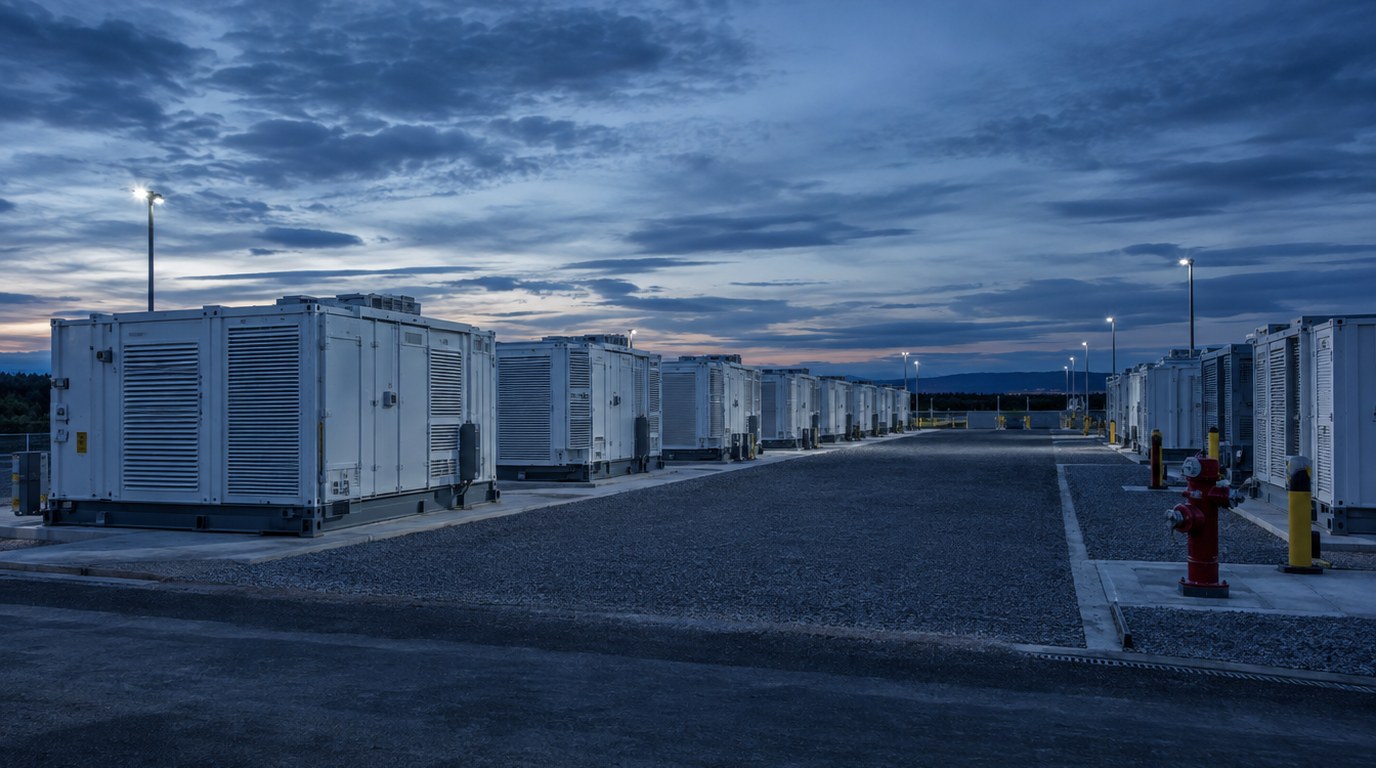
- NFPA 855 is the main installation standard for stationary energy storage, and it works alongside UL product standards and test methods.
- Lithium-ion failures involve thermal runaway, flammable off-gas and spread between cells, so protection is layered.
- UL 9540A test data can justify spacing and protection choices that would otherwise be set by default values.
- Siting, access for responders and ventilation are as important as the suppression system itself.
- California projects face local fire review, utility interconnection and sometimes state level requirements.
- Commissioning, emergency response planning and decommissioning belong in the original design package.
- What Are NFPA 855 and BESS Fire Safety?
- How Battery Fires Develop and How Protection Works
- Chemistries and Installation Types
- Codes, Standards and Approvals
- Applications by Building Type
- Design Process and Deliverables
- Special Cases and Hard Sites
- How to Specify a BESS and What Drives Cost
- Best Practices, Mistakes and Maintenance
- Where Budlong Delivers This
- Related Reading
- Frequently Asked Questions
Battery energy storage is moving from pilot projects into everyday building design. Owners add batteries to cut demand charges, ride through outages, support electric vehicle charging and pair with solar. The same energy density that makes batteries useful also creates a fire hazard that older building codes never anticipated, and NFPA 855 is the standard that now frames the answer.
Budlong designs the electrical, mechanical and life safety systems that surround storage equipment, supported by our commercial electrical services and recognized in our awards. This guide explains the standard in plain terms, so decision makers can plan a safe installation from the first concept sketch.
1. What Are NFPA 855 and BESS Fire Safety?
A battery energy storage system, or BESS, is a combination of battery cells, modules and racks, a battery management system, a power conversion system, an energy management controller, and the enclosure and thermal control that hold them together. NFPA 855, the Standard for the Installation of Stationary Energy Storage Systems, addresses how those assemblies are placed, protected and operated. It is published by the National Fire Protection Association and is referenced by the fire code in many states.
What the standard is trying to prevent
The objectives are straightforward: limit the chance of a failure, detect one quickly, keep it from spreading beyond the unit, protect people and neighbors, and give emergency responders the information they need. Each requirement in the standard traces back to one of those goals.
Why it matters to building owners
Storage often sits inside or beside occupied buildings and is tied into a building electrical system, so a failure becomes a building issue. The change in energy supply is part of a broader shift described in our article on the impact of electrification on MEP engineering, and it ties directly to long-term goals in our sustainability practice.
2. How Battery Fires Develop and How Protection Works
The hazard most associated with lithium-ion storage is thermal runaway. A cell that is damaged, overcharged, overheated or defective can begin to heat itself through internal chemical reactions. Once its temperature rises far enough, it vents flammable gas and may ignite. Heat from one cell can push neighbors toward the same state, which is how a single failure becomes a module or rack event.
Gas, not just flame
The gases released by a failing cell can include hydrogen, carbon monoxide and hydrocarbons. If they collect in an enclosed container or room and find an ignition source, a deflagration can result. For that reason, modern guidance puts as much weight on gas detection, ventilation and explosion control as on sprinklers.
Layers of protection
| Layer | Goal | Typical measures |
|---|---|---|
| Prevention | Keep cells within safe operating limits | Listed cells and modules, battery management system, temperature and voltage monitoring |
| Detection | Recognize abnormal conditions early | Smoke, heat and off-gas detection, connected to a fire alarm panel |
| Control | Remove energy and limit exposure | Automatic disconnects, shutdown of charging, controlled ventilation |
| Suppression and cooling | Slow spread between units | Water based sprinklers or listed alternatives, based on test data |
| Containment | Keep a failure from reaching neighbors | Spacing, fire rated barriers, explosion venting or prevention |
| Response | Support safe firefighting | Signage, access, an emergency response plan and responder training |
Detection should tie back to the building alarm network, and the broader goal of keeping power available through disruptions is explored in our article on resilient MEP systems for climate adaptation.
Also Read: Code Compliant Fire Safety Engineering in California
3. Chemistries and Installation Types
Common battery chemistries
| Chemistry | Where it is used | Fire safety consideration |
|---|---|---|
| Lithium iron phosphate | Commercial and utility storage | More thermally stable, but still capable of failure and gas release |
| Lithium nickel manganese cobalt | Dense storage and vehicles | Higher energy density, with a more energetic failure profile |
| Lead acid | Backup power and legacy systems | Hydrogen release during charging and corrosive electrolyte |
| Flow batteries | Long duration storage | Liquid electrolyte handling and spill control |
The standard sets energy thresholds by technology, and lithium-ion thresholds are lower than those for lead acid. Above a threshold the full set of requirements applies. Below it, simpler provisions may apply, though a local authority can still ask for more.
Installation types
Residential systems are small and often placed in garages or utility closets. Commercial systems may be cabinets in electrical rooms or dedicated enclosures. Utility scale projects use outdoor containers or walk-in units arranged in arrays. Each category has its own limits on size, spacing and protection, and each interacts differently with the building and the neighborhood.
Pairing with solar and charging
Many storage projects are linked to on-site generation. Our photovoltaic system design engineering team designs the solar side, and our complete guide to photovoltaic system design explains how storage fits a solar plan.
4. Codes, Standards and Approvals
NFPA 855 does not stand alone. It calls on other documents to prove that equipment is fit for use and to fix the limits of electrical design.
The documents that matter
- UL 9540 is the safety standard for energy storage systems as a whole, while UL 1973 covers the batteries themselves. You can confirm certifications through UL Solutions.
- UL 9540A is the test method that evaluates thermal runaway propagation, and its results feed the design decisions.
- NFPA 70, the National Electrical Code, addresses energy storage and interconnected sources, including conductor sizing, disconnects and overcurrent protection.
- NFPA 68 and NFPA 69 address explosion venting and prevention where flammable gas could collect.
- The International Fire Code, from the International Code Council, includes a section on electrical energy storage that California and local jurisdictions adopt with amendments.
California context
Local fire and building authorities approve projects, the utility reviews interconnection, and the California Energy Commission sets energy code policy that encourages storage in many new buildings. Energy code issues are explained in our article on what Title 24 is. Large facilities can trigger state level review, and recent incidents have led to closer scrutiny of emergency response planning, so confirm the current rules before design starts.
Use the edition of NFPA 855 and the fire code that your local authority has adopted. Newer editions often add test based options, but they are not usable until the jurisdiction accepts them.
Electrical safety around batteries also depends on short-circuit and arc flash analysis. See our guide to arc flash analysis and NFPA 70E compliance, and learn how our fire and life safety group aligns the protection design with the electrical design.
5. Applications by Building Type
Mission critical facilities
Data centers and other critical sites use batteries for ride-through and as part of resilient power. Our mission critical practice and our guide to power distribution for data centers show how storage is coordinated with switchgear and generators. For lessons on weak points, read why data center power systems fail.
Transit and fleet charging
Depot charging creates large, spiky loads that storage can smooth. Budlong has engineered zero emission bus infrastructure at the LAX bus charging station, the El Monte Transit Center and the Harbor Gateway Transit Center. Storage on such sites must also leave room for fire apparatus.
Healthcare and campuses
Hospitals value storage for resilience but face stricter rules on what may be placed near patients. Our health facilities experience informs how storage is separated from critical care areas and coordinated with the emergency power system.
Commercial and mixed-use buildings
Owners add storage for demand management, backup and incentives. Rooftop, parking garage and basement placements all raise different questions about weight, ventilation and responder access, which the design process must resolve.
Planning a battery storage project?
We can help you test siting options, define protection requirements and prepare a submittal package that fire reviewers can approve.
Also Read: Electrical Engineering for Safety, Reliability and Efficiency
6. Design Process and Deliverables
The design should begin with a decision about where the batteries will go. That choice drives clearances, ventilation, structure and responder access, and it is expensive to reverse once drawings progress.
A practical workflow
- Define the use case, energy capacity, power rating and chemistry.
- Collect the manufacturer listing and UL 9540A data for the specific product.
- Screen candidate locations against distance to lot lines, buildings, exits and combustible storage.
- Prepare a hazard mitigation analysis that explains failure modes and the controls for each one.
- Design detection, ventilation, explosion control and suppression to match the test data and code.
- Draft the emergency response plan and discuss it with the local fire authority.
- Develop electrical single line diagrams, protection settings and the interconnection package.
- Prepare commissioning and decommissioning plans.
Deliverables
Expect a siting plan, enclosure and equipment layout, single line diagram, fire alarm and gas detection riser, ventilation calculations, suppression design, a hazard mitigation analysis and an emergency response plan. A complete set of construction documents, like those described in our article on an electrical engineering design CD package, keeps these documents consistent.
7. Special Cases and Hard Sites
Indoor and rooftop installations
Placing batteries within a building raises exposure for occupants. Designers use fire rated separation, dedicated rooms, ventilation that exhausts to a safe location, and limits on total energy. Rooftop placement avoids some risks, but adds structural load and may complicate firefighting access.
Parking structures and charging hubs
Garages combine vehicle batteries, charging equipment and storage. Clear separation between the storage system and the parked vehicles helps prevent a single event from involving both.
Cogeneration, microgrids and on-site generation
Batteries are often added to sites that already make their own power. The planning approach resembles what we apply on projects such as the San Antonio Community Hospital cogeneration plant, where controls must coordinate multiple sources. Related goals appear in our article on net zero building MEP design.
Wildfire and seismic exposure
In California the site may also face wildfire or earthquake risk. Clearance from vegetation, flexible conduit connections, and anchored racks are routine requirements for projects in these areas.
Also Read: Commercial Solar PV Design That Transforms Business Energy
8. How to Specify a BESS and What Drives Cost
The specification should state the capacity and power, the required listings, the test data that the manufacturer must provide, the protection systems, and the warranty and service terms. It should also assign responsibility for integration testing, because a battery supplier, an inverter supplier and a controls contractor often share the work.
| Cost driver | Why it matters | Planning response |
|---|---|---|
| Energy capacity | More cells need more space and protection | Match capacity to the actual load profile |
| Chemistry and listing | Test data may allow tighter spacing | Request UL 9540A results before design |
| Siting | Clearances and site work are major costs | Screen locations at concept stage |
| Fire protection scope | Gas detection, ventilation and suppression add systems | Design to the hazard analysis rather than a template |
| Utility interconnection | Studies and upgrades can take months | Start the utility application early |
For larger energy projects, see our article on utility scale solar engineering design. Programs and technical research from the U.S. Department of Energy and the National Renewable Energy Laboratory provide further background on storage technology and costs.
9. Best Practices, Mistakes and Maintenance
Mistakes to avoid
- Choosing a product before confirming that its test data supports the intended spacing.
- Treating the fire alarm tie-in as an afterthought, so no one is notified when the battery system alarms.
- Assuming that a safer chemistry removes the need for a hazard analysis.
- Ignoring ventilation failure as a hazard in its own right.
- Leaving the emergency response plan to a later phase.
Commissioning and testing
Functional testing should prove that each safety function acts as designed: detection signals, disconnects, ventilation, alarms and communications with the building. Independent review helps, and our new building commissioning services include integrated systems testing of this kind.
Operations and end of life
Plan for routine inspection, firmware updates, sensor checks and battery health monitoring. Keep records of any alarm event. When the system reaches the end of its service life, a decommissioning plan covers de-energizing, removal and recycling.
- NFPA 855 is the framework, and UL 9540 and UL 9540A supply the product evidence.
- Thermal runaway and off-gas drive a layered protection strategy.
- Choose the location before the layout, since siting controls cost and risk.
- Use test data to justify spacing and suppression rather than relying on defaults.
- Prepare the hazard analysis and emergency response plan during design.
- Commission every safety function and plan for decommissioning.
10. Where Budlong Delivers This
Budlong electrical engineers in Glendale, Downtown Los Angeles, Camarillo and Fremont support storage, solar and charging projects across California. Choose the page for the office nearest your site.
11. Related Reading
12. Frequently Asked Questions
What is NFPA 855?
NFPA 855 is the Standard for the Installation of Stationary Energy Storage Systems. It sets requirements for siting, spacing, fire detection, suppression, ventilation, explosion control, commissioning and emergency planning for battery and other energy storage installations.
Does NFPA 855 apply to small home batteries?
Yes, in part. The standard includes provisions for one and two family dwellings and townhouses, such as limits on the size of each unit and the total energy allowed in a given location. Local amendments and the adopted edition decide exactly how it is applied.
What is UL 9540A and why does it matter?
UL 9540A is a test method that forces a battery cell into thermal runaway and measures how the failure spreads from cell to module to unit. The data show whether spacing, suppression and ventilation can be reduced or must be increased, so it often drives the design.
How is thermal runaway different from an ordinary fire?
Thermal runaway is a self-heating chemical reaction inside a cell that produces heat and flammable gas without outside oxygen. It can spread to neighboring cells and can restart after it looks controlled, so protection focuses on cooling, gas management and containment.
Is lithium iron phosphate safer than nickel manganese cobalt?
Lithium iron phosphate cells are generally more thermally stable, but they can still fail and release flammable gas. The chemistry is one input to the risk analysis, and it does not remove the need for detection, ventilation, spacing and emergency planning.
Can a battery energy storage system be installed inside a building?
It can, but indoor installations face tighter limits. The standard restricts where batteries may be placed, requires fire rated separation, detection, ventilation and suppression, and may cap the energy in a room. Outdoor siting with proper clearances is often simpler.
What fire suppression is used for battery storage?
Water based sprinklers are the most common approach in rooms, because water cools cells and limits spread. Other systems may be used where listing and large scale fire test data support them. Suppression is paired with detection, gas monitoring and ventilation, never used alone.
What is a hazard mitigation analysis?
A hazard mitigation analysis is a documented study of how the system could fail, what the consequences would be and how the design controls them. It considers failure modes such as thermal runaway, ventilation loss, electrical faults and external fire exposure.
Who approves a battery storage project in California?
The local building department and fire authority usually approve the project, and the utility reviews the interconnection. Large facilities can also face state level review and requirements for emergency response planning, so confirm the current rules at the start of design.