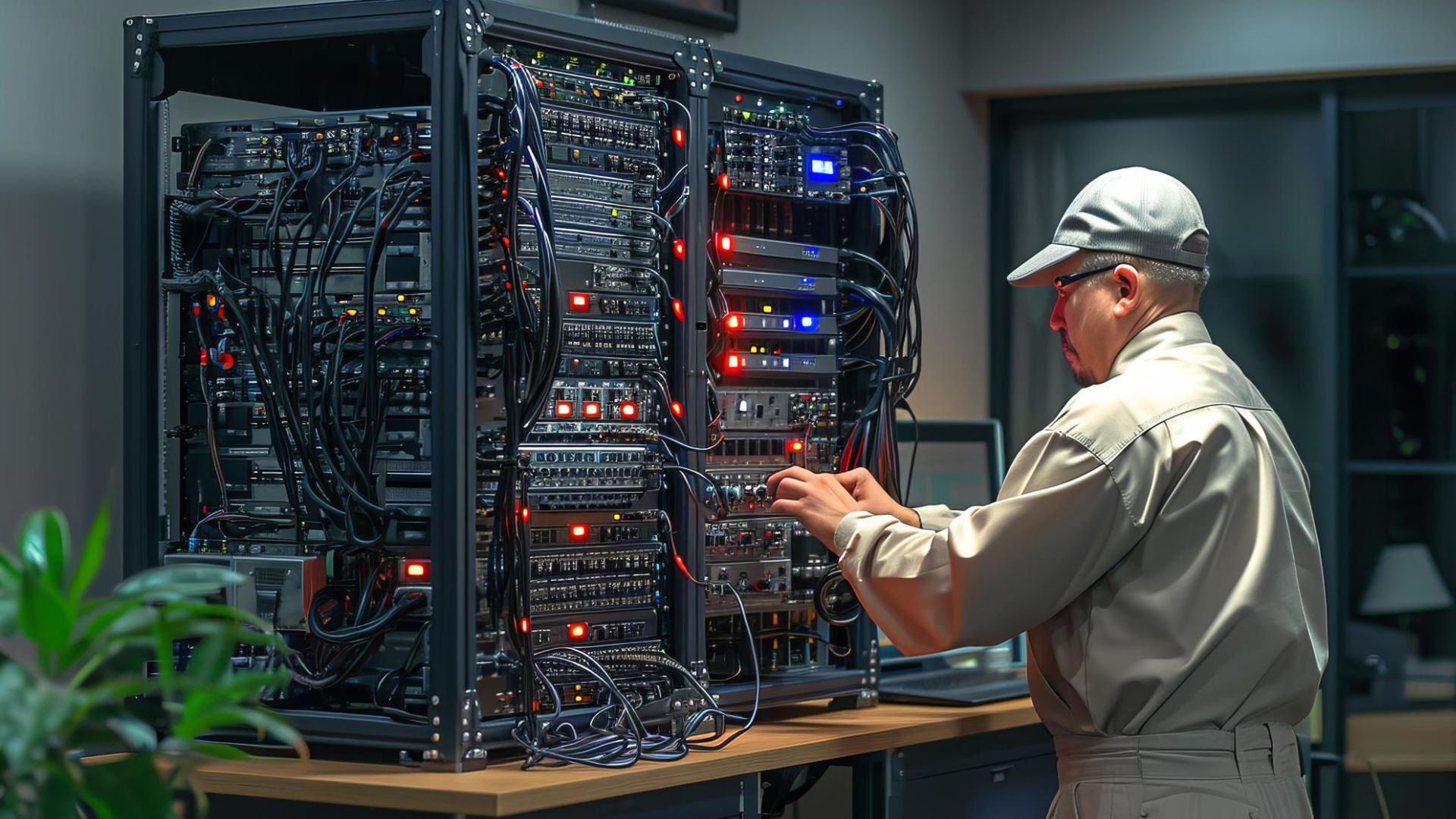
- Data center power distribution design requires redundancy at every level from utility service through UPS, generators, switchgear, PDUs, and rack power strips — with zero tolerance for single points of failure in Tier III and Tier IV facilities.
- The Uptime Institute Tier Classification (I through IV) is the primary framework defining reliability requirements for data center electrical and mechanical infrastructure.
- UPS systems bridge the gap between utility failure and generator start-up, providing conditioned power and filtering power quality disturbances that damage IT equipment.
- Generator sizing must cover IT UPS input load plus all mechanical cooling loads, with N+1 configuration providing redundancy against single generator failure.
- Power distribution units (PDUs) are the final distribution stage, providing branch circuit protection, power monitoring, and automatic transfer switching at the rack level.
- Budlong’s electrical engineers design power distribution systems for data centers, healthcare mission-critical facilities, and other critical infrastructure throughout California.
- Why Mission-Critical Electrical Design Is Different
- Uptime Institute Tier Classification
- Utility Service and Primary Distribution
- UPS System Design and Topologies
- Standby Generator Systems
- Automatic Transfer Switches and Critical Switchgear
- Power Distribution Units (PDUs)
- Redundancy Strategies: N+1 vs. 2N
- Power Usage Effectiveness and Electrical Efficiency
- Who Uses Mission-Critical Electrical Design Services?
- Related Reading
- Frequently Asked Questions
A data center is a building that has zero tolerance for electrical failure. A single power interruption of milliseconds can corrupt data, crash servers, and disrupt business operations — potentially costing millions of dollars per hour of downtime for large enterprises. The electrical power distribution system is the most critical infrastructure element of any data center, and its design demands a fundamentally different engineering approach from standard commercial buildings.
At Budlong, our electrical engineers design mission-critical power distribution systems for enterprise data centers, colocation facilities, healthcare critical infrastructure, financial systems, and other applications where downtime is not acceptable. This guide covers the engineering principles, redundancy strategies, and equipment configurations that define best-practice power distribution design for data centers and mission-critical facilities in California and beyond.
1. Why Mission-Critical Electrical Design Is Different
Standard commercial electrical design assumes that utility power is generally reliable and that brief interruptions — while inconvenient — do not cause catastrophic harm. A momentary voltage sag trips a few computers, a building loses lights for a few seconds, and operations resume. In a data center, the same event corrupts databases, crashes trading systems, drops hospital monitoring, or defeats security infrastructure. The entire design philosophy of mission-critical electrical systems is built around this zero-tolerance premise.
Mission-critical electrical design differs from standard commercial design in five fundamental ways: every IT load must be on UPS-backed power with no exceptions; redundancy at every equipment level prevents any single failure from causing an outage; systems must be maintainable while fully loaded without shutting down IT equipment; power quality must be conditioned to eliminate voltage disturbances that damage IT hardware; and fuel storage must support multi-day generator operation without utility restoration. Why data center power systems fail — and how to prevent failure — is a topic Budlong’s engineers address systematically in every mission-critical design engagement.
2. Uptime Institute Tier Classification
The Uptime Institute Tier Classification System is the industry-standard framework for defining the redundancy and reliability level of data center infrastructure. Understanding the Tier requirements is the first step in defining the engineering scope for any data center power distribution design.
| Tier | Name | Redundancy | Annual Downtime Allowance | Typical Use Case |
|---|---|---|---|---|
| Tier I | Basic Capacity | None (N) | 28.8 hours | Small business IT closets |
| Tier II | Redundant Components | N+1 components | 22.0 hours | Mid-size enterprise data rooms |
| Tier III | Concurrently Maintainable | N+1 with dual paths | 1.6 hours | Enterprise data centers, colocation |
| Tier IV | Fault Tolerant | 2N fully independent paths | 0.4 hours | Financial, healthcare critical, Tier IV colo |
The Tier level drives every major electrical infrastructure decision — the number of utility feeds, the UPS configuration, the generator quantity and arrangement, the distribution switchgear topology, and the PDU configuration. Most enterprise data centers are designed to Tier III standards; financial services, healthcare critical infrastructure, and the most demanding colocation operators target Tier IV. Electrical engineering for safety, reliability, and efficiency at Budlong applies Tier-appropriate redundancy strategies from the outset of the design process.
3. Utility Service and Primary Distribution
The utility service is the starting point of the power distribution system. For Tier III and Tier IV data centers, the utility service strategy directly determines whether the facility can achieve the target redundancy level.
Dual Utility Feeds
Tier III data centers require two independent utility service feeds that enter the facility from different directions and connect to different sections of the main switchgear — so that a fault on one utility service (underground cable fault, transformer failure, or substation event) does not interrupt the second service. True utility feed independence requires that the two feeds originate from different utility substations or at minimum different distribution feeders within the utility grid — feeds from the same substation on the same distribution line do not provide meaningful redundancy.
Medium-Voltage Distribution
Data centers above a few megawatts of IT load are typically served at medium voltage (12 kV to 35 kV) from the utility, with unit substation transformers stepping down to 480V for UPS input and IT equipment distribution. Medium-voltage distribution is more economical for high-power facilities because it reduces the current carried by service conductors — larger conductors at low voltage are more expensive than smaller conductors at medium voltage for the same power delivery capacity. The medium-voltage switchgear must be rated for the available utility fault current and must be designed for safe operation and maintenance in the data center environment.
Utility Coordination for California Data Centers
California data centers require early and detailed coordination with the serving utility to confirm available capacity, available fault current, service entrance requirements, and the timeline for utility infrastructure upgrades if the required service capacity exceeds what is currently available. In high-density California urban markets, utility capacity is not always immediately available at the scale required for large data centers. Designing for future load expansion at the utility service level is critical for data center projects with phased build-out plans.
4. UPS System Design and Topologies
The uninterruptible power supply (UPS) system is the central component of data center power protection. It performs three critical functions: it bridges utility outages until generators start and reach stable output; it conditions power quality by filtering voltage sags, surges, frequency variations, and harmonic distortion; and it provides backup battery energy to support IT loads through brief outages without generator involvement.
Double-Conversion Online UPS
Double-conversion online UPS is the standard topology for data center applications. The incoming AC utility power is first rectified to DC, then inverted back to AC for output to the IT loads. Because the IT loads are always powered from the inverter — never directly from the utility — they are completely isolated from utility power quality problems. Any utility disturbance, including a complete outage, is seamlessly absorbed by the battery bank with zero transfer time. The battery maintains IT loads during utility outages and generator start-up, and then the rectifier charges the battery back to full capacity once the generator or utility is restored.
UPS Battery Systems
Traditional data center UPS systems use valve-regulated lead-acid (VRLA) batteries, sized to provide 10 to 15 minutes of runtime at full IT load — sufficient to start generators and stabilize output before handoff. Lithium-ion battery systems are rapidly gaining adoption in data centers due to their higher energy density (allowing smaller UPS footprints), longer cycle life, wider operating temperature range, and integrated battery management systems that provide state-of-health monitoring. The engineering trade-off is a higher first cost for lithium-ion versus VRLA, which is typically justified on a lifecycle cost basis for large facilities.
Modular UPS Architecture
Modern data center UPS systems use modular architectures in which individual power modules (typically 25 to 100 kW each) plug into a shared bus within a rack-mounted UPS frame. This architecture allows incremental capacity additions as IT load grows, enables hot-swap replacement of failed modules without any power interruption, and achieves N+1 redundancy at the module level without requiring a second complete UPS system. The modular approach is now the dominant UPS architecture for enterprise data centers because of its flexibility and maintainability advantages.
A frequently overlooked UPS design issue is the UPS bypass circuit. Every UPS system has a static bypass that transfers IT loads directly to utility power when the UPS is taken offline for maintenance or in the event of an internal UPS fault. If the bypass is energized when utility power quality is poor — during a storm, grid disturbance, or local power event — the IT loads receive unconditioned utility power with no protection. Design the bypass circuit carefully and train facility staff on when bypass use is appropriate.
5. Standby Generator Systems
Standby generators provide the long-duration backup power source for data centers during extended utility outages. They must start and reach stable output voltage and frequency within 10 to 30 seconds of utility failure — the time window the UPS battery system must bridge. Generator sizing, fuel systems, and starting systems are all critical design elements.
Generator Sizing for Data Centers
Generator sizing for a data center must account for: the full IT UPS input load (IT load divided by UPS efficiency, typically 95 to 97 percent), all mechanical cooling loads (CRAC units, chillers, cooling towers, pumps, and fans), lighting and general power for the facility operations area, and the starting current of the largest motor load that may start while the generator is running. A commonly used rule of thumb is that total generator capacity should be approximately 1.5 to 2 times the IT load to accommodate cooling, infrastructure, and starting transients. A 25 percent minimum spare capacity should be added for future load growth. Sound demand factors and load calculations give the starting figure for this sizing.
Generator Paralleling and N+1 Configurations
For Tier III data centers, N+1 generator configurations use multiple generators connected to a paralleling switchgear bus, where any single generator failure allows the remaining generators to assume the full load. Paralleling switchgear synchronizes generator output before closing them onto the common bus, ensuring seamless load transfer without voltage transients that could upset IT equipment. For Tier IV facilities, two independent generator plants each capable of serving 100 percent of the load provide full 2N redundancy.
Fuel Storage and Extended Runtime
California data centers typically size fuel storage for a minimum of 12 to 24 hours of full-load operation at the data center’s peak demand. Mission-critical facilities often specify 48 to 96 hours of fuel storage based on the owner’s risk tolerance and the availability of fuel delivery services in their area. The fuel system must include day tanks at each generator, bulk storage tanks, transfer pumps, fuel polishing systems (to prevent microbial growth in stored fuel), and leak detection systems compliant with California EPA and fire code requirements. Fire safety engineering in MEP for data centers addresses the specific fire hazard of large diesel fuel storage systems.
6. Automatic Transfer Switches and Critical Switchgear
Automatic transfer switches (ATS) and critical switchgear manage the transition between utility power and generator power during an outage. In data center applications, the ATS is not just a simple transfer device — it is a sophisticated switching system that must operate reliably in milliseconds and must be integrated with the generator paralleling controls and UPS bypass systems.
Static Transfer Switches
Static transfer switches (STS) use thyristor-based solid-state switching to transfer between two power sources in less than a quarter cycle (4 milliseconds) — fast enough to be transparent to IT equipment that can tolerate brief voltage interruptions. STS devices are used in dual-bus data center configurations to switch individual IT loads or PDUs between Bus A and Bus B power sources with no detectable interruption to sensitive equipment. This speed of switching is not achievable with electromechanical ATS devices and is essential in Tier IV fault-tolerant configurations.
Critical Distribution Switchgear
The critical distribution switchgear distributes power from the generator/UPS output to the floor PDUs and mechanical HVAC distribution panels. It must be rated for the available fault current, must have fully draw-out construction to allow breaker maintenance without shutting down the bus, and must be housed in the data center’s dedicated electrical room with appropriate clearances and access. For large facilities, the critical switchgear may be an entire room of equipment serving dozens of PDU circuits, each representing hundreds of kilowatts of IT load.
7. Power Distribution Units (PDUs)
Power distribution units are the final stage of electrical distribution between the critical distribution switchgear and the IT equipment racks. They receive high-voltage power (480V three-phase or 208V three-phase from a step-down transformer within the PDU), distribute it to individual branch circuits, and often provide automatic transfer switching between A and B power paths.
PDU Configurations
A typical enterprise data center PDU accepts 480V three-phase input, steps it down to 208Y/120V three-phase through an integral transformer, and distributes it through branch circuit breakers to floor-mounted power strips serving racks within a defined zone. PDU capacity ranges from 30 kVA to 300 kVA depending on the density of the zone it serves. Each PDU output circuit serves a defined number of racks — typically 4 to 12 racks for standard 10 to 20 kW rack density configurations. Because power and cooling are sized from the same density figure, match the cooling approach by rack density before finalizing PDU zones.
Intelligent PDU Monitoring
Modern data centers require branch-level power monitoring at the PDU to track power consumption at the circuit level, enabling real-time calculation of Power Usage Effectiveness (PUE), capacity planning, and compliance with the data center’s energy efficiency targets. Intelligent PDUs with SNMP-enabled monitoring interfaces connect to the data center’s DCIM (Data Center Infrastructure Management) platform, providing facility operators and IT teams with unified visibility into power consumption from the utility meter through individual server power supplies.
Mission-Critical Power Distribution Design from Budlong
Our licensed electrical engineers design Tier III and Tier IV power distribution systems for enterprise data centers, healthcare critical infrastructure, and mission-critical facilities throughout California.
8. Redundancy Strategies: N+1 vs. 2N
The choice between N+1 and 2N redundancy strategies is the most fundamental architectural decision in data center electrical design. It determines the facility’s Tier classification, its fault tolerance capability, and its electrical infrastructure cost.
N+1 Redundancy (Tier III)
In N+1 redundancy, the system has one more unit of capacity than required to serve the full load. Any single component can fail or be taken offline for maintenance without impacting IT loads, because the remaining N units are sufficient to serve the full load. N+1 UPS module configurations, N+1 generators on a paralleling bus, N+1 PDUs with automatic load transfer, and N+1 distribution paths from the UPS to the PDU are all characteristic of Tier III data center design. N+1 is more capital-efficient than 2N (requiring approximately 25 to 50 percent more capacity rather than 100 percent more), making it the economic choice for most enterprise and colocation data centers.
2N Redundancy (Tier IV)
2N redundancy provides two completely independent systems, each capable of serving 100 percent of the load. The IT equipment has dual power supplies — one connected to System A power and one to System B — so that the loss of either complete system (including all generators, UPS modules, distribution switchgear, and PDUs on that path) does not cause any IT equipment to lose power. 2N is required for Tier IV fault-tolerant certification and is the standard for financial trading systems, life-critical healthcare systems, and government continuity-of-operations facilities. The capital cost premium over N+1 is approximately 40 to 60 percent of electrical infrastructure cost.
9. Power Usage Effectiveness and Electrical Efficiency
Power Usage Effectiveness (PUE) is the most widely used metric for data center energy efficiency. It is calculated as total facility power divided by IT equipment power, with a theoretical minimum of 1.0 (all power goes to IT) and a practical range of 1.1 to 2.0+ for most facilities.
Electrical Design Choices That Affect PUE
Electrical design choices have a direct and measurable impact on PUE. High-efficiency UPS systems in double-conversion mode achieve 96 to 97 percent efficiency — older UPS technologies achieve only 90 to 94 percent, wasting 6 to 10 percent of all power passing through them as heat. Distributing power at higher voltages (480V rather than 208V) to the IT equipment reduces distribution losses. Eliminating unnecessary power conversion stages — for example, using 480V to direct-fed rack-level transformers rather than room-level PDUs with secondary transformation — reduces cascaded conversion losses. Deploying high-voltage DC (HVDC) distribution in specific high-density zones further reduces conversion losses. Energy-efficient MEP design for data centers focuses on these electrical efficiency measures as a primary operating cost reduction strategy.
California Title 24 and Data Center Efficiency
California Title 24 includes specific provisions for data center energy efficiency, including minimum UPS efficiency requirements and lighting power density limits for data center support areas. Data centers seeking LEED certification may also pursue LEED EA credits related to optimized energy performance, requiring energy modeling that accurately represents UPS losses, distribution losses, and cooling system energy. Sustainable design services at Budlong incorporate data center energy efficiency into the integrated MEP design process.
10. Who Uses Mission-Critical Electrical Design Services?
- Mission-Critical Electrical Design in Los Angeles
- Mission-Critical Electrical Design in Glendale
- Mission-Critical Electrical Design in Fremont
- Mission-Critical Electrical Design in Camarillo
- MEP Engineering Services in Los Angeles
- MEP Engineering Services in San Jose
- MEP Engineering Services in Northern California
- Enterprise Data Centers — Tier III colocation and enterprise-owned data centers with N+1 redundancy
- Healthcare Critical Infrastructure — Hospital systems requiring uninterrupted power for life-critical equipment
- Financial Services Facilities — Trading floors and data centers requiring Tier IV fault-tolerant design
- Emergency Operations Centers — Government and public safety facilities requiring continuity of operations
- Network Operations Centers — Telecommunications and internet infrastructure requiring 99.999% uptime
11. Related Reading
- Data center power distribution requires zero tolerance for single points of failure — redundancy at every level from utility feed through PDUs is mandatory for Tier III and Tier IV facilities.
- The Uptime Institute Tier Classification (I-IV) defines the redundancy and annual downtime allowance for data center infrastructure — most enterprise facilities target Tier III.
- Double-conversion online UPS systems provide complete isolation of IT loads from utility power quality problems with zero transfer time during outages.
- Generator sizing must cover IT UPS input load plus all cooling loads, with N+1 configuration on a paralleling bus for Tier III reliability.
- Fuel storage for 12 to 96 hours of full-load operation is required depending on the facility’s risk profile and fuel delivery reliability in its location.
- PDUs are the final distribution stage — intelligent PDUs with branch-level metering enable real-time PUE calculation and data center capacity management.
- Electrical design choices (UPS efficiency, distribution voltage, conversion stages) directly affect PUE — high-efficiency designs approach PUE of 1.1 to 1.2 in California’s mild climate.
For technical reference, consult the Uptime Institute Tier Classification Standard, ASHRAE TC 9.9 Data Center Thermal Guidelines, the NEC Articles 700 and 708 for emergency and critical operations power systems, the U.S. Department of Energy Data Center Energy Efficiency resources, and The Green Grid PUE benchmarking resources.
12. Frequently Asked Questions
What is the Uptime Institute Tier Classification for data centers?
The Uptime Institute Tier Classification rates data center infrastructure reliability from Tier I (basic, no redundancy, 28.8 hours annual downtime allowance) through Tier IV (fault tolerant, 2N fully independent paths, 0.4 hours annual downtime allowance). Most enterprise data centers are designed to Tier III (concurrently maintainable, N+1 redundancy, 1.6 hours annual downtime allowance). Budlong’s electrical engineering team designs to the Tier standard defined by each client’s operational requirements.
What is a UPS system and why is it required for data centers?
A UPS (uninterruptible power supply) system provides conditioned, uninterrupted power to IT loads during utility failure and power quality disturbances. In double-conversion online topology, IT loads are always powered from the inverter — completely isolated from utility power. The battery bridges the gap between utility failure and generator start-up (10 to 30 seconds). UPS systems also filter voltage sags, surges, frequency variations, and harmonics that damage IT equipment.
What is N+1 redundancy in data center electrical design?
N+1 redundancy means the system has one more unit of capacity than required for the full load. A three-module N+1 UPS where two modules serve the load (N=2) and one is spare (+1) can lose any single module without load interruption. N+1 applies at every level — generators, UPS modules, distribution paths, and PDUs — in Tier III data center design.
How are standby generators sized for data centers?
Generators must serve the full UPS input load (IT load / UPS efficiency) plus all cooling loads (CRAC, chillers, cooling towers, pumps) plus facility operations loads. A minimum 25 percent spare capacity for future growth is standard. N+1 generator configuration on a paralleling switchgear bus is required for Tier III. Fuel storage is sized for 12 to 96 hours of full-load operation depending on the facility’s risk profile.
What is a power distribution unit (PDU) in a data center?
A PDU is the final electrical distribution stage between the UPS output and IT equipment racks. It receives 480V three-phase input, steps it down to 208Y/120V through an integral transformer, and distributes power through branch circuit breakers to rack-level power strips. Modern intelligent PDUs provide branch-level power monitoring via SNMP for real-time PUE tracking and capacity management.
What is 2N redundancy in data center electrical design?
2N redundancy provides two completely independent systems each capable of serving 100 percent of the load. IT equipment has dual power supplies — one on System A (with its own generators, UPS, and distribution path) and one on System B. Loss of either complete system does not cause any IT equipment to lose power. 2N is required for Tier IV fault-tolerant certification and is standard for financial trading, healthcare critical, and government continuity-of-operations facilities.
What is power usage effectiveness (PUE) and how does electrical design affect it?
PUE = total facility power / IT equipment power. A perfect PUE of 1.0 means all power serves IT loads. High-efficiency UPS systems (97 percent efficient), higher distribution voltages, fewer conversion stages, and intelligent load management all reduce overhead losses and improve PUE. California data centers with modern electrical designs and efficient cooling typically achieve PUE of 1.1 to 1.4.
What are the main differences between data center and standard commercial electrical design?
Data center electrical design differs fundamentally: all IT loads are on UPS and generator-backed circuits; N+1 or 2N redundancy is required at every distribution level; systems must be maintainable without shutting down IT loads; power quality conditioning eliminates even momentary voltage disturbances; power density is 50 to 200 times higher per square foot than office buildings; and fuel storage supports multi-day operation without utility restoration.