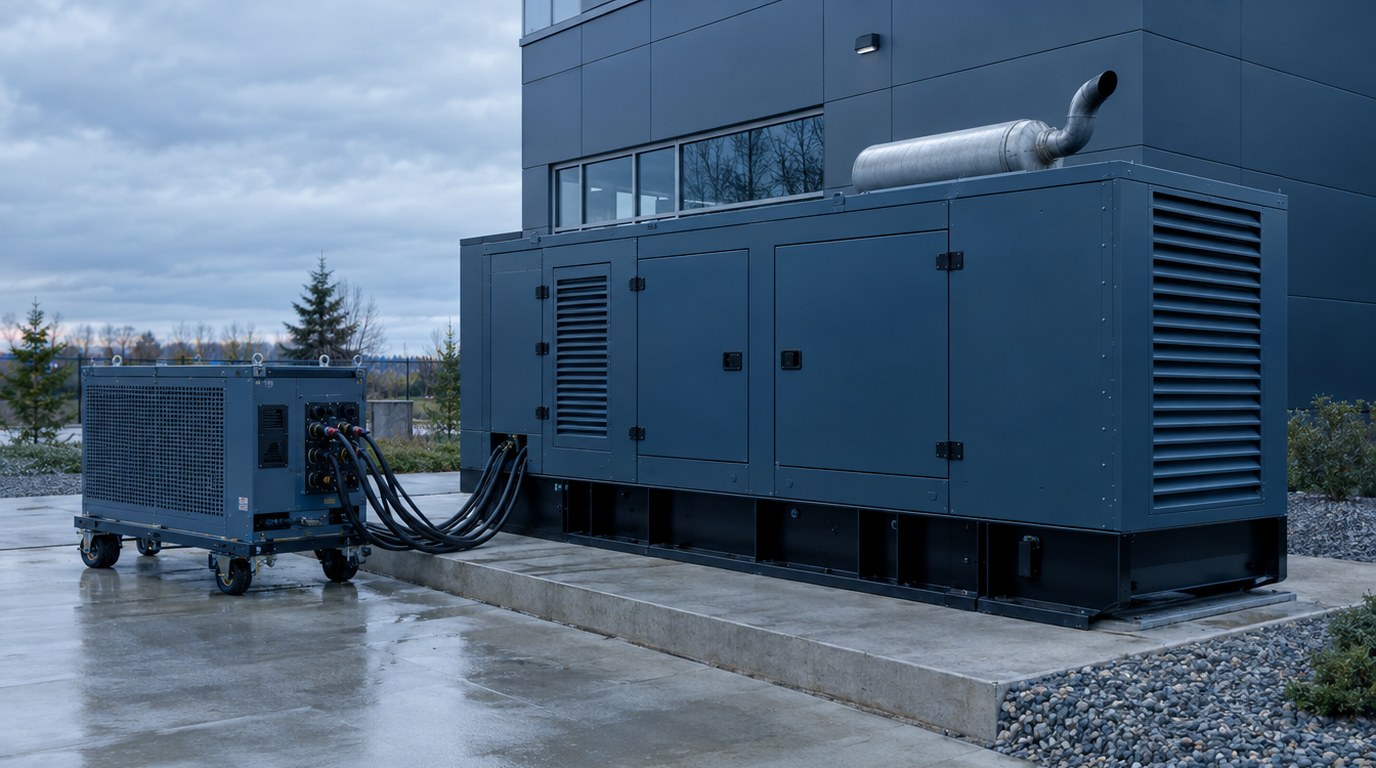
- NFPA 110 defines how an emergency or standby generator system is built, started, fueled, tested and maintained.
- Level 1 systems protect life safety loads, while Level 2 systems serve loads where failure is serious but not life threatening.
- Monthly exercise runs alone do not prove a generator can carry its design load, which is why load bank testing exists.
- Resistive and reactive load banks let a facility test at rated kW and power factor without disturbing building operations.
- Transfer time, fuel autonomy, paralleling logic and selective coordination are set during design, not at the first failure.
- Good documentation turns each test into evidence the authority having jurisdiction and insurers can accept.
- What Is NFPA 110 Emergency and Standby Power?
- How an Emergency Power Supply System Works
- Levels, Classes, Types and Load Bank Varieties
- Code Requirements and Governing Standards
- Applications by Building Type
- Design Process and Deliverables
- Special Cases: Paralleling, Cogeneration and Fuel
- How to Specify Equipment and What Drives Cost
- Testing, Maintenance and Common Mistakes
- Where Budlong Delivers This
- Related Reading
- Frequently Asked Questions
When the utility drops out, a standby generator is the only thing standing between a normal outage and a failed operating room, a dark control tower or a lost production batch. Our electrical engineering services team treats that generator as a system, not a box in the yard: engine, alternator, fuel, controls, transfer equipment, distribution and the test plan that proves they all work together.
This guide explains what NFPA 110 requires, how load bank testing fits in, and how owners, architects and facility managers can plan for both. It draws on more than six decades of design experience at Budlong, and on the emergency generator replacement work our electrical practice has delivered across Southern California.
1. What Is NFPA 110 Emergency and Standby Power?
NFPA 110, the Standard for Emergency and Standby Power Systems, is published by the National Fire Protection Association. It does not tell you how many kilowatts a building needs. It tells you how the supply system must perform once you have chosen that size: how fast it must pick up load, how long it must run, what must be monitored and how often it must be exercised.
The standard covers the whole emergency power supply system, abbreviated EPSS. That includes the prime mover, the generator set, the automatic transfer switches, the fuel system, the starting batteries, the remote annunciation and the room that houses them. A failure in any one element is a failure of the system, which is why the standard writes requirements for each.
Emergency power versus standby power
Emergency systems feed loads whose loss endangers life, such as egress lighting, fire pumps and critical care areas. Legally required standby systems feed loads such as smoke control and communications. Optional standby systems protect business interests and carry the lightest code burden. The electrical code assigns each load to a branch, and NFPA 110 then governs how the source behaves.
2. How an Emergency Power Supply System Works
The sequence begins at the automatic transfer switch. A sensor watches utility voltage and frequency. When voltage falls outside its window for a short, adjustable time, the switch sends a start signal. The engine cranks, the alternator builds voltage, and once voltage and frequency are stable the switch moves the load from the utility to the generator.
Transfer timing and the 10 second rule
NFPA 110 classifies systems by Type, which is the maximum time allowed between loss of normal power and acceptable power on the emergency bus. Type 10 means ten seconds, the figure that governs most life safety loads. Egress lighting that must come back sooner relies on battery units or inverters that bridge the gap, because no engine starts and stabilizes instantly.
Retransfer and cooldown
When utility power returns, the switch waits for a stability timer before retransfer so that a flickering grid does not cause repeated switching. The generator then runs unloaded for a cooldown period so the turbocharger and block can shed heat safely. Controls for these timers, together with exerciser clocks and bypass isolation paths, are specified by the engineer.
Why the alternator and the engine see different loads
Real buildings are full of motors, variable frequency drives and uninterruptible power supplies. These loads draw reactive current, harmonics and inrush that stress the alternator and the voltage regulator differently than a simple resistive heater. Sizing studies therefore examine starting kVA and step loading, not just connected kW.
3. Levels, Classes, Types and Load Bank Varieties
NFPA 110 sorts systems with four labels. Understanding them is the quickest way to read an equipment schedule or a test report.
| Classification | What it describes | Typical meaning |
|---|---|---|
| Level 1 | Consequence of failure | Failure could result in loss of human life or serious injury |
| Level 2 | Consequence of failure | Failure is less critical to life safety |
| Class | Minimum run time at rated load | Expressed in hours, from a fraction of an hour up to long duration classes |
| Type | Maximum transfer time | Type 10 allows ten seconds |
| Category | Installation, construction and arrangement | Category A to D, set by how robust the location and equipment must be |
Load bank varieties
A load bank converts generator output into heat or returns it to the system so the set can be tested at a defined percentage of nameplate. The choice depends on what the test must prove.
| Load bank type | What it simulates | Best use |
|---|---|---|
| Resistive | Unity power factor kW only | Verifying engine output, cooling and fuel flow |
| Resistive and reactive | Realistic lagging power factor such as 0.8 | Verifying alternator kVA and voltage regulation |
| Capacitive | Leading power factor | Specialized UPS and data center checks |
| Building load | The facility’s real connected load | Routine exercise when the load is large and steady enough |
4. Code Requirements and Governing Standards
NFPA 110 does not stand alone. The National Electrical Code assigns loads to emergency, legally required standby and optional standby systems in Articles 700, 701 and 702. In California, those requirements arrive through the California Electrical Code and the California Building Code, both published through the International Code Council family of model codes and adopted with state amendments. When we cite an edition, we cite the adopted edition, because California adopts on its own cycle.
Healthcare and public buildings
Hospitals add NFPA 99 and its essential electrical system rules, and in California the review authority is the Department of Health Care Access and Information. Our HCAI process guide explains how that review works. Schools follow the Division of the State Architect, whose requirements are summarized at dgs.ca.gov.
Selective coordination and fault protection
Emergency system overcurrent devices must be selectively coordinated so that a fault on one branch does not open a device upstream and black out unrelated life safety loads. That requirement shapes breaker selection and is verified during commissioning. Related arc flash exposure during maintenance is covered in our guide to arc flash analysis and NFPA 70E compliance, and workplace electrical safety obligations are outlined by OSHA.
Air quality and fuel storage
Diesel generators are regulated by the local air district. Permits typically limit annual hours of non emergency operation, which affects how long routine testing can run. The U.S. Environmental Protection Agency publishes the federal emission rules for stationary engines that those local permits build on.
5. Applications by Building Type
The same standard produces very different systems depending on what the building does.
Hospitals and medical campuses
Hospitals divide emergency power into life safety, critical and equipment branches, each with its own transfer path. Generators here are often paralleled, with fuel for long duration operation. See our overview of healthcare MEP design and the work our team supports through health facilities engineering.
Airports and transit
Airfields and bus depots run around the clock. Budlong’s mission critical practice designs generator plants with redundancy so that one unit can be removed for testing while the facility stays protected.
Municipal and civic buildings
City halls, police stations and water districts are expected to stay open in disasters. Examples from our portfolio include the City of Anaheim emergency generator replacement, the Inglewood City Hall generator replacement and the LACMTA multi site generator replacement.
Commercial, residential and industrial
High rise towers need generators for elevators, stair pressurization and fire pumps, and offices increasingly add capacity for tenant loads. Our commercial electrical services page describes how those needs are handled.
Also Read: Why Data Center Power Systems Fail
Planning a generator replacement or test program?
Talk to an engineer who has designed emergency power for hospitals, airports and city facilities before you commit to equipment.
Talk to a Budlong electrical engineer
6. Design Process and Deliverables
Good emergency power design starts with a load list, not a catalog. Every connected load is tagged as emergency, legally required, optional or none, and then analyzed for starting characteristics.
Step by step
- Build the load schedule and sort loads into the code branches.
- Run demand and step load analysis. Our commercial load calculation guide shows the method.
- Choose generator size, voltage and quantity, including spare capacity for growth.
- Select transfer switch types and decide on bypass isolation.
- Design fuel storage, day tank, venting and containment.
- Specify exhaust, acoustic treatment, louvers and combustion air.
- Prepare coordination, short circuit and arc flash studies.
- Write the commissioning and load bank test requirements into the specifications.
What the drawing set contains
A complete package includes a one line diagram, generator and transfer switch schedules, equipment room plans, fuel piping diagrams, control wiring diagrams, a sequence of operations and a specification section on testing. Our write up of a typical electrical construction document package lists these in detail.
Decide the load bank connection point early. A permanent load bank tap with a quick connect cabinet costs little during design and saves hours of crane time and shutdown risk every year afterward.
7. Special Cases: Paralleling, Cogeneration and Fuel
Paralleling switchgear
Large sites use several smaller generators on a common bus instead of one large set. The switchgear synchronizes the units, shares load and sheds non critical loads if capacity falls short. Paralleling increases reliability and allows maintenance on one machine while others stay available. It also adds control complexity that must be tested under every credible failure.
Cogeneration and central plants
Some campuses combine heat and power plants with standby capability. Budlong designed several, including the San Antonio Community Hospital 5 MW cogeneration plant. These plants must be able to island from the grid and restart without utility support, a capability sometimes called black start.
Fuel and resilience
Diesel remains the dominant fuel because it stores on site, but natural gas depends on pipeline pressure that may fail in an earthquake. Planning for long outages is part of resilient MEP design for climate adaptation. Fuel quality also matters, since diesel degrades in storage and fuel polishing and sampling are routine maintenance.
Also Read: Power Distribution System Design for Data Centers
Also Read: Resilient MEP Systems for Climate Adaptation
8. How to Specify Equipment and What Drives Cost
Specifications should name performance, not just brands. The items below move price the most.
| Cost driver | Why it matters | How to manage it |
|---|---|---|
| Generator capacity and quantity | Sets equipment price and room size | Right size using real demand data and a planned growth margin |
| Emission tier and air permit | Affects engine choice and aftertreatment | Confirm local district requirements early |
| Fuel storage duration | Larger tanks need containment and inspection | Match run time to the Class and the owner’s risk tolerance |
| Sound attenuation | Neighbors and tenants limit noise | Choose enclosures during design |
| Transfer switch count | Each branch needs a switch | Group loads logically without breaking code separation |
| Test provisions | Permanent taps reduce lifetime cost | Include load bank connection cabinets |
Specifying load bank testing
A specification should state the load steps, durations, power factor, who provides the load bank, how readings are recorded and what the acceptance criteria are. Ask for a trend of voltage, frequency, coolant temperature, oil pressure and exhaust temperature rather than a single snapshot. For a broader view on how to plan the budget, see how to estimate MEP engineering costs.
Future load and expansion
Generators are expensive to replace, so leave headroom for growth. Our note on electrical design for future load expansion explains how to reserve capacity without oversizing from day one. Electrification of vehicles and heating is also raising loads across the industry.
9. Testing, Maintenance and Common Mistakes
The NFPA 110 test rhythm
Under the maintenance chapter of NFPA 110, owners perform weekly inspections, and Level 1 and Level 2 systems are exercised at least monthly. The monthly run is typically 30 minutes at a load that meets a minimum fraction of nameplate or a manufacturer recommended exhaust temperature. The standard also expects automatic transfer switches to be operated monthly and checked annually.
When a load bank is required
If the monthly run does not reach the minimum load or exhaust temperature, the standard calls for a supplemental load bank test at least annually. Many Level 1 systems also see a stepped annual test that increases from a light load to a heavy load over about two hours, plus a longer test on a multi year cycle. Because exact intervals depend on the adopted edition and the authority having jurisdiction, confirm them against the edition in force for your project.
Lightly loaded diesel engines can suffer wet stacking, where unburned fuel and carbon accumulate in the exhaust. Periodic load banking at higher load burns off those deposits and is as much a maintenance task as a compliance one.
Commissioning new systems
Acceptance testing proves the installation before the building opens. It includes functional tests of every transfer path, a full load run, and a simulated utility failure with the real building load. Our commissioning services follow the process described in our building commissioning process guide.
Common mistakes
- Testing only with the building load, which may never exceed a small fraction of the generator rating.
- Skipping the reactive portion of the load, which hides alternator and regulator problems.
- Failing to record readings, which leaves no evidence for inspectors.
- Letting fuel age without sampling.
- Leaving batteries and chargers unmonitored until a start failure.
- Treating an outage as a test without a written procedure.
- NFPA 110 governs the entire emergency power supply system, not only the generator.
- Level, Class and Type tell you how critical, how long and how fast.
- Monthly exercise is required, but a load bank is how you verify rated capacity.
- Design permanent test connections, selective coordination and fuel autonomy up front.
- Record every test. Documentation is part of compliance.
- Confirm edition specific intervals with your authority having jurisdiction.
10. Where Budlong Delivers This
Founded in 1958, Budlong works from offices in Glendale, downtown Los Angeles, Camarillo and Fremont, serving Los Angeles, Ventura, Orange, San Bernardino, Riverside and Santa Barbara counties. Emergency power is one thread through our MEP engineering services, and our expertise spans aviation, healthcare and civic work.
11. Related Reading
12. Frequently Asked Questions
What is the difference between emergency power and standby power?
Emergency power serves loads whose failure could endanger life, such as egress lighting and critical care areas, and must restore power within ten seconds. Standby power serves loads such as smoke control or business operations, where the timing and code burden are lighter.
What does NFPA 110 Level 1 mean?
Level 1 applies where failure of the equipment to perform could result in loss of human life or serious injuries. It carries the strictest installation, monitoring, testing and maintenance expectations in the standard.
How often should a generator be exercised under NFPA 110?
Generators are inspected weekly and exercised at least monthly. The monthly run is typically 30 minutes at a load that meets the standard’s minimum fraction of nameplate rating or a manufacturer recommended exhaust temperature.
When is a generator load bank test required?
A supplemental load bank test is required when the monthly exercise cannot reach the minimum load or exhaust temperature. Many Level 1 systems also receive a periodic stepped load bank test to verify rated capacity. Confirm intervals with the adopted edition and your authority having jurisdiction.
What is the difference between a resistive and a reactive load bank?
A resistive load bank tests real power in kilowatts and mainly challenges the engine, cooling and fuel systems. A reactive load bank adds inductive load, which tests the alternator and voltage regulator at a realistic power factor such as 0.8.
What is wet stacking and why does it matter?
Wet stacking is the buildup of unburned fuel and carbon in the exhaust of a diesel engine that runs at light load. It reduces efficiency and can damage the engine, and periodic higher load testing helps clear it.
Can we test using the building load instead of a load bank?
Yes, if the building load is high enough to meet the standard’s minimum loading requirements and the facility can tolerate the transfer. Many buildings cannot, so a load bank is used to reach the required percentage of nameplate safely.
Do we need a permanent load bank connection?
It is not required, but it is a wise design choice. A permanent connection cabinet shortens test time, reduces shutdown exposure and avoids repeated cable work during every annual test.
Who is responsible for emergency generator testing records?
The facility owner is responsible for keeping inspection, exercise and test records available for the authority having jurisdiction. Engineers and commissioning agents help by writing test procedures and documenting acceptance results.