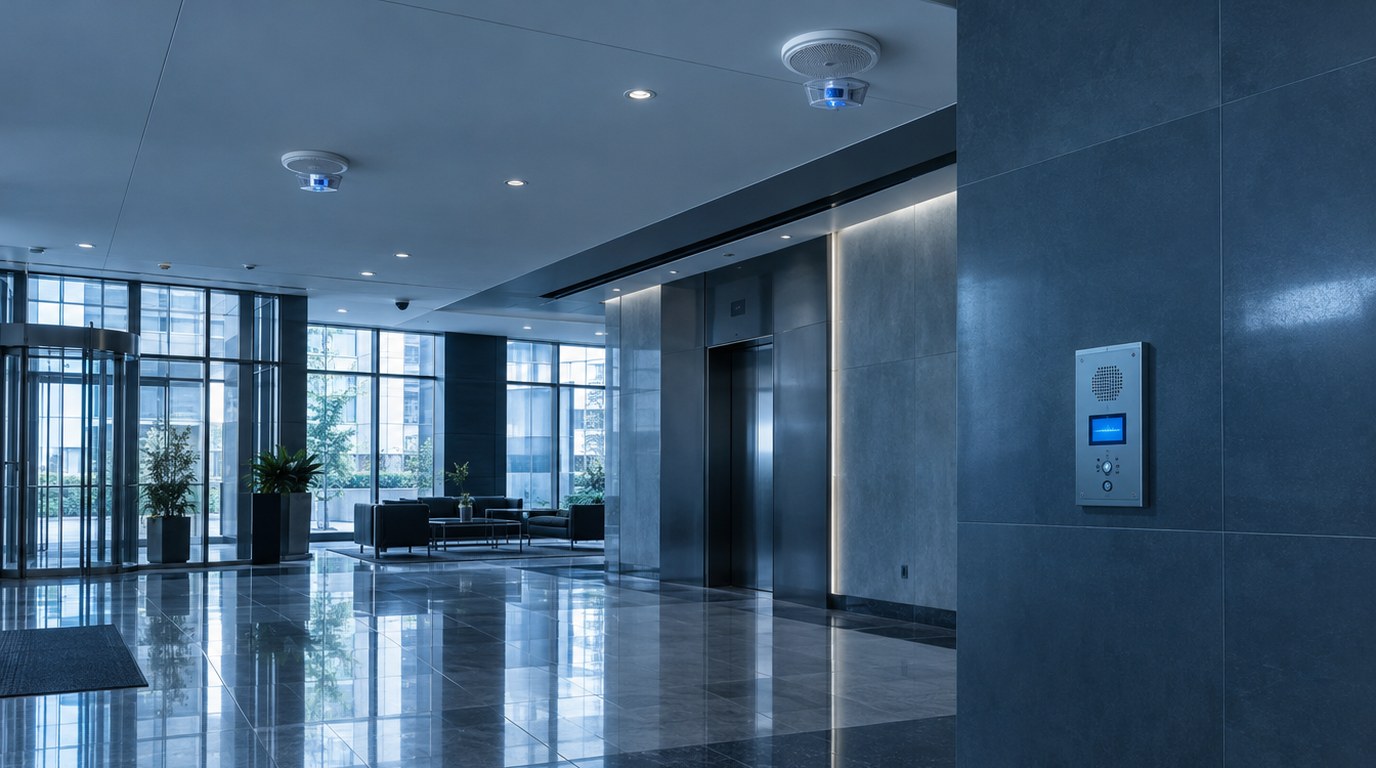
- A mass notification system delivers clear, authorized instructions to occupants during fire, security and weather emergencies.
- NFPA 72 treats mass notification as one part of an emergency communications system, with its own risk analysis and design rules.
- Intelligibility matters as much as loudness, so speaker layout and acoustic testing drive the design.
- Fire alarm signals, voice evacuation and mass notification must have a clear priority order that stakeholders agree on in writing.
- Survivable pathways and secondary power keep the system alive when the emergency itself damages the building.
- Schools, hospitals, airports and campuses each need a different mix of speakers, signs, strobes and alerts to personal devices.
- What Is a Mass Notification System?
- How a Mass Notification System Works
- Types of Systems and Notification Methods
- Codes, Standards and Approvals
- Applications by Building Type
- Design Process and Deliverables
- Special Cases and Hard Problems
- How to Specify a System and What Drives Cost
- Testing, Maintenance and Common Mistakes
- Where Budlong Delivers This
- Related Reading
- Frequently Asked Questions
A fire alarm tells people that something is wrong. A mass notification system tells them what is wrong, where to go and when it is safe to return. That difference is why more owners now ask their design teams to look beyond horns and strobes. Our fire life safety engineering group designs these systems alongside the fire alarm, sprinkler, smoke control and egress features they must work with.
This article is written for owners, architects, developers and facility managers who need to decide whether a building requires mass notification, what it should include and how to get it approved. It reflects the integrated approach that fire safety engineering at Budlong takes with every project, and the way our firm has coordinated life safety systems since 1958.
1. What Is a Mass Notification System?
A mass notification system, often shortened to MNS, is a set of devices and software that sends prioritized messages to a population. Messages can be spoken, displayed, flashed or pushed to phones and computers. They may warn of fire, a hazardous materials release, severe weather, an active threat or a utility failure.
The National Fire Protection Association addresses these systems in NFPA 72, the National Fire Alarm and Signaling Code. The chapter on emergency communications systems groups mass notification with related functions such as two way communication at areas of refuge and in stairwells. In other words, the code sees mass notification as one capability within a larger communications strategy rather than a stand alone product.
How it differs from a fire alarm
A fire alarm responds to an automatic or manual detection event and sounds a coded or voice signal. A mass notification system can be started by an authorized person, an automated sensor or an external alert, and the content is flexible. A principal can announce a lockdown. A campus officer can broadcast a shelter in place order. A control room can tell a terminal to hold in place while smoke is cleared.
2. How a Mass Notification System Works
Every installation, no matter the scale, has four functional layers. They are the initiation layer, the control layer, the distribution layer and the output layer.
Initiation
Messages begin at a console, a wall mounted microphone station, a software interface, a sensor input or an external gateway. Authorization is critical. The design identifies who may send which message, from where and with what level of approval.
Control and priority
A central control unit interprets requests, resolves conflicts and drives the outputs. If a fire alarm and a lockdown message arrive together, a priority rule decides what the audience hears. That rule is not an engineering guess. NFPA 72 expects the owner, the authority having jurisdiction and the design team to document it in a risk analysis and an emergency response plan.
Distribution and survivability
Signals travel over copper, fiber or network paths. The code defines pathway survivability levels, so a design for a high rise stair or a campus backbone can require protected conduit, fire rated cable or redundant loops. This detail often decides whether a system keeps working when part of the building is burning.
Outputs
Speakers, strobes, text displays, digital signs, desktop alerts, mobile messages and outdoor sirens receive the final signal. A strong design uses more than one output for the same message so that people who cannot hear or see one channel still receive the warning.
3. Types of Systems and Notification Methods
NFPA 72 and related guidance describe several system categories. The right choice depends on the geography of the site and who must be reached.
| System type | Reach | Typical use |
|---|---|---|
| In building mass notification | Occupants inside one structure | Offices, hospitals, schools, terminals |
| Wide area mass notification | Outdoor areas, campuses, perimeters | University quads, industrial yards, ports |
| Distributed recipient mass notification | Individuals on phones, computers and screens | Large employers, campuses with remote staff |
| Two way emergency communication | Specific points such as refuge areas and stairs | High rises, hospitals, accessible egress |
Choosing output methods
| Method | Strength | Limitation |
|---|---|---|
| Voice speakers | Immediate and understandable to everyone present | Needs good acoustics and ambient noise control |
| Strobes and visual devices | Reaches people who are deaf or in loud areas | Conveys little detail |
| Text displays and digital signs | Provides written, repeated instruction | Requires line of sight |
| Mobile and desktop alerts | Reaches remote and off site people | Depends on networks that may be congested |
| Outdoor sirens and long range speakers | Covers open ground | Messages are harder to make intelligible |
4. Codes, Standards and Approvals
Mass notification sits on a stack of requirements. The designer must read them together.
Model codes and California adoption
The California Building Code and California Fire Code, based on publications of the International Code Council, decide whether a building requires a fire alarm with voice evacuation. Certain high rise, assembly and educational occupancies fall under that requirement. Mass notification as a separate feature is often required by a risk analysis, a campus policy or a federal contract rather than by the base code. California adopts on its own cycle, so confirm the edition in force on your permit date. Our guide to fire life safety compliance in building projects walks through the process, and code compliant fire safety engineering in California covers state specifics.
NFPA 72 design requirements
The standard governs the following design points, and each one translates into drawings, calculations or test procedures.
- A documented risk analysis that identifies threats, populations and message priorities.
- Audibility targets relative to ambient sound, with separate expectations for public and private modes.
- Speech intelligibility, commonly verified with a speech transmission index measurement.
- Visible notification coverage and synchronization of strobes.
- Secondary power capacity and supervised circuits.
- Pathway survivability and protection from physical damage.
Listings and equipment
Control equipment should carry the appropriate listing. UL publishes standards for fire alarm control units and a separate standard for mass notification systems, and the American National Standards Institute oversees the process by which many of these standards become national standards. Federal projects often add Department of Defense criteria such as UFC 4-021-01, which prescribes mass notification for many military facilities.
Workplace and school approvals
Employers must maintain emergency action and alarm procedures under rules published by OSHA. California public schools go through the Division of the State Architect, summarized by DGS and in our DSA process guide.
5. Applications by Building Type
Schools and universities
Campuses face lockdown, evacuation, severe weather and medical events, each requiring a distinct message. Classrooms need speakers or intercom integration, quads need outdoor coverage and administrative staff need desktop alerts. See our education facilities practice. Modernization work such as the LAUSD Jordan High School modernization is the kind of project where fire alarm upgrades and communications are coordinated.
Hospitals and care settings
Hospitals avoid panic, so messages often use coded phrases to staff and quiet visual cues for patients. Surgical suites, imaging rooms and isolation wards may require tailored zones. Our health facilities engineers coordinate notification with nurse call, security and smoke compartments.
Airports and transit
Terminals have heavy noise, multiple languages and a mix of public and restricted areas. Messages often come from an operations center and may be integrated with flight displays. Budlong’s aviation team has supported major airport work such as LAX Bradley West, where life safety systems operate across large open volumes.
Civic and public safety buildings
Fire stations, police stations and city halls are both users and originators of alerts. Examples in our portfolio include the Ventura County Fire District headquarters and the Rampart police station. Our institutional practice handles this category.
Offices, hotels and residential towers
High rises rely on emergency voice systems for phased evacuation, with floor by floor messages. Voice control from a fire command center is a standard feature. Workplace safety guidance appears in fire life safety essentials.
Also Read: Fire Protection Engineering Explained
Not sure whether your building needs mass notification?
A short review of occupancy, code path and threat assessment can save months of rework later. Speak with a Budlong fire life safety engineer.
Request a life safety consultation
6. Design Process and Deliverables
Mass notification works best when it is planned with the architecture, not added after the ceiling grid is set.
Phases of work
- Gather the emergency response plan and stakeholder roles. Who is allowed to send a message, and who must approve it?
- Run a risk analysis with the owner, the fire marshal and security staff.
- Define zones, priority order and message library.
- Lay out devices and calculate audibility, visibility and intelligibility.
- Design power, battery capacity, pathways and network.
- Prepare drawings, specifications and a sequence of operations.
- Coordinate with sprinkler, smoke control, access control and elevator recall.
- Support plan review and field inspection.
Deliverables
Expect a device layout, riser diagram, battery and voltage drop calculations, a matrix that links each input to each output, zone maps and a written sequence of operations. Our overview of how fire safety engineering integrates MEP systems explains how these drawings relate to the rest of the set.
Cross discipline coordination
Speakers share space with diffusers, lights and sprinkler heads. Network switches need power and cooling. Low voltage cabling needs protected routes. The low voltage design best practices article explains how to organize that infrastructure, and our technology services cover related networked systems.
Write the priority matrix first. Once the owner agrees which message wins in each conflict, device selection and programming become straightforward.
7. Special Cases and Hard Problems
Large volume spaces
Atria, terminals, gymnasiums and concourses produce echo and reverberation that wreck speech clarity. Designers often use many low power speakers closely spaced rather than a few loud ones, and they select directional units where the geometry demands it. Acoustic modeling before installation is cheaper than retuning afterward.
High noise and mixed occupancy
Industrial plants and kitchens have ambient levels that require much higher output or visual redundancy. Mixed use buildings combine different owners with different policies, so the system may need separate zones with a shared head end.
Smoke control and egress interplay
Messages should match what the building is doing. If a smoke control system pressurizes a stair, occupants should hear instructions consistent with that behavior. Our smoke control system design and commissioning guide and the article on fire sprinkler design under NFPA 13 describe the systems the mass notification platform must be coordinated with.
Accessibility and language
Visual notification must serve people who are deaf or hard of hearing, and text should be short and plain. In diverse regions, prerecorded messages in more than one language are common. The design should state which languages are required and who maintains the message library.
Cybersecurity and false messages
Networked platforms can be misused. Access control, logging, role based permissions and message authentication are part of the design, not only the IT policy.
Also Read: The Intersection of Security and Audio Visual Integration
Also Read: How Fire Safety Engineering Integrates MEP Systems
8. How to Specify a System and What Drives Cost
Specifications should state performance and approval requirements, not only a manufacturer name.
| Cost driver | Effect | Planning tip |
|---|---|---|
| Number of zones and message types | More programming and testing | Agree on a limited, clear message library |
| Acoustic difficulty of spaces | More speakers or specialty devices | Model large volumes early |
| Pathway survivability level | Rated cable or protected routes cost more | Match level to the risk analysis |
| Outdoor coverage | Poles, power and weather rated equipment | Decide the coverage footprint with campus security |
| Integration with other systems | Interfaces and testing time | List all integrations in the specification |
| Software licenses and support | Recurring annual costs | Include lifecycle cost in the budget |
What to put in the specification
Name the standards the equipment must meet, define intelligibility test locations, require factory trained installers, call for as built drawings and demand training for the people who will send messages. Add the acceptance test criteria, so the contractor knows what a pass looks like. For an overview of early budgeting see how to estimate MEP engineering costs.
Choosing an integrated solution
Combining fire alarm and mass notification on one platform reduces cabling and training. Separate platforms offer independence and may suit sites with strong security teams. The choice should follow the risk analysis. Our fire safety engineers can help weigh the trade offs.
9. Testing, Maintenance and Common Mistakes
Acceptance testing
Testing includes functional checks of every input and output, confirmation of the priority matrix, battery calculations verified under load, supervision tests and acoustic measurements. Intelligibility is measured at representative points, including the worst locations, and recorded in the commissioning report.
Ongoing inspection
NFPA 72 sets inspection, testing and maintenance intervals for fire alarm equipment, and mass notification equipment should follow a documented schedule. Many owners hire a licensed contractor under a service agreement. Our fire safety service page outlines support options, and message drills with staff should run at least as often as fire drills.
The most common failure is human, not electronic. A system that no one is trained to operate will not be used under pressure. Run a quiet test message every term or quarter so operators keep their skills fresh.
Common mistakes
- Skipping the risk analysis and guessing priority rules.
- Specifying loudness without specifying intelligibility.
- Ignoring ceiling height, finishes and furniture when placing speakers.
- Failing to protect pathways to the standard the risk analysis demands.
- Forgetting to budget for software updates and message maintenance.
- Leaving key staff off the authorized sender list.
- Mass notification extends the fire alarm into a flexible, authorized, multi channel warning system.
- A risk analysis and a written priority matrix are the foundation of the design.
- Intelligibility, survivability and secondary power matter as much as device count.
- Different building types need different mixes of speakers, signs, strobes and personal alerts.
- Training and regular test messages are part of the system, not an extra.
- Confirm edition specific requirements with the authority having jurisdiction.
10. Where Budlong Delivers This
Budlong designs life safety systems from offices in Glendale, downtown Los Angeles, Camarillo and Fremont, and serves Los Angeles, Ventura, Orange, San Bernardino, Riverside and Santa Barbara counties. Our MEP engineering services put fire life safety beside electrical, mechanical and plumbing design so conflicts are found on paper. Browse our expertise to see the sectors we serve.
11. Related Reading
12. Frequently Asked Questions
What is a mass notification system in a building?
It is a prioritized communication system that sends voice, visual and text messages to occupants during emergencies. It can warn about fire, severe weather, security threats and other hazards, and it often extends beyond the fire alarm to phones, signs and outdoor speakers.
Is mass notification required by code?
The base building codes mainly require fire alarm and voice evacuation in certain occupancies. Mass notification is often triggered by a risk analysis, an owner policy, a campus standard or a federal contract. Confirm with the authority having jurisdiction for your project.
What does NFPA 72 say about mass notification?
NFPA 72 includes mass notification within its emergency communications systems chapter. It calls for a risk analysis, defines audibility, intelligibility, survivability and power expectations, and requires coordination between mass notification and the fire alarm system.
What is the difference between a fire alarm and a mass notification system?
A fire alarm responds to fire detection and sounds a signal or a fixed voice message. A mass notification system can be started by authorized people or sensors, supports many message types and may reach people on phones and screens as well as speakers.
What is speech intelligibility and why does it matter?
Speech intelligibility describes how clearly a listener can understand words from a speaker. It matters because a loud message that cannot be understood does not help people act. It is usually verified with a speech transmission index test.
Which message wins if a fire alarm and a lockdown happen together?
The priority is set by the risk analysis and emergency response plan, agreed by the owner, the fire authority and security staff. Programming then reflects that decision so operators do not have to decide under stress.
Do mass notification systems need backup power?
Yes. NFPA 72 requires secondary power with supervised batteries sized for standby and alarm operation, and the risk analysis may call for more. Generators and uninterruptible power supplies can add resilience for head end equipment.
Can a mass notification system reach people with disabilities?
It should. Designs combine audible speakers with strobes, text displays and mobile alerts so that people who are deaf, hard of hearing or blind still receive the warning. Two way communication points serve areas of refuge.
How often should a mass notification system be tested?
Follow the inspection and testing schedule set by NFPA 72 and the adopted code, and add regular operator drills with test messages. Many owners test components on a recurring service contract and run message drills each school term or quarter.