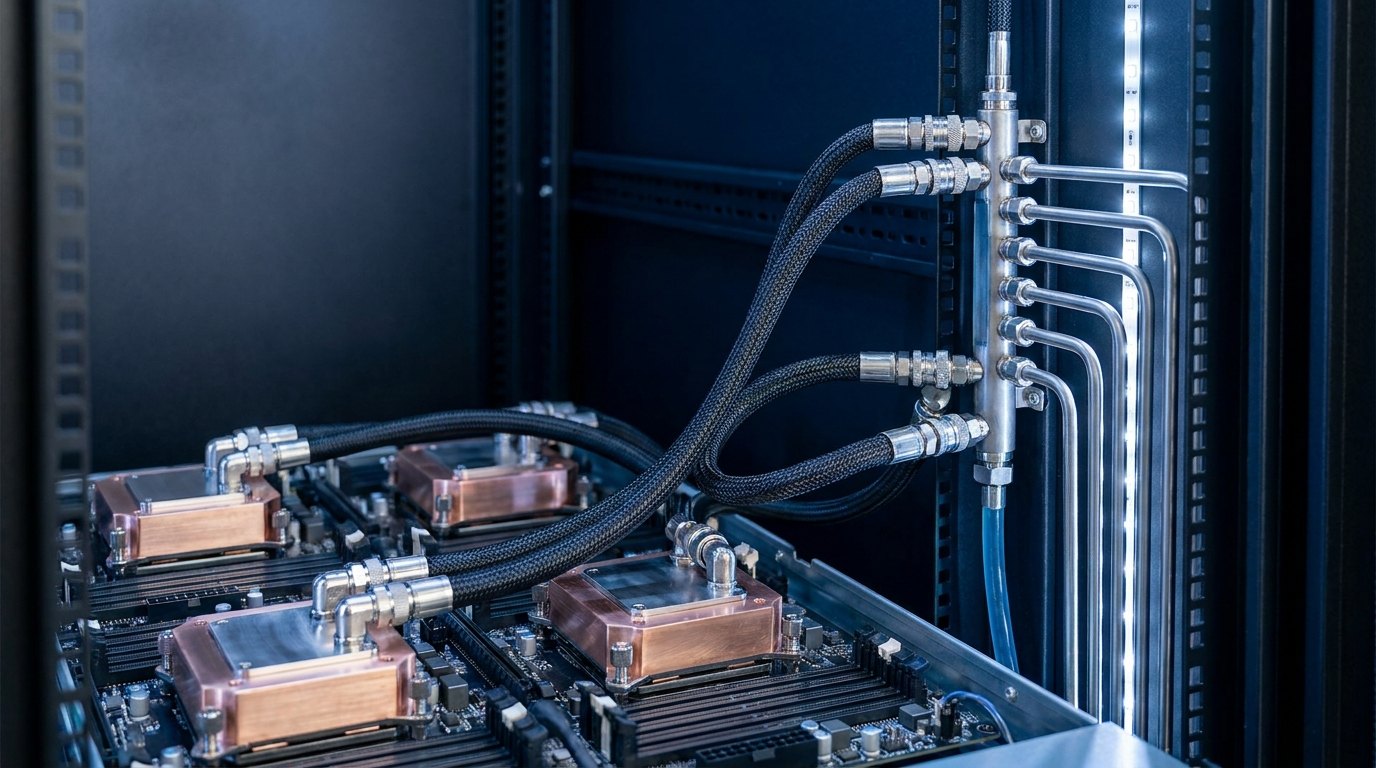
- Liquid cooling is a numbers decision, not a technology preference. Rack density, the share of heat captured to liquid and the cost of electricity decide whether it pays.
- Well contained air cooling remains the cheaper answer below roughly 15 to 20 kW per rack. Above roughly 40 kW per rack, air stops being a practical option for most rooms.
- Direct to chip cold plates capture most but not all of the heat. The residual air load still needs a designed air system.
- Warm facility water is where the savings come from, because it lets dry coolers and economizers replace chiller hours.
- The cost stack is dominated by piping, coolant distribution units, leak management and structural work, not by the cold plates themselves.
- Retrofits succeed or fail on floor loading, water service, electrical capacity and isolation from live rooms.
- What Is Liquid Cooling for Data Centers?
- How Liquid Cooling Works
- Types of Liquid Cooling
- The Density Threshold: When Air Stops Working
- Where Liquid Cooling Pays Off
- The Cost Stack
- Retrofits, New Builds and California Requirements
- How to Decide: A Selection Guide
- Design, Commissioning and Operation
- Where Budlong Works
- Related Reading
- Frequently Asked Questions
Most conversations about liquid cooling start with the technology: cold plates, immersion tanks, dielectric fluids and coolant distribution units. That is the wrong place to start. The question an owner actually needs answered is narrower and more useful. At what rack density, with what workload, at what electricity price and in what building does liquid cooling cost less over its life than a well designed air system? Below that point it is an expensive experiment.
The pressure behind the question is real. According to the U.S. Department of Energy, data centers used about 4.4 percent of total U.S. electricity in 2023, and that share is projected to reach somewhere between 6.7 and 12 percent by 2028. Much of that growth comes from GPU accelerated servers. It draws on the mission critical work Budlong delivers across California and on the wider engineering expertise behind it.
1. What Is Liquid Cooling for Data Centers?
Liquid cooling is any approach that moves heat away from IT equipment using a liquid rather than relying on air alone. Water carries heat far more effectively than air, so a liquid loop removes the same heat with a fraction of the flow. That single physical fact explains every advantage liquid cooling claims: higher density, warmer operating temperatures, less fan energy and a usable stream of waste heat.
The term covers three families of system, rear door heat exchangers, direct to chip cold plates and immersion, and each moves the boundary between the air side and the liquid side to a different place.
Why it matters to the building, not just the rack
Liquid cooling is often presented as an IT decision. It is equally a mechanical engineering decision, because it changes the heat rejection plant, the piping distribution, the structural loading of the floor and the way the room is commissioned and operated. Only the building can supply water at the right temperature, flow and quality, with the redundancy the workload demands.
2. How Liquid Cooling Works
Every liquid cooled data hall has the same basic heat path, and each loop carries its own cost and risk.
The technology cooling system loop
The loop closest to the IT equipment is usually called the technology cooling system, or TCS. It circulates treated coolant through the cold plates, rear doors or immersion tanks. Its chemistry, filtration and wetted materials are tightly controlled, and it is kept small so any leak releases a limited volume.
The coolant distribution unit
The coolant distribution unit, or CDU, separates the TCS from the facility water. It contains a heat exchanger, pumps, filtration and controls. CDUs come as in rack units serving a single cabinet, in row units serving a group of racks, or larger floor mounted units serving an entire hall. The CDU is where the IT side and the building side meet, and its approach temperature sets how warm the facility water can run.
The facility water system
Beyond the CDU sits the facility water system, which carries heat to the rejection plant. This is ordinary building engineering: pipe sizing, pump selection, redundancy, isolation valves and controls. The design principles are the same ones used in any large hydronic system, and our article on chilled water system design covers many of them. The critical difference is temperature. A liquid cooled hall can often run facility water far warmer than a conventional chilled water plant.
Heat rejection
The final step rejects heat to atmosphere through dry coolers, cooling towers, adiabatic coolers or chillers. The warmer the facility water, the more hours each year the plant can reject heat without running compressors. That is where most of the operating savings come from.
The liquid cooling classes published by ASHRAE Technical Committee 9.9 define facility water by its maximum supply temperature: W17, W27, W32, W40, W45 and W+. The class the IT equipment is rated for, not the cooling hardware, should set the plant design. A plant designed for W32 can support any equipment rated W32, but an owner who asks for W17 water to be safe gives away most of the economizer hours that justified liquid cooling in the first place.
3. Types of Liquid Cooling
The three families differ in how much heat they capture to liquid, how much air cooling they still need and how much they disrupt the room and the operations team.
Rear door heat exchangers
A rear door heat exchanger replaces the back door of the rack with a water coil. Server fans push hot exhaust through the coil, which returns the air to the room close to room temperature. Active doors add their own fans for higher loads. Rear doors are the least disruptive option because the servers themselves are unchanged, which makes them attractive for retrofits and mixed estates.
Direct to chip cold plates
Direct to chip, sometimes called direct liquid cooling, mounts cold plates on the highest power components. Coolant flows through micro channels in the plate and carries the heat away at its source. This is the approach most current high density AI and high performance computing platforms are designed around. Cold plates typically capture the large majority of rack heat, but memory, storage, power supplies and network components still reject heat to air. That residual air load is often still larger than an entire legacy rack.
Immersion cooling
Immersion cooling submerges servers in a dielectric fluid. Single phase systems pump the fluid through a heat exchanger. Two phase systems let the fluid boil on the hot components and condense on a coil above the bath. Immersion captures close to all of the heat to liquid and removes server fans entirely. Its costs are in the operations model: tanks change the floor layout, add significant floor loading, and change how technicians service hardware.
| Factor | Rear Door Heat Exchanger | Direct to Chip | Immersion |
|---|---|---|---|
| Heat captured to liquid | Exhaust air heat, at the rack | Most of the rack heat, at the chip | Close to all of it |
| Residual air load | Low at the room, servers still air cooled | Significant, needs a designed air system | Minimal |
| Typical density range | Moderate to high | High to very high | Very high |
| Change to IT hardware | None | Liquid ready servers required | Immersion rated hardware and procedures |
| Floor and structural impact | Low | Moderate, piping and CDUs | High, tank weight and fluid volume |
| Retrofit suitability | Good | Good with planning | Usually a dedicated zone |
| Operations change | Small | Moderate | Large |
📖 Also Read: Data Center Cooling Systems Compared for how liquid options sit alongside CRAH, in row and economizer based air systems.
4. The Density Threshold: When Air Stops Working
Air cooling does not fail at a single number. It becomes progressively more expensive and harder to control as density rises, until the airflow, fan energy and room geometry needed to hold inlet temperatures simply stop being practical. The commonly cited bands below are a starting point, not a design rule.
| Rack Density | Practical Cooling Approach | What Usually Decides It |
|---|---|---|
| Up to about 10 kW | Conventional air cooling, hot or cold aisle layout | Containment discipline and airflow management |
| About 10 to 20 kW | Contained air cooling, in row cooling | Containment quality, supply temperature, ceiling height |
| About 20 to 40 kW | Rear door heat exchangers or a hybrid of air and liquid | Whether the estate is mixed or uniform, retrofit constraints |
| Above about 40 kW | Direct to chip, with a designed residual air system | Hardware platform, facility water temperature, redundancy |
| Above about 100 kW | Direct to chip at scale, or immersion | Structural capacity, power delivery, operations model |
Two points matter more than the table. First, density is now set by the hardware platform rather than by the owner. Current rack scale accelerator systems are often specified well above 100 kW per rack, and they arrive designed for liquid cooling. For those deployments the question is not whether to use liquid but how to deliver it. Second, the rack density figure has to be honest. A design based on nameplate power overstates the load. A design based on today’s average understates the peak. The electrical load calculation and the cooling load must come from the same assumptions, or the plant and the power train will be sized for different buildings.
The threshold that matters is the room average, not the peak rack. A hall with a handful of 60 kW racks among dozens of 8 kW racks can often be served by targeted rear doors or in row units. A hall where every rack is a 60 kW rack cannot. Plan the cooling strategy around the density profile of the whole room over the life of the lease, not around the single hottest cabinet on day one.
5. Where Liquid Cooling Pays Off
Liquid cooling earns its cost in a handful of identifiable situations. Outside them, a disciplined air design usually wins on lifecycle cost.
AI training and inference clusters
Accelerator dense clusters are the clearest case. The hardware is designed for liquid, densities are far beyond what air can handle in a normal room, and the workload runs near full load around the clock, which maximises the energy savings. Here liquid cooling is less an option than a precondition.
High performance computing and research
University and laboratory computing clusters run continuously at high utilisation and often sit inside campuses that can use low grade heat. The National Renewable Energy Laboratory built its high performance computing data center around warm water, component level liquid cooling with a power usage effectiveness target of 1.06 or better, and reuses the captured heat in the surrounding building. That combination of density, utilisation and heat reuse is the strongest economic case liquid cooling has. It is also the type of facility covered by our laboratory and industrial sector work.
Space constrained and urban sites
Where floor area is expensive, density is the product. In dense California markets, the floor area liquid cooling frees can outweigh the energy savings.
Sites with a use for the heat
Warm water return from a liquid cooled hall can preheat domestic hot water, serve heating loops or feed heat pumps. That only pays where there is year round heat demand nearby, common on campus and healthcare sites.
Is Your Facility Ready for Liquid Cooled Racks?
Budlong assesses floor loading, water service, electrical capacity and heat rejection before a single rack is ordered, so the decision is made on numbers rather than vendor promises.
6. The Cost Stack
The cold plates and CDUs are the visible cost of liquid cooling, but they are rarely the largest part of it. A realistic cost stack has six layers, and owners who budget only the first two are routinely surprised.
IT side hardware
Cold plates, manifolds, quick disconnects and CDUs. Much of this now ships with the server platform, which moves cost to the IT budget without removing it.
Secondary distribution
Piping from the CDUs to the racks, including valves, strainers, flexible connections, leak detection and drip management. This is labour intensive work, and it has to be coordinated with cable trays, busway and fire protection in a congested space. Early MEP BIM coordination is the difference between a clean installation and weeks of field rework.
Facility water and heat rejection
Pumps, primary piping, heat exchangers and the heat rejection plant. If the facility can run warm water, this layer can be cheaper than a conventional chilled water plant because chillers shrink or disappear. If the design defaults to cold water, it costs more.
Structural and architectural
Floor loading for filled racks, CDUs and immersion tanks, roof structure for dry coolers, and containment for any leak. Raised floors designed for air cooling may need reinforcement or removal.
Electrical
Higher density means higher power per rack, which changes busway, PDU and UPS sizing, and adds pump and CDU loads that need their own redundancy. The power distribution design has to be revisited alongside the cooling design, not after it. Pump and CDU loads must also be included in the arc flash analysis for the new distribution equipment.
Operations
Water treatment, coolant testing, filter changes, leak response procedures, spare parts and staff training. These costs recur every year and are often missing from the business case.
Liquid cooling saves money in the plant and spends it in the distribution. The energy savings come from warm water heat rejection and the elimination of server and air handler fan energy. The capital premium sits in piping, leak management and structure. A business case that counts the first without the second will always look better than the project that gets built.
📖 Also Read: Energy Modeling in MEP Design for how to test cooling options against real hourly weather data before committing capital.
7. Retrofits, New Builds and California Requirements
New construction
A new build can be designed around warm water from the start: plant sized for liquid, floors rated for filled racks, piping corridors reserved and electrical capacity matched to the density. Reserving facility water connections and structural capacity for future liquid zones is far cheaper at design than after occupancy.
Retrofits
Most California projects are retrofits, often a liquid cooled zone inside a live air cooled facility. Four existing conditions decide feasibility. Floor capacity determines whether the racks and CDUs can be supported. Water service determines whether there is a source of facility water at a usable temperature, or whether a new loop and heat rejection plant are needed. Electrical capacity determines whether the additional power is available at all. Isolation determines whether the new zone can be built, filled, flushed and commissioned without risk to equipment already in service.
California Energy Code
Section 140.9 of the California Energy Code carries prescriptive requirements specific to computer rooms, covering topics including economizers, reheat, humidification, fan power and containment. Liquid cooled designs generally make those requirements easier to meet because warm water extends economizer operation, but the compliance path still has to be documented and confirmed against the current code cycle published by the California Energy Commission. Our overview of Title 24 explains how the Energy Code is structured.
Water use, seismic and fire protection
Water is a scarce resource in much of the state, so evaporative heat rejection deserves scrutiny. Dry coolers paired with warm water often deliver most of the efficiency without the water consumption. Seismic bracing of piping, CDUs and tanks follows California requirements and needs early coordination. Fire protection strategy for the room follows applicable NFPA standards, and immersion fluids in particular should be reviewed with the fire safety engineering team and the authority having jurisdiction early in design.
8. How to Decide: A Selection Guide
The table below sets out how the main variables usually push the answer.
| Decision Factor | Points Toward Air Cooling | Points Toward Liquid Cooling |
|---|---|---|
| Rack density, room average | Below about 15 to 20 kW | Above about 40 kW, or any accelerator platform designed for liquid |
| Utilisation | Low or variable | High and continuous |
| Hardware refresh cycle | Mixed, short lived equipment | Standardised liquid ready platform |
| Floor area value | Space is plentiful | Space is expensive or limited |
| Heat reuse opportunity | None nearby | Year round heating demand on site |
| Existing building | Low floor capacity, no water service | Structural margin, water service available |
| Operations team | No liquid experience, no plan to build it | Willing to adopt water treatment and leak response procedures |
A hybrid answer is often the right one. Many facilities now design a liquid cooled zone for accelerator racks and keep contained air cooling for storage, networking and general purpose compute. That approach limits the capital premium to the racks that genuinely need it while keeping the rest of the room simple. The broader principles for comparing system options are the same ones we set out for selecting HVAC systems for commercial buildings, applied to a much denser load.
Ask the IT team one question before the cooling strategy is fixed: what platform will be in these racks in five years? If the answer is accelerator hardware, design the facility water and structure for liquid now, even if the first racks are air cooled. Retrofitting piping into a live hall costs far more than reserving the space on day one.
9. Design, Commissioning and Operation
Design the residual air system properly
Direct to chip racks still reject a meaningful share of their heat to air. That load must be calculated, delivered and contained like any other. Ignoring it is one of the most expensive early errors.
Specify water quality from the start
The TCS loop needs defined chemistry, filtration and wetted material compatibility. Contamination introduced during installation, flushing or filling can block cold plate micro channels. Flushing and fill procedures belong in the specification, not in the contractor’s discretion.
Plan redundancy across both loops
Redundancy has to apply to CDUs, pumps, heat exchangers and controls as well as to the heat rejection plant. A single CDU serving many high density racks is a single point of failure, and thermal ride through time on a liquid cooled rack can be very short.
Commission under load
Test with load banks at design flow and temperature, including failure scenarios, before production hardware arrives. A structured building commissioning process led by an independent commissioning services team catches control sequence, flow balance and redundancy faults while they are still cheap to fix.
Key Takeaways
- Liquid cooling is justified by numbers: density, utilisation, electricity cost, floor value and heat reuse.
- Contained air cooling remains cheaper below roughly 15 to 20 kW per rack. Above roughly 40 kW per rack, liquid is the practical answer.
- Warm facility water is where the energy savings come from. Specify the ASHRAE W class the hardware supports, not a colder margin.
- The capital premium sits in distribution piping, leak management, structure and electrical work, not in the cold plates.
- Direct to chip still leaves a residual air load that must be designed and contained.
- Retrofits depend on floor capacity, water service, electrical capacity and the ability to isolate a new liquid zone.
- Commission both loops under load, including failure modes, before production hardware arrives.
10. Where Budlong Works
Liquid cooling decisions are shaped by local conditions: utility capacity and rates, water availability, seismic requirements and plan check expectations all vary across California. Budlong supports mission critical, laboratory and campus computing projects with integrated HVAC design services, mechanical design services, electrical engineering and plumbing design for water treatment and drainage, from offices across the state. More on how the practice has grown since 1958 is on our company story page.
📖 Also Read: Why Data Center Power Systems Fail for the electrical side of the same reliability problem.
11. Related Reading
12. Frequently Asked Questions
What is liquid cooling in a data center?
Liquid cooling removes heat from IT equipment using treated water, a water glycol mixture or a dielectric fluid instead of air alone. The main approaches are rear door heat exchangers, direct to chip cold plates and immersion. Because liquids carry heat far better than air, it supports much higher rack densities and warmer operating temperatures.
At what rack density does liquid cooling make sense?
Well contained air cooling is usually the lower cost option below roughly 15 to 20 kW per rack. Between roughly 20 and 40 kW, rear door heat exchangers or hybrid designs are often the best fit. Above roughly 40 kW per rack, and for accelerator platforms designed for liquid, direct to chip or immersion cooling becomes the practical answer. The room average density matters more than the single hottest rack.
Is liquid cooling more expensive than air cooling?
The capital cost is usually higher because of distribution piping, coolant distribution units, leak management, structural work and electrical changes. Operating cost is usually lower at high density and high utilisation, because warm water heat rejection reduces chiller hours and server fan energy falls.
What is the difference between direct to chip and immersion cooling?
Direct to chip cooling pumps coolant through cold plates mounted on processors and accelerators, capturing most of the rack heat while the remaining components are still cooled by air. Immersion cooling submerges the whole server in a dielectric fluid and captures close to all of the heat.
Does direct to chip cooling eliminate the need for air conditioning?
No. Cold plates cover the highest power components, while memory, storage, power supplies and networking still reject heat to air. The room still needs a properly calculated and contained air system.
What are the ASHRAE liquid cooling classes?
ASHRAE Technical Committee 9.9 classifies facility water for liquid cooled IT equipment by its maximum supply temperature, using the classes W17, W27, W32, W40, W45 and W+. Running warmer water within the rated class increases economizer hours and reduces compressor energy.
Can an existing data center be retrofitted for liquid cooling?
Often, yes, but feasibility depends on four existing conditions: floor loading capacity, availability of facility water at a usable temperature, spare electrical capacity and the ability to build and commission a liquid zone without risk to equipment already in service.
How does liquid cooling affect Title 24 compliance in California?
The California Energy Code includes prescriptive requirements for computer rooms covering economizers, reheat, humidification, fan power and containment. Warm water liquid cooling often makes these easier to meet, but compliance must still be documented against the current code cycle.
What are the main risks with liquid cooling and how are they managed?
The main risks are leaks, poor water quality, single points of failure in coolant distribution and very short thermal ride through time. They are managed with leak detection and drip containment, defined coolant chemistry and filtration, controlled flushing and fill procedures, redundant pumps and coolant distribution units, and commissioning under load that includes failure scenarios before production hardware is installed.