- A recirculation loop trades some energy for fast hot water, so the design goal is to keep that trade as small as possible.
- Pump flow is set by heat loss and allowable temperature drop, not by the fixture demand of the building.
- Balancing is the step most often skipped, and it is the step that decides whether remote branches ever get hot water.
- Return temperatures are both a comfort metric and a Legionella control point.
- Insulation, pump controls and heat pump integration drive most of the energy outcome.
- Commissioning with logged temperatures gives owners a baseline for future troubleshooting.
- What Is a Hot Water Recirculation System?
- How a Recirculation Loop Works
- Loop Types and Variants
- Codes, Standards and Legionella Guidance
- Applications by Building Type
- Design Process and Deliverables
- Special Cases: Heat Pumps, High Rises and Healthcare
- Choosing Controls and Understanding Cost Drivers
- Best Practices, Testing and Key Takeaways
- Where Budlong Delivers This
- Related Reading
- Frequently Asked Questions
Hot water that arrives in seconds feels like a basic feature. Behind it sits a loop of pipe, a small pump, a handful of balancing devices and a control strategy that has to respect energy rules, scald limits and bacterial growth all at once. Our plumbing design services team treats the recirculation loop as its own system, with its own calculations, rather than a line item hung on the water heater.
This article focuses on the loop itself: pumps, balancing, return temperatures, Legionella and energy considerations, and controls. If you need the broader view of heaters, storage and demand sizing, start with our existing guide to domestic hot water system design. For the full range of building systems we deliver, see our MEP services overview.
1. What Is a Hot Water Recirculation System?
A hot water recirculation system is a continuous or on-demand loop that moves heated water from the source out to the far reaches of the plumbing and back again. Instead of a dead-end pipe full of cooled water waiting to be flushed down the drain, the user finds hot water already waiting nearby.
Why buildings need one
In a large building, the distance from the heater to a remote fixture can reach hundreds of feet. Without a loop, a user may wait a long time for hot water to arrive while the cool water in the pipe runs to waste. That is a comfort problem, a water waste problem and, in many jurisdictions, a code problem. Some codes limit the volume of water allowed between the source of hot water and the outlet, which pushes designers toward loops or branch heat maintenance.
What a loop includes
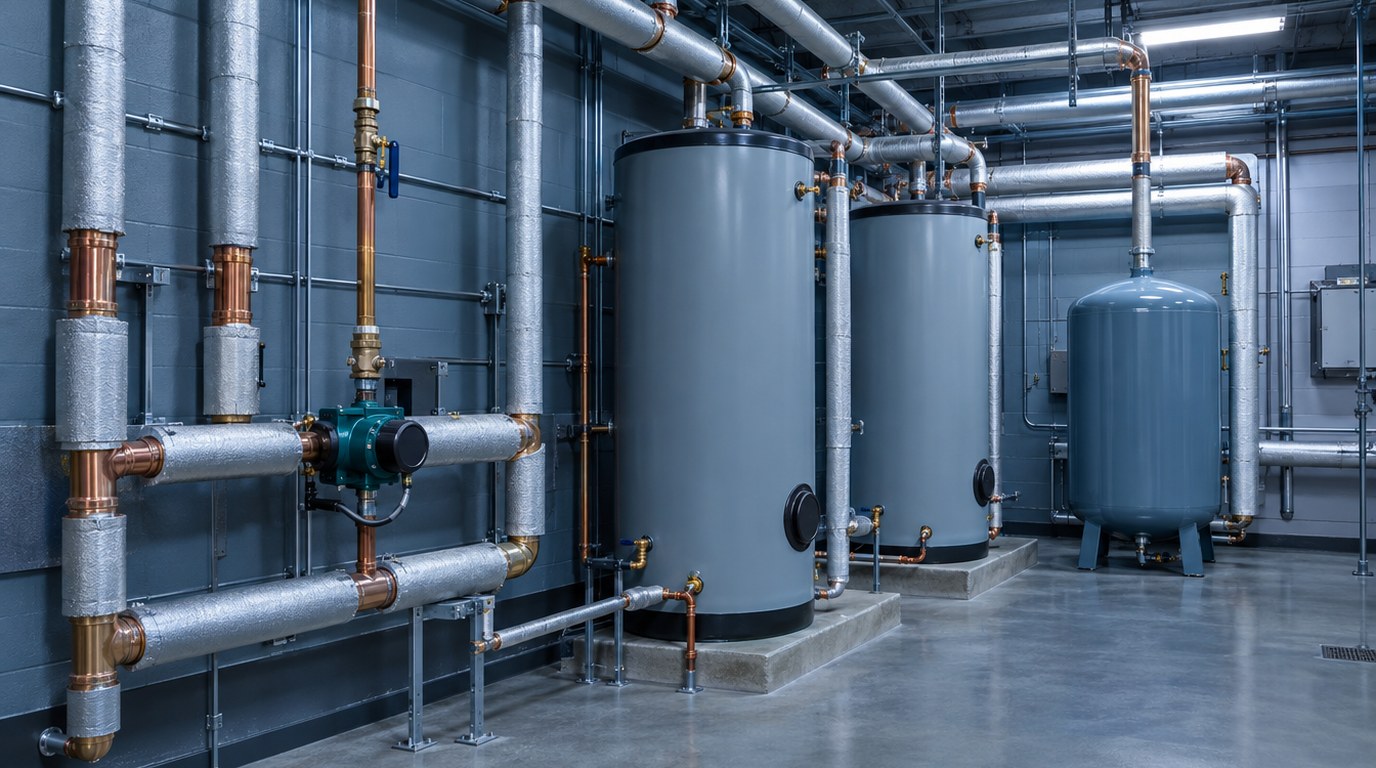
A basic loop includes supply piping, a dedicated return pipe, a circulator pump, check valves, balancing devices, insulation and a control. The loop connects back to the water heater or storage tank through a return connection. Everything else, from expansion tanks to mixing valves, supports those parts.
Think of the loop as a heat distribution system that happens to carry drinking water. It loses heat all along its length, and the pump exists only to replace that heat before the water cools too much.
Also Read: Domestic Hot Water System Design
2. How a Recirculation Loop Works
The heat loss basis for flow
The most common misunderstanding is that the pump must supply the fixtures. It does not. The pump only needs to circulate enough water to replace the heat lost through the piping walls. If the loop loses a given amount of heat, and the owner accepts a temperature drop across the loop, the required flow follows from a standard relationship for water: flow in gallons per minute equals heat loss in Btu per hour divided by 500 times the temperature drop in degrees F.
As an illustration only, a loop that loses 20,000 Btu per hour and is allowed a 10 degree F drop needs about 4 gallons per minute. If the allowed drop is cut to 5 degrees, the flow doubles. This is why a modest change in the temperature target can have a large effect on pump size, pipe size and energy use.
Pressure and head
Once flow is known, the pump head equals the friction loss through the longest circuit plus losses in the heater, valves and fittings. Because recirculation flows are small, the head is usually modest. Oversized pumps are common, and they cause trouble through noise, high velocity and premature erosion of copper tube, which is typically limited to velocities near 5 feet per second in hot service.
Why balance matters
Flow in a loop follows the path of least resistance. Short branches pull most of the flow, while far branches receive little. Balancing valves add controlled resistance to the easy paths so that each branch receives its share. In a thermostatic balancing valve, a wax element opens and closes in response to local water temperature, which allows the valve to adapt without a technician on site.
The role of check valves and expansion
Check valves keep the pump from short circuiting the loop and prevent cold water from backing into the return. Heated water also expands, so the system needs an expansion tank or a thermal expansion device where a backflow device or check valve closes the system. Skipping this step is a classic cause of relief valve weeping.
| Design input | What it controls | Typical consequence if wrong |
|---|---|---|
| Piping heat loss | Required loop flow | Undersized pump and cold remote branches |
| Allowed temperature drop | Flow rate and pipe sizes | Excess pumping energy or poor temperature maintenance |
| Longest circuit friction | Pump head | Noise, erosion and a pump that runs off its curve |
| Balancing devices | Flow split between branches | Hot spots near the pump and warm stagnant zones elsewhere |
| Insulation quality | Heat loss and energy use | Higher flow needs and wasted gas or electricity |
3. Loop Types and Variants
There is no single best loop. The right choice depends on building height, fixture density, budget and the maintenance team’s skills.
Dedicated return loop
The traditional approach runs a full return pipe back to the heater. It gives the most reliable temperatures and is the usual choice for hotels, hospitals and large offices. The cost is the extra piping, insulation and the return risers that must be coordinated in the shafts.
Crossover or retrofit loop
In some existing buildings a pump at the farthest fixture pushes hot water into the cold line, using it as a return path. This is cheap but it warms the cold water system, which can raise cold water temperatures into a range that supports bacterial growth. We consider it a last resort and avoid it in new work.
Electric heat trace
Self-regulating heat trace cable replaces the return pipe by keeping the supply pipe warm. It suits small buildings, long single runs and retrofit spaces where a return pipe will not fit. It uses electricity continuously, so energy studies must account for that load, which may conflict with efficiency goals.
Branch recirculation and demand loops
Large buildings often split the system into zones, each with its own pump and branch controls. Demand-initiated systems circulate only when a user presses a button or a sensor detects use. They save energy but allow longer periods of cooler water, so they are generally used where health risk is low and a standing temperature is not required.
| Loop type | Best fit | Main advantage | Main limitation |
|---|---|---|---|
| Dedicated return | Hotels, hospitals, offices | Stable temperatures at every riser | More piping and shaft space |
| Crossover | Existing homes and small retrofits | Lowest first cost | Warms the cold water line |
| Heat trace | Long single runs, retrofit | No return pipe needed | Continuous electric load |
| Demand-initiated | Low-risk, low-use zones | Saves pump and heat energy | Slower response and cooler standing water |
| Zoned loops | Towers and campuses | Shorter loops and easier balancing | More pumps and controls to maintain |
4. Codes, Standards and Legionella Guidance
The loop sits at the intersection of plumbing, energy and public health rules.
Energy code
California energy requirements, set by the California Energy Commission, apply to recirculation piping insulation and pump controls. The adopted edition of Title 24, Part 6 requires insulation on hot water piping and certain controls for recirculating systems. Our Title 24 compliance guide and explanation of what Title 24 is cover the context. Read the adopted edition for the exact thickness and control wording, because both have changed over time.
Plumbing code
The California Plumbing Code governs materials, thermal expansion protection, valves and the maximum delivery temperature at certain fixtures. Public lavatories commonly need a temperature limiting device so that users are not exposed to scalding water, and tempering valves usually follow recognized standards for scald protection. Hot water at 140 degrees F can cause serious burns within seconds, so mixing and limiting devices belong at the point of use as well as at the heater.
Legionella management
Legionella bacteria multiply in warm, stagnant water. The Centers for Disease Control and Prevention describes Legionella control through water management programs, and ASHRAE Standard 188 and Guideline 12 provide the framework used by many owners. The standard does not mandate one temperature. It requires a program that identifies hazards, sets control limits and verifies them. Commonly cited strategies keep stored water hot, maintain distribution temperatures above the range where Legionella thrives and avoid dead legs. For a regulatory view of workplace exposure, see the technical information at OSHA.
Federal energy research
The U.S. Department of Energy and its laboratories publish performance data on water heating and distribution losses. The National Renewable Energy Laboratory has also studied water heating in buildings, which is useful when you evaluate controls and heat pump systems.
5. Applications by Building Type
Hotels and resorts
Guests expect hot water at once, and rooms stack vertically, which suits risers with branch returns. Occupancy varies by season, so controls that adapt to demand matter. See our hospitality work, the hospitality MEP design article and the Hotel Casa del Mar project.
Hospitals and clinics
Healthcare patients are more susceptible to waterborne infection, so loops have tighter temperature controls, more monitoring and documented water management. Thermal disinfection and flushing plans are common. Our health facilities experience, the healthcare MEP design article and the Sharp Memorial Hospital project illustrate the context.
Multifamily and senior living
Apartment buildings and senior communities have many small draws spread across floors. Central loops with zoned returns are the norm, and residents notice any delay. Senior residents are also more vulnerable to scalding and to waterborne illness, so point-of-use protection and monitoring both matter. Review our multifamily and assisted living pages, and the Belmont Village project.
Offices, schools and laboratories
Offices and schools draw hot water mostly at restrooms and breakrooms, where use is light and intermittent. Demand controls and localized electric heaters sometimes beat a long loop. Laboratories have specialized needs for emergency fixtures and process water, which we discuss in our laboratory plumbing system design guide.
Is your hot water loop working?
If occupants wait too long or return temperatures drift, our engineers can survey the system and recommend balancing or redesign steps.
6. Design Process and Deliverables
Step 1: Define goals and constraints
We start with the building use, occupant profile, temperature targets and the owner’s Legionella or infection control program. We also confirm energy compliance paths and whether the project is pursuing electrification or net-zero targets.
Step 2: Lay out the loop
We arrange risers and branches so the longest circuit is as short as practical and so that every fixture group is close to the loop. Dead legs beyond the loop should be kept short, since the stagnant volume in a branch is both a wait-time problem and a health concern. Early coordination with structure and the architect keeps shafts in the right places, as discussed in our piece on early MEP coordination.
Step 3: Calculate heat loss and flow
Heat loss is calculated for each segment from pipe size, insulation thickness, ambient temperature and length. The totals set branch and main flows. We then size pipes for acceptable velocity and select the pump from the system curve.
Step 4: Select balancing and controls
We specify balancing devices at every branch return, along with isolation valves, air vents and thermometers or sensors where logs are needed. The control strategy is defined in a written sequence of operations that lists setpoints, schedules and alarms.
Step 5: Document
The construction documents include riser diagrams, pump and valve schedules, insulation details and the sequence of operations. A good riser is easy to read, which is why we point clients to our article on preparing a plumbing riser diagram. Our plumbing engineering services page lists the typical drawing set.
Also Read: How to Read and Prepare a Plumbing Riser Diagram
Also Read: Commercial Plumbing Design Mistakes
7. Special Cases: Heat Pumps, High Rises and Healthcare
Heat pump water heaters
California policy is moving toward electrified water heating, and our article on the impact of electrification on MEP engineering explains the trend. Heat pump water heaters perform best when the water they heat is cool. A recirculation return at 120 degrees F entering the primary tank can reduce capacity and efficiency. Many designs use a separate temperature maintenance tank, sometimes with electric resistance elements, so that loop losses are covered without disturbing the heat pumps. Laboratory data from Lawrence Berkeley National Laboratory and others informs these layouts. Review how this ties into net-zero building MEP design.
High-rise zoning
Tall buildings divide into pressure zones, each served by its own heater or by pressure reducing valves. Each zone needs its own loop and balancing scheme, otherwise gravity and pressure differences cause flow imbalance. Zone return temperatures should be logged separately.
Thermal disinfection
Some healthcare and hospitality owners raise loop temperatures periodically to disinfect the system. This requires mixing valves rated for the higher temperature, warning signage and a procedure that protects occupants. We design the loop so it can handle this safely.
Low-use and seasonal areas
Pool bathhouses, stadium concourses and event spaces sit idle for long stretches. Water stagnates in these areas, which raises risk. We combine isolation, flushing schedules and automatic flush valves to prevent stagnation.
8. Choosing Controls and Understanding Cost Drivers
Control options
The simplest control is a continuous pump with an aquastat that cycles the pump based on return temperature. A time clock adds scheduled setbacks. Demand control starts the pump on a signal. Building automation integration allows trending, alarms and remote adjustment, and ties into the wider technology stack discussed in our smart building technologies article and the technology services page.
| Control strategy | Energy impact | Health consideration | Typical use |
|---|---|---|---|
| Continuous pump | Highest pump and heat loss energy | Most stable temperatures | Hospitals and high-risk buildings |
| Aquastat on return | Moderate savings | Holds a minimum return temperature | Hotels and multifamily |
| Time clock | Savings at night and weekends | Needs approval in a water management plan | Offices and schools |
| Demand control | Lowest energy | Cooler standing water between uses | Low-use, low-risk zones |
| BAS trending and alarms | Enables optimization | Provides temperature records | Large and managed facilities |
Cost drivers
First cost depends on the number of return risers, the insulation grade, the number of balancing devices and the controls. Operating cost depends on heat loss, pump runtime and heater efficiency. Many owners find that spending more on insulation and balancing pays back through lower energy and fewer complaints. Our article on energy-efficient MEP design and operating costs shows how to weigh these choices.
Material choices
Copper remains common but is sensitive to velocity and water chemistry. Stainless steel resists erosion, and some plastic systems are approved for hot water service. Each has different insulation and expansion needs, so the choice should reflect water quality, budget and the owner’s maintenance preferences.
9. Best Practices, Testing and Key Takeaways
Best practices
- Insulate all hot and return piping to the adopted code level, including valves and fittings where practical.
- Keep dead legs short and remove them whenever fixtures are demolished.
- Install balancing devices at every branch return and record their settings.
- Place temperature sensors or thermometers where operators can read them.
- Write the sequence of operations before the controls are purchased.
- Provide isolation and drain points so maintenance does not shut down the whole building.
Common mistakes
The mistakes we see most often are oversized pumps, unbalanced loops, missing insulation, return piping tied into the wrong point on the tank, and controls that are specified but never programmed. Our article on commercial plumbing design mistakes lists more.
Testing and commissioning
Before occupancy, the loop should be flushed, disinfected and pressure tested. Technicians verify pump rotation and flow, set balancing valves and record return temperatures at every branch. Sequences are tested with simulated signals. Independent verification is covered by our commissioning services, and the process is outlined in the building commissioning process article. For existing buildings, see commissioning versus retro-commissioning.
Maintenance
Operators should log return temperatures regularly, inspect pumps and check strainers and check valves. Seasonal changes in cold water temperature can shift balance, so re-verify settings when temperatures swing.
- Size the pump from heat loss and temperature drop, not from fixture demand.
- Balance every branch and record the settings at turnover.
- Keep return temperatures high enough to support the water management plan.
- Insulation and controls decide the energy result.
- Plan heat pump integration early so loop losses do not undercut efficiency.
- Commission the loop and keep temperature logs for the life of the building.
10. Where Budlong Delivers This
Budlong designs building water systems across Southern and Northern California from offices in Glendale, downtown Los Angeles, Camarillo and Fremont. Local knowledge of inspectors, utility programs and climate conditions helps loops perform as intended.
11. Related Reading
12. Frequently Asked Questions
What does a hot water recirculation system do?
A recirculation system moves hot water continuously or on demand through a loop of piping so that hot water is available close to every fixture. It reduces the wait for hot water, saves the water that would be wasted while waiting and helps keep distribution temperatures from falling into a range that supports bacterial growth.
What temperature should the return line stay at?
Many designers aim for a return temperature that stays at or above about 120 degrees F at the end of the loop, with a design temperature drop of roughly 5 to 10 degrees F across the loop. The right target depends on the water management plan, the building type and the code that applies to the project.
How do you size a recirculation pump?
Start with the heat loss of the supply and return piping, then divide it by 500 times the allowed temperature drop to find the flow in gallons per minute. Add the pressure drop through the longest circuit, valves and heater, and select a pump that delivers that flow at that head.
Why do balancing valves matter?
Without balancing, hot water takes the path of least resistance and short loops get too much flow while remote branches get almost none. Balancing valves, either manual or thermostatic, distribute flow so every branch holds its target temperature and no branch drifts into a warm and stagnant range.
Does recirculation increase Legionella risk?
A properly designed and balanced loop usually lowers risk because it keeps water moving and hot. A poorly balanced loop can do the opposite by leaving dead legs and warm zones. A written water management plan, aligned with ASHRAE Standard 188, is the accepted way to manage the risk.
Is a continuous pump or a controlled pump better?
Continuous operation gives the most stable temperatures but wastes the most energy. Timer, temperature and demand controls cut heat loss and pump energy, but they must still respect any minimum temperature or flushing requirement for health reasons. Most commercial projects use a mix based on the building use.
How do heat pump water heaters change the design?
Heat pump systems work best with cool inlet water, and warm return water can reduce their efficiency. Designers often use a separate temperature maintenance tank or a carefully arranged return connection so that the loop is kept hot without forcing the primary heat pumps to reheat already warm water.
What testing is done before occupancy?
Typical checks include flushing and disinfection, pressure testing, verifying pump rotation and flow, setting balancing valves, logging return temperatures at each branch and confirming controls sequences. Commissioning agents document the results so the owner has a baseline for later maintenance.
When should a recirculation system be redesigned?
Consider a review when occupants complain about slow hot water, when return temperatures fall below target, when pump or heater energy rises, after a water treatment or Legionella finding, or when the building adds or changes fixtures. A temperature survey usually reveals where balancing or piping changes are needed.