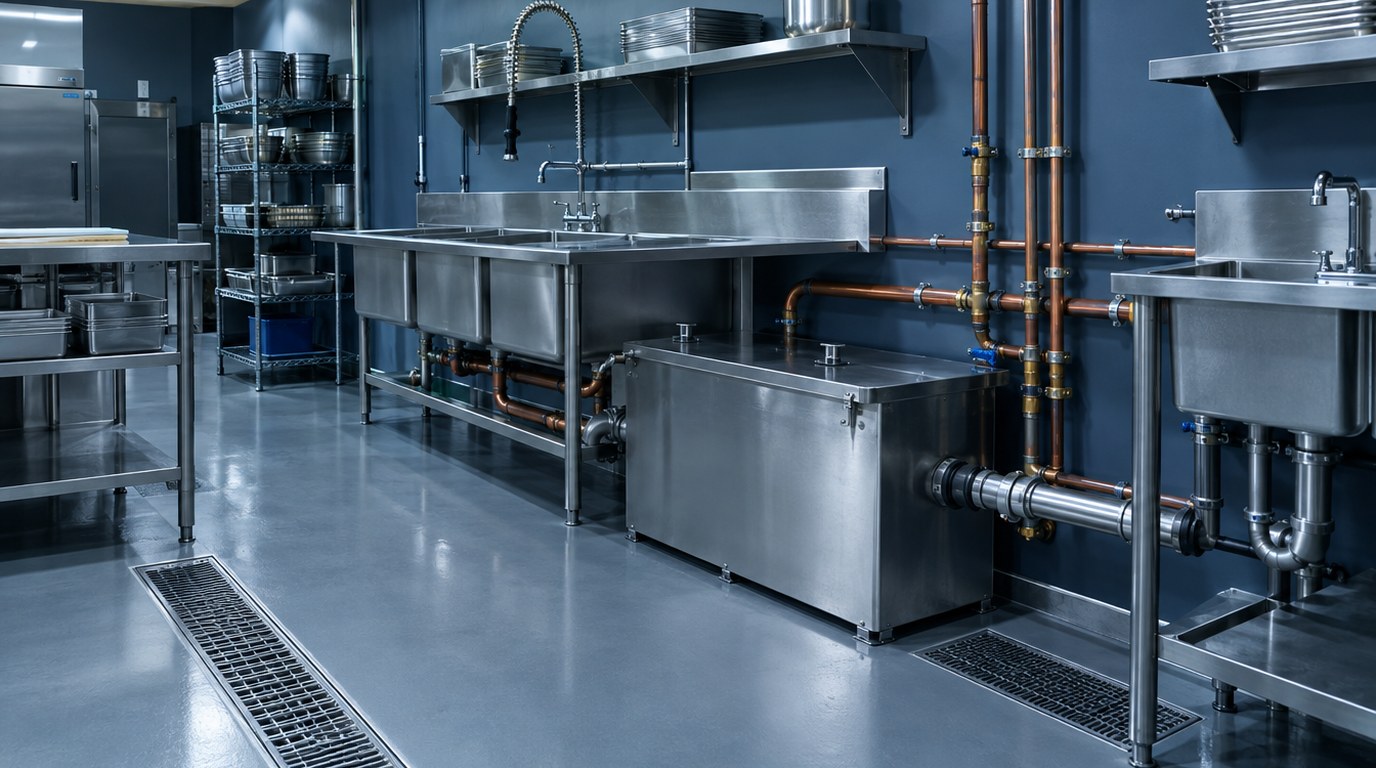
- Kitchen drainage is built around indirect waste, floor sinks and a grease interceptor.
- Hydromechanical units suit smaller kitchens. Gravity tanks handle larger or shared loads.
- Sizing methods use fixture volumes, peak meals, retention time and operating hours.
- Local sanitation agency rules often override the model plumbing code.
- Hot water demand, gas piping and backflow protection shape the rest of the design.
- Scheduled pumping and records keep the system compliant and the sewer clear.
- What Is Commercial Kitchen Plumbing?
- How the Drainage and Separation Process Works
- Types of Grease Interceptors
- Codes, Standards and Agency Rules
- Kitchen Plumbing by Building Type
- Design Process and Deliverables
- Special Cases and Constraints
- Sizing Methods, Specifications and Cost Drivers
- Best Practices, Mistakes and Maintenance
- Where Budlong Delivers This
- Related Reading
- Frequently Asked Questions
A restaurant can survive a mediocre menu. It cannot survive a backed-up floor drain on a Saturday night. Commercial kitchen plumbing has to move large volumes of hot, greasy water out of the building, supply high-temperature water to sanitizing equipment, and feed gas to the cooking line, all without cross contamination. This article covers how those systems are designed and how grease interceptors are sized. The work sits within Budlong’s plumbing design services and its wider MEP services.
If you are an owner, operator, architect or developer planning a new restaurant, hotel kitchen, school cafeteria or food hall, the sections below explain what the engineer needs from you and what to expect in return. Budlong has served hospitality and food service clients since 1958, as described in our story.
1. What Is Commercial Kitchen Plumbing?
Commercial kitchen plumbing is the combined system of water supply, drainage, venting, gas piping and wastewater pretreatment that serves cooking, dishwashing and food preparation areas. It differs from ordinary building plumbing in three ways. Flows are far larger, wastewater is hot and loaded with fats, and health codes demand strict separation between sewage and food contact surfaces.
Why grease is the central problem
Fats, oils and grease, commonly shortened to FOG, leave the kitchen as a warm liquid. Once the water cools in the building drain or the street sewer, the grease solidifies and clings to pipe walls, shrinking the opening until flow stops. The U.S. Environmental Protection Agency identifies grease as a leading contributor to sanitary sewer blockages and overflows, which is why municipalities regulate food service connections.
What the plumbing engineer actually designs
- Fixture connections and indirect waste arrangements for sinks, dishwashers and equipment.
- Floor drains, floor sinks, trench drains and slab depressions.
- The grease waste line, interceptor location and sampling or inspection access.
- Domestic cold and hot water, including booster heating for sanitizing.
- Backflow prevention at beverage, steam and chemical dispensing equipment.
- Gas piping, shutoff valves and connections for cooking equipment.
Many kitchen plumbing problems are really coordination problems. The kitchen equipment schedule, the architectural floor plan and the plumbing drawings must show the same equipment, the same drain locations and the same slab elevations before bidding starts.
Also Read: Commercial Plumbing Design Mistakes
2. How the Drainage and Separation Process Works
The path of kitchen wastewater
Fixtures such as pot sinks, prep sinks and pre-rinse stations discharge through an air gap into a nearby floor sink, rather than connecting directly to the drain. The floor sinks collect into a dedicated grease waste line. That line runs to the interceptor, and the interceptor discharges to the building sewer. Sanitary waste from restrooms travels on a separate path and joins the building sewer downstream of the interceptor.
How an interceptor separates grease
An interceptor works on a simple principle. Wastewater enters, velocity drops, and the lighter grease rises while heavier solids settle. Baffles and a controlled outlet keep floating grease from escaping. Longer retention time gives better separation, which is why large gravity tanks hold wastewater for minutes while small point-of-use devices rely on engineered flow control and internal baffles.
Why indirect waste is not optional
The air gap at each fixture prevents sewage from backing up into equipment that touches food. It also isolates the fixture from drain blockages. Dishwashers, ice machines, steam tables and food preparation sinks all rely on this protection, and plan reviewers look for it on the drawings.
Hot water has its own layer of design. Dishwashers need booster heaters, and sinks need tempered or mixed supply. The principles are covered in domestic hot water system design, and the same indirect-drain thinking appears in HVAC condensate drain design.
3. Types of Grease Interceptors
Comparing the main options
| Type | Typical location | Strengths | Limits |
|---|---|---|---|
| Hydromechanical unit | Inside, near the fixtures it serves | Compact, lower cost, easy to retrofit | Frequent cleaning, limited capacity, flow rated in gpm |
| Gravity grease interceptor | Underground, outside the building | Large retention volume, less frequent pumping | Needs space, excavation, access lids and sometimes traffic loading |
| Automatic grease recovery unit | Inside the kitchen or back of house | Removes grease on a timer, less manual cleaning | Needs power, maintenance and storage for recovered grease |
| Solids interceptor | At dishwashing and disposer lines | Protects the interceptor from food solids | Does not remove dissolved grease, so it supplements rather than replaces |
Hydromechanical interceptors
These are factory-built units certified to recognized standards, including ASME A112.14.3 and the IAPMO and ANSI Z1001 standard, and rated in gallons per minute and pounds of grease retention. They are used when flows are modest and space is tight. In multistory buildings they can also be installed at upper floors where a gravity tank would be impractical.
Gravity interceptors
Gravity interceptors are underground concrete or fiberglass tanks with an inlet baffle, one or more chambers and an outlet tee. They hold hundreds to thousands of gallons and favor large kitchens, hotels and shared food courts. Owners should plan for traffic-rated covers, manways and a safe route for pump trucks.
Hybrid and supporting devices
Large facilities may combine a solids interceptor, an automatic recovery unit and a gravity tank. Choosing among these is a systems decision involving operating hours, staffing and sewer agency rules. The broader role of the discipline is outlined in the plumbing engineer’s role in MEP systems.
4. Codes, Standards and Agency Rules
Several layers of rules apply at once, and the strictest one wins.
Plumbing code
California adopts the California Plumbing Code, published through the California Building Standards Code and based on a model code from the International Code Council family of publishers. Its provisions on traps, interceptors and indirect waste set the baseline for fixtures, venting, backflow protection and materials. Confirm the adopted edition and local amendments for each project.
Local sanitation agency
City and county sanitation departments run FOG control programs. They often require an interceptor for any new food service establishment, set minimum sizes, require cleaning logs and may restrict hydromechanical units. These local rules can be stricter than the plumbing code, so engineers contact the agency during schematic design.
Health and kitchen safety
County environmental health departments review food facilities under the California Retail Food Code, including handwashing sinks, warewashing, hot water and drainage. Kitchen exhaust hoods and their fire suppression follow NFPA 96 from the National Fire Protection Association, which also drives the gas shutoff arrangement for cooking equipment. Wet floors create slip hazards, and the Occupational Safety and Health Administration publishes expectations for walking and working surfaces that influence floor drain placement and slab slope.
Water efficiency
Kitchens use a great deal of water. California green building rules, covered in the CALGreen MEP guide, set fixture efficiency expectations, and design teams can reduce load through efficient pre-rinse spray valves, combi ovens and conveyor dishwashers. Read more in MEP plumbing services for water conservation. The U.S. Department of Energy also publishes guidance on efficient water heating and commercial kitchen equipment.
5. Kitchen Plumbing by Building Type
Restaurants and bakeries
Independent restaurants and bakeries usually fit a hydromechanical unit under or near the dishwashing station when space allows, and a gravity tank when the local agency requires it. Budlong’s portfolio includes food and beverage work such as Dominique Ansel Bakery at The Grove and Los Agaves Restaurant, which show how compact kitchens are coordinated with existing buildings.
Hotels and resorts
Hotels combine banquet kitchens, room service, restaurants and laundry. They have high peak flows, long operating hours and often a central interceptor serving several outlets. Learn more in MEP design services for hospitality and hospitality MEP design.
Schools, campuses and corporate dining
Cafeterias see a concentrated lunch peak, so interceptors are sized around peak meals per hour. The education sector also faces public agency review. Large employers run commissaries like the one at DreamWorks, where throughput and sanitation come first.
Senior living and healthcare
Care communities serve three meals a day with hot holding and tray service, and hospitals add patient trays and retail dining. The kitchens are often tied into central plants and generators, so reliability matters as much as capacity. See how assisted living kitchens differ from restaurant kitchens.
Also Read: Best Practices for MEP Plumbing in Large-Scale Developments
Opening a new kitchen?
Send us your equipment schedule and floor plan and our plumbing engineers will size the interceptor, hot water and gas piping to the adopted code.
6. Design Process and Deliverables
Start with the equipment schedule
Plumbing for a kitchen is driven by equipment. The kitchen consultant or operator provides a schedule listing each fixture and appliance, its water, drain and gas requirements and its dimensions. Without this schedule, the engineer is guessing, and mistakes appear as change orders.
Step by step
- Confirm the rules: meet the sanitation agency and review the local FOG requirements.
- Collect fixture data: note fixture volumes, drain sizes, flow rates and operating hours.
- Size and select: calculate the interceptor, hot water demand, drain and gas sizes.
- Place and route: locate the interceptor, floor sinks, trenches and depressions with the architect and structural engineer.
- Document: prepare plans, riser diagrams, schedules, details and specifications.
- Support construction: review submittals, inspect rough-in and witness testing.
Coordination points
Slab depressions and sloped floors need structural and waterproofing input. Drain lines compete with ceiling space below, particularly when a kitchen sits above another tenant. Early coordination, supported by BIM clash detection, prevents rework. Kitchen ventilation design, which shares ceiling and wall space with drainage, is addressed by ASHRAE standards.
7. Special Cases and Constraints
Tenant improvements with no yard space
Many restaurants occupy leased shells in dense neighborhoods where a gravity tank has nowhere to go. Options include an interior hydromechanical unit with a strict cleaning schedule, an automatic recovery unit, a shared interceptor serving multiple tenants, or a below-slab tank. Each option has maintenance and agency approval consequences, so confirm before lease signing when possible.
Upper floors and mixed-use buildings
When a kitchen sits above retail or apartments, a leaking drain damages other tenants. Waterproofing, drain pans, protected slab penetrations and clear access for cleaning matter more than usual. Projects like Hyatt Regency Century Plaza demonstrate how kitchens in a large hotel integrate with a vertical building.
The most expensive kitchen plumbing change is moving a drain after the slab is poured. Freeze the equipment layout, confirm every floor sink location and verify slab depressions before concrete day.
Fire safety and gas
Cooking equipment ties into hood suppression systems, and the gas supply must shut off on activation. Plumbing and fire protection engineers share this scope, as discussed in fire safety engineering. In California, flexible gas connectors on movable equipment use restraints, and seismic shutoff valves may be required by local rules.
Reuse and efficiency
Heat recovery from dishwasher exhaust or condenser water can cut energy use, and some projects look at on-site water reuse for non-food purposes. See stormwater and greywater reuse system design and energy efficient MEP design for broader strategies. Note that kitchen wastewater containing grease is not suitable for greywater reuse without extensive treatment.
8. Sizing Methods, Specifications and Cost Drivers
Sizing is where owners most often ask for a number. The correct number depends on the adopted code, the local agency and the equipment, so the examples below show the method rather than a universal answer.
Sizing a hydromechanical interceptor
The common method sizes the unit from the flow into it. For each fixture, the engineer computes the volume from its inside dimensions in cubic inches, divides by 231 to get gallons, applies about 75 percent as the working fill, and divides by the drainage period, often one minute. A compartment measuring 24 by 24 by 14 inches holds about 35 gallons, 75 percent is about 26 gallons, and a one minute drain period gives about 26 gallons per minute. The engineer adds the flows that discharge together, and selects a certified unit whose rated flow meets or exceeds the total.
Sizing a gravity interceptor
Model code appendices use a volume method. Multiply peak meals per hour by waste flow per meal, a retention time and a storage factor linked to operating hours. As an illustration with factors commonly used for a kitchen with a dishwasher, 120 peak meals at 6 gallons per meal, 2.5 hours of retention and a storage factor of 2 for a 16-hour day yields 3,600 gallons. Many agencies set a minimum or require their own method, so the agency result governs.
| Sizing input | Where it comes from | Effect on size |
|---|---|---|
| Fixture volume and drain period | Equipment schedule and cut sheets | Drives flow rating for a hydromechanical unit |
| Meals in the peak hour | Operator seat count and turnover | Scales gravity tank volume directly |
| Dishwasher or disposer present | Equipment list | Raises waste flow and retention requirements |
| Operating hours | Business plan | Longer hours raise the storage factor |
| Agency minimum | Local sanitation rules | May override the calculated result |
What the specification should state
- Interceptor type, certification standard, rated flow and grease capacity.
- Materials for hot discharge lines suited to dishwasher temperatures.
- Access, venting, sampling provisions and cover loading ratings.
- Backflow devices for carbonators, coffee brewers and chemical feeds.
- Testing requirements for drainage, water and gas piping before concealment.
Cost drivers
- Interceptor type and size, with underground tanks adding excavation, shoring and dewatering.
- Slab work, such as trenches, depressions and waterproofing.
- Booster heaters and recirculation, which add equipment and electrical load.
- Pipe materials selected for temperature and corrosion resistance.
- Agency fees, permits and required cleaning contracts during operation.
For budgeting methods across disciplines, see how to estimate MEP engineering costs.
9. Best Practices, Mistakes and Maintenance
Practices that work
- Meet the sanitation agency before the drawings are far along.
- Place interceptors where trucks and technicians can reach them without crossing the dining room.
- Vent the interceptor and provide cleanouts at changes in direction.
- Keep sanitary waste separate from kitchen waste.
- Label each valve, shutoff and floor sink so staff understand what each serves.
Common mistakes
- Undersized interceptors based on an early, incomplete equipment list.
- Food waste disposers connected to a small hydromechanical unit.
- Floor sinks that are inaccessible because equipment was moved after rough-in.
- Missing backflow protection at beverage dispensers.
- Hot water lines too small for simultaneous dishwasher and sink use.
Also Read: Hospitality MEP Design and Smart Engineering
Maintenance that keeps the system compliant
Interceptors only work when they are emptied. A common rule among sanitation agencies is to clean the unit whenever floating grease and settled solids reach about 25 percent of the liquid depth, plus a fixed service interval. Operators should keep a log, keep pumping manifests, and avoid pouring grease down drains. Commissioning the kitchen systems before opening helps catch missing cleanouts and unbalanced hot water, as explained in commissioning services.
- Design kitchen drainage around indirect waste, floor sinks and a properly sized interceptor.
- Use fixture-flow sizing for hydromechanical units and volume methods for gravity tanks.
- Check local sanitation agency rules early, because they often control.
- Plan hot water, gas and backflow protection with the same care as drainage.
- Maintain the interceptor on schedule and keep records.
10. Where Budlong Delivers This
Restaurants and food operators want engineers who know local plan review and sewer agency practices. Budlong works from Glendale, Downtown Los Angeles, Camarillo and Fremont and serves Los Angeles, Ventura, Orange, San Bernardino, Riverside and Santa Barbara counties.
11. Related Reading
12. Frequently Asked Questions
What is a grease interceptor and why is it required?
A grease interceptor is a tank or device that slows kitchen wastewater so fats, oils and grease float to the top and solids settle out before the water continues to the sewer. It is required because grease that reaches the public sewer cools, hardens and blocks pipes, which can cause overflows.
How is a hydromechanical grease interceptor sized?
The designer calculates the volume of each connected fixture, takes about 75 percent of that volume, and divides it by the drainage period, usually one minute. The result is the flow in gallons per minute. A listed unit is then selected with a flow rating that meets or exceeds the calculated flow.
When is a gravity grease interceptor needed instead?
A gravity interceptor is used when kitchen flows or grease loads are too large for a hydromechanical unit, when the local agency requires it, or when a shared system serves several tenants. These are larger underground tanks with baffles and long retention times.
How is a gravity grease interceptor sized?
Model code methods multiply meals served during the peak hour by the waste flow per meal, a retention time and a storage factor tied to operating hours. Local sanitation agencies often set minimum volumes or their own formula, so the agency requirement controls over the model code.
Which fixtures must connect to the grease interceptor?
Pot and pan sinks, prep sinks, pre-rinse stations, dishwashers and floor drains or floor sinks in cooking and cleaning areas normally connect to it. Restroom fixtures and other sanitary waste never connect, because they add solids and flow that defeat separation.
Why do kitchen fixtures use indirect waste connections?
An indirect connection leaves an air gap between the fixture drain and the receiving floor sink, so sewage can never back up into equipment that touches food. It also isolates the fixture from drain stoppages and sewer gas.
How often should a grease interceptor be cleaned?
Many agencies require cleaning whenever fats, oils, grease and settled solids reach about 25 percent of the liquid depth, and also on a fixed schedule. Hydromechanical units may need service every week or two in busy kitchens, while gravity tanks are often pumped every one to three months.
Which code governs commercial kitchen plumbing in California?
The California Plumbing Code governs fixtures, drainage, venting, backflow protection and interceptors, with local sanitation district rules layered on top. County environmental health departments review the food facility under the California Retail Food Code. Always confirm the adopted edition and local amendments.
Can biological additives replace pumping a grease interceptor?
No. Additives and enzymes do not remove grease from the system. They may only move it downstream, where it can solidify in the sewer. Regular pumping and cleaning remain the accepted method, and most agencies prohibit using additives in place of service.