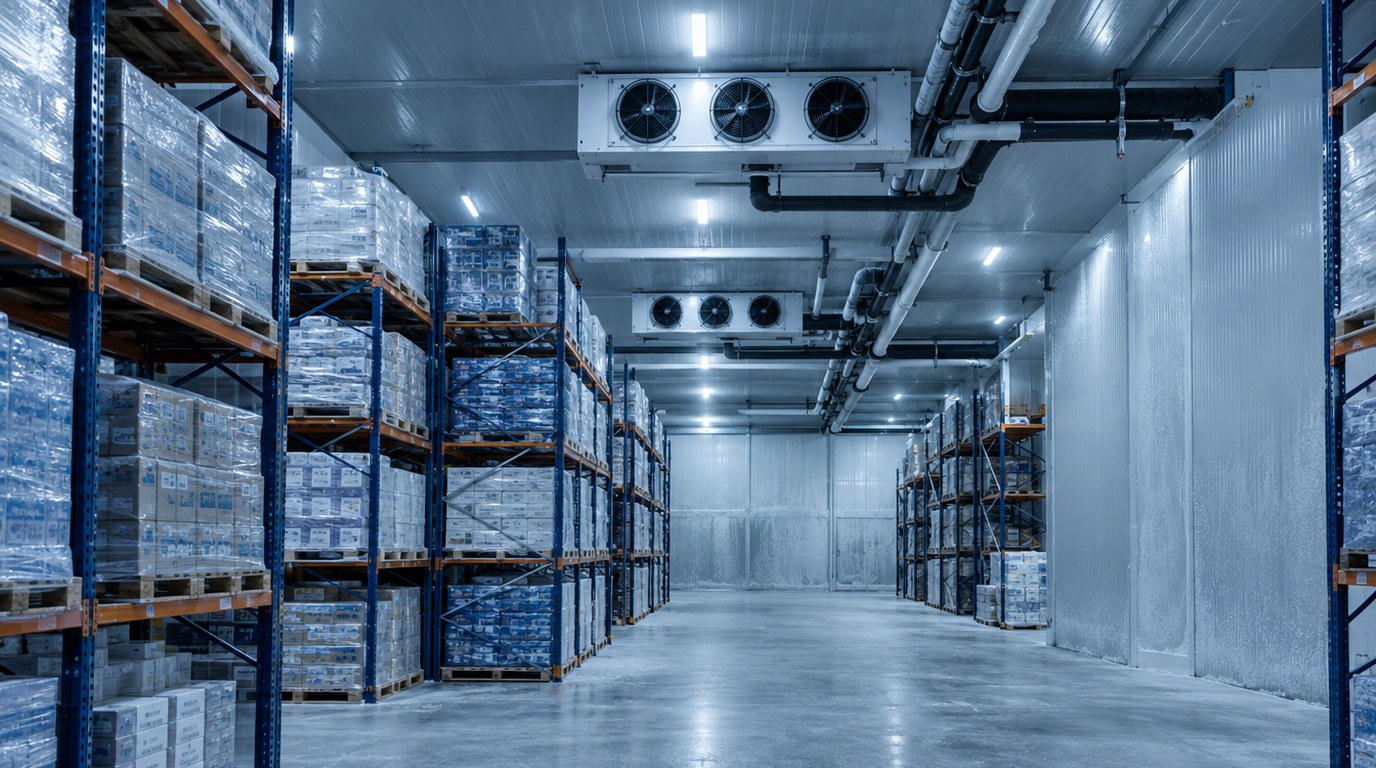
- Cold storage is a thermal machine wrapped in a building, so envelope, refrigeration and electrical design must be solved together.
- Refrigerant selection drives safety rules, machinery room design and long-term regulatory exposure.
- Dock traffic and infiltration can swing loads more than the stored product itself.
- Freezers need underslab heating, vapor control and fire protection suited to sub-freezing space.
- California energy code has dedicated refrigerated warehouse provisions that shape fans, condensers and controls.
- Heat recovery, thermal mass and rooftop solar offer practical paths to lower operating cost.
- What Is Cold Storage MEP Design?
- How a Cold Storage Facility Works
- Refrigeration System Types
- Codes, Standards and Safety Rules
- Applications by Facility Type
- Design Process and Deliverables
- Special Cases and Niche Conditions
- How to Choose a System and What Drives Cost
- Best Practices, Testing and Maintenance
- Where Budlong Delivers This
- Related Reading
- Frequently Asked Questions
Cold storage buildings look simple from the road: a large insulated box with dock doors. Inside, they hold some of the heaviest electrical loads and most demanding refrigeration plants in the commercial world, and a single design decision, such as the refrigerant or the dock layout, can lock in operating cost for decades. Teams planning one benefit from HVAC and mechanical services that understand refrigeration, backed by full-scope MEP engineering services.
This article explains how cold storage is engineered, how refrigerant and equipment choices compare, which rules apply in California, and how to control energy and risk. Our industrial MEP design group works with owners, developers and operators, and you can meet the people behind that work on our leadership page.
1. What Is Cold Storage MEP Design?
Cold storage MEP design covers the refrigeration plant, the building systems that serve it, and the power, water and fire protection that keep it running. The goal is to hold a product at a set temperature, around the clock, at the lowest practical cost and with acceptable risk.
Why It Differs From Standard Warehousing
A conventional warehouse is mostly lighting and ventilation. A cold facility adds large compressors, evaporators, condensers, defrost systems, floor heating, special doors and a controls network that watches product temperature. Electrical demand per square foot is far higher, and plumbing must cope with defrost water that can freeze in the drain line.
Who Needs It
Typical owners include food distributors, grocery chains, produce handlers, pharmaceutical logistics firms and commissary kitchens. Each has different temperature bands, product turnover and compliance duties, so a template from one project rarely transfers cleanly to the next.
2. How a Cold Storage Facility Works
Heat enters through the envelope, the doors, the product, the people and the equipment inside. Evaporators absorb that heat into refrigerant, compressors lift the refrigerant pressure, and condensers reject the heat outdoors. Controls balance all of it against changing conditions.
Load Components
The main loads are transmission through walls, roof and floor, infiltration at doors, product heat on arrival, evaporator fan heat, lighting, forklifts and defrost. Product pull-down is large in a facility that receives warm goods, but small in a pure storage warehouse. Infiltration through dock doors is often the least predictable component, which is why dock design deserves attention equal to the plant.
Air Distribution and Defrost
Evaporators sit overhead and move air through the room, often with ducted or sock distribution to even out temperatures. Coils frost over time, so each one cycles through defrost using hot refrigerant gas, electric elements or water. Defrost adds a heat pulse that the system must remove again, so strategy and scheduling shape the energy bill.
Condensing and Heat Rejection
Most large plants use evaporative condensers, which reject heat efficiently but use water and need treatment. Lower condensing pressure when ambient conditions allow, known as floating head pressure, saves compressor energy and is addressed in California requirements.
Also Read: Electrical Load Calculation for Commercial Buildings
3. Refrigeration System Types
The refrigerant and system architecture are the first big fork in the road. Each option moves risk, cost and efficiency around.
| System | Best Fit | Advantages | Watch For |
|---|---|---|---|
| Central ammonia, pumped liquid | Large distribution and food processing plants | High efficiency, no global warming impact, proven | Toxicity, process safety rules, trained operators |
| Ammonia with CO2 cascade | Owners wanting less ammonia in occupied areas | Ammonia confined to the machinery room, CO2 serves the cold rooms | Higher pressures, added complexity |
| Transcritical CO2 | Mid-size facilities and supermarket back-of-house | Natural refrigerant, good heat recovery | Efficiency drops in hot weather unless ejectors or subcooling are used |
| Low global warming synthetic blends | Smaller rooms and packaged systems | Simpler codes, familiar contractors | Phasedown exposure, leak management |
| Glycol secondary loop | Sites needing limited primary refrigerant charge | Small charge, flexible zoning | Pumping energy, higher temperature difference |
Compressors and Controls
Screw compressors dominate large plants, with reciprocating machines used for lower capacity or high-stage duty. Variable speed drives, suction pressure optimization and good sequencing separate an average plant from an efficient one. Connected systems can also support demand response, discussed in our review of electrification and MEP engineering.
4. Codes, Standards and Safety Rules
Refrigeration safety is set by overlapping documents. ASHRAE 15 covers refrigeration system safety and machinery rooms, and ASHRAE 34 classifies refrigerants, both published through ASHRAE. The IIAR standards address ammonia design, operation and inspection. The California Mechanical Code and Building Code cover machinery rooms, ventilation and egress.
Process Safety for Ammonia
When an ammonia system holds 10,000 pounds or more, federal OSHA process safety management applies, as described on the OSHA process safety management page. The EPA risk management program has a parallel threshold, explained at EPA risk management program resources. In California, the state accidental release program is administered through local agencies.
Refrigerant Regulation
The AIM Act directs a phasedown of high global warming potential hydrofluorocarbons, and EPA rules limit which refrigerants may be used in new equipment. See the U.S. Environmental Protection Agency for current status. Specifying a low global warming potential option now avoids a costly conversion later.
Energy and Fire Codes
California Title 24 Part 6 includes refrigerated warehouse provisions, and the 2025 cycle took effect on 1 January 2026. The California Energy Commission hosts the standards. Our Title 24 compliance checklist shows the typical steps. Fire protection follows NFPA 13 and related documents from the National Fire Protection Association, covered in fire sprinkler system design under NFPA 13.
5. Applications by Facility Type
| Facility | Typical Temperature Bands | Design Emphasis |
|---|---|---|
| Food distribution center | Cooler and freezer zones, tempered dock | Dock infiltration control, racking, high door traffic |
| Food processing and bakery | Blast chilling, freezing, proofing | Washdown plumbing, sanitary finishes, rapid pull-down |
| Pharmaceutical cold chain | Refrigerated, frozen and ultra-low rooms | Tight tolerances, redundancy, monitoring and alarms |
| Commissary and restaurant back-of-house | Walk-in coolers and freezers | Compact plants, condensate routing, hood and kitchen coordination |
| Produce and ripening | Precise cooler setpoints, humidity control | Air distribution, ethylene and humidity management |
Related Work in Our Portfolio
Our work with food service, production and loading environments includes DreamWorks commissary food services, La Brea Bakery at Downtown Disney and the Pharmavite loading dock air conditioning project. These are not full-scale warehouses, but they show the same attention to temperature, moisture and operations.
Evaluating a Cold Storage Site or Retrofit?
Our engineers can review utility capacity, refrigerant options and dock layouts before you commit to a building design.
6. Design Process and Deliverables
Site and Utility Review
Start with power, water and gas availability. A plant of any size may need a dedicated utility service and a new transformer, and lead times can exceed the building schedule. Early commercial electrical services input prevents surprises.
Load Calculation and Refrigeration Basis
The refrigeration engineer builds an hourly load profile covering product, transmission, infiltration and equipment, then selects the plant architecture. A basis of design records temperatures, humidity, turnover, redundancy and refrigerant, so everyone designs to the same assumptions.
Building Systems Design
Mechanical design includes machinery room ventilation, dock tempering and any conditioned support spaces. Plumbing design covers floor drains, defrost drains, washdown and trap protection from freezing, with attention to HVAC condensate drain design principles. Electrical design handles motor controls, variable speed drives, lighting and emergency power.
Coordination
Racking, structure, panels and piping compete for the same airspace. A coordinated model reduces conflicts, a point supported by our guidance on early MEP coordination.
7. Special Cases and Niche Conditions
Frost Heave and Underslab Systems
Below a freezer, soil can freeze and push the slab upward. Designers protect against this with a heated underslab system using warm glycol, electric cable or ventilated ducts. Waste heat from the compressors can often supply the glycol loop.
Blast Freezing and Ultra-Low Temperatures
Blast freezers need very high airflow and low suction pressure, and some pharmaceutical rooms must hold temperature far below standard freezers. Redundant refrigeration, backup power and continuous monitoring are normal expectations, and cascade systems often serve the lowest temperatures.
Retrofit and Refrigerant Conversion
Owners with aging synthetic refrigerant plants face rising service costs. A retrofit may swap compressors, add CO2 for the low temperature side, or convert evaporators. Existing structure, panel condition and electrical capacity all limit what is practical, so an assessment should come first.
Resilience
Stored product is valuable, and outages are costly. Plan generator capacity for the refrigeration load, a controlled shutdown sequence, and thermal mass strategies that let the building coast through short interruptions. Our article on resilient MEP systems for climate adaptation expands on the approach.
Also Read: Arc Flash Analysis and NFPA 70E Compliance
8. How to Choose a System and What Drives Cost
Selection should weigh capital cost, energy, safety, staffing and regulatory trends across the building life, not just the bid price.
| Cost Driver | Why It Matters | Ways to Control It |
|---|---|---|
| Refrigerant and plant type | Sets equipment, piping, safety and staffing cost | Compare lifecycle cost, not first cost only |
| Envelope quality | Panel thickness and sealing set transmission load | Invest in tight joints and thermal breaks |
| Dock design | Infiltration and door cycling use large energy | Use vestibules, seals and a tempered dock |
| Electrical service | Large services need long utility lead times | Start utility requests at site selection |
| Controls and monitoring | Affect efficiency and audit readiness | Specify open, well-documented controls |
Rooftop area on a large warehouse is a natural home for solar, which can offset the high daytime refrigeration load. See our overview of rooftop solar PV design services and the broader efforts in energy-efficient MEP design. For fee planning, read how to estimate MEP engineering costs. The U.S. Department of Energy maintains general guidance on industrial refrigeration efficiency.
9. Best Practices, Testing and Maintenance
Commissioning and Pull-Down
Verify leak tightness, charge, controls and safeties before loading product. Freezer rooms should be cooled gradually, following a written schedule, to protect slabs and panels. Independent commissioning services confirm that defrost, alarms and standby equipment work as specified, and the comparison in commissioning versus retro-commissioning helps owners plan the long game.
Common Mistakes
- Undersizing dock vestibules and relying on door curtains alone.
- Placing the machinery room far from the load, which lengthens pipe runs.
- Forgetting drain heat tracing and freezing the sanitary line.
- Skipping a refrigerant strategy review before purchase.
- Treating fire protection as an afterthought once racking is laid out.
Operations
Trained operators, mechanical integrity inspections, oil and leak records and regular defrost review keep plants efficient and compliant. Monitoring dashboards that track suction pressure, defrost frequency and door open time reveal problems before product is at risk. Sustainability goals can reinforce the same discipline, as noted in our sustainable design services overview.
Door open time is a hidden energy bill. Tracking it by dock and by shift often points to staffing and scheduling fixes that cost little to apply.
Also Read: MEP Engineering for Industrial Facilities
- Design the envelope, dock and refrigeration plant as one thermal system.
- Settle refrigerant strategy early, with regulation and staffing in view.
- Protect freezer slabs with underslab heat and a slow first cool-down.
- Match fire protection to the stored commodity and sub-freezing space.
- Use heat recovery, controls and solar to lower operating cost.
- Engage MEP engineers at site selection, not after the shell is drawn.
10. Where Budlong Delivers This
With offices in Glendale, downtown Los Angeles, Camarillo and Fremont, Budlong supports distribution and food projects across Southern California and the Bay Area. Start with the page nearest your site.
11. Related Reading
12. Frequently Asked Questions
What temperatures do cold storage warehouses operate at?
Coolers for produce and dairy generally run a little above freezing, while frozen food freezers run near 0 degrees Fahrenheit or lower. Blast freezers and some pharmaceutical rooms run much colder. Each band needs its own insulation, refrigeration capacity and fire protection approach.
Is ammonia still the best refrigerant for large cold storage?
Ammonia remains very common for large facilities because of its efficiency and zero global warming potential, but it is toxic and regulated. Carbon dioxide cascade systems and low global warming potential synthetic blends are strong options where owners want to limit ammonia inventory.
Why do freezer floors need underslab heating?
Without heat, the soil under a freezer slowly freezes, expands and lifts the floor, a problem known as frost heave. Underslab heating, using warm glycol, electric elements or ventilated ducts, keeps the soil above freezing and protects the slab.
What is the largest heat load in a cold storage building?
It depends on the facility, but product pull-down, door and dock infiltration, evaporator fans, lighting and defrost often dominate. In high turnover distribution centers, dock traffic can be among the largest and most variable loads.
How is a freezer protected by fire sprinklers?
Water-filled pipe cannot be used in sub-freezing space, so freezers typically use dry pipe or preaction systems, designed under NFPA 13 for the stored commodity and rack arrangement. Insulated panel fire performance also needs review.
Does Title 24 apply to refrigerated warehouses?
Yes. The California energy code includes provisions for refrigerated warehouses that address items such as insulation, evaporator fan control, condenser control and underslab heating. Always confirm the requirements in the adopted edition for the project.
When do ammonia process safety rules apply?
Federal OSHA process safety management and EPA risk management program rules apply when an ammonia system holds more than the threshold quantity, which is 10,000 pounds. California adds its own accidental release program through local agencies.
Can waste heat from refrigeration be reused?
Yes. Compressor discharge heat can serve hot gas defrost, underslab heating, dock tempering and domestic hot water. Heat recovery lowers net energy use, but it needs controls that protect the refrigeration process first.
How early should MEP engineers join a cold storage project?
At site selection and programming. Utility capacity, machinery room location, roof loads and dock layout all shape the building, and the cost of changing them rises quickly once structure and civil drawings are issued.