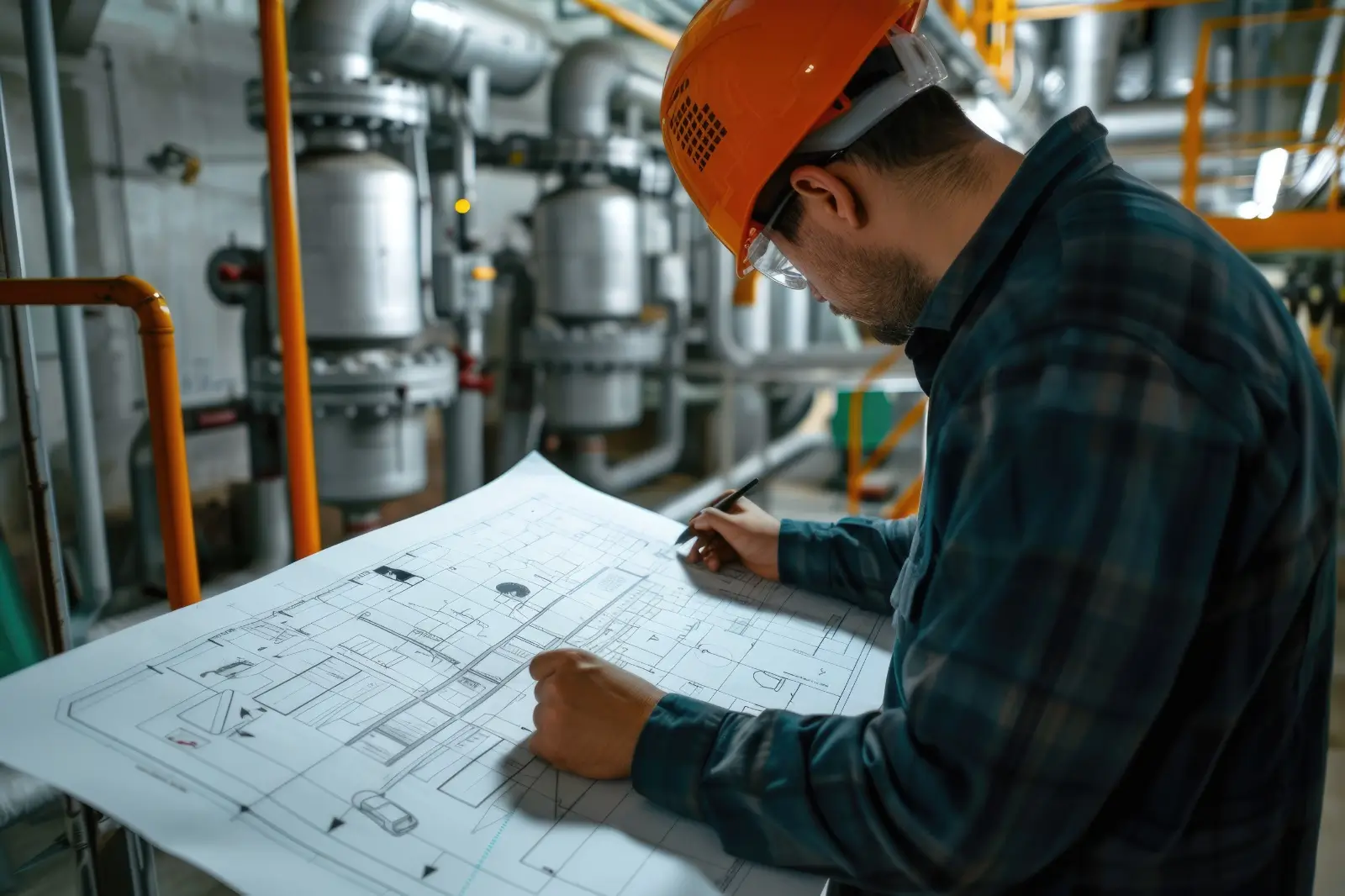
- Industrial MEP engineering addresses process HVAC, high-capacity power distribution, chemical waste plumbing, and hazardous location classification.
- Process loads in industrial facilities can dwarf comfort HVAC loads, requiring fundamentally different system approaches than commercial buildings.
- NEC hazardous location classification (Articles 500-516) governs electrical design in areas where flammable materials are present.
- Industrial plumbing systems often include chemical waste neutralization, process water, compressed air, and fire protection piping.
- California Title 24 applies to comfort HVAC and lighting in industrial occupancies; process loads are generally exempt.
- Budlong has extensive experience delivering MEP design for industrial, manufacturing, and research facility projects across California.
- What Makes Industrial MEP Engineering Different?
- Industrial Mechanical and HVAC Design
- Industrial Electrical Design
- Industrial Plumbing and Process Piping
- Hazardous Location Classification
- Fire Protection in Industrial Facilities
- California Title 24 and Energy Compliance
- MEP Coordination Challenges in Industrial Projects
- Selecting an MEP Firm for Industrial Projects
- Who Uses Industrial MEP Design Services?
- Related Reading
- Frequently Asked Questions
Industrial facilities present MEP engineers with challenges that bear little resemblance to those encountered in a commercial office building or a school. Process heat loads may be ten times greater than occupant comfort loads. Electrical demand can run into multiple megawatts. Plumbing systems may handle corrosive chemicals, ultra-pure process water, or hazardous waste streams. Ventilation must manage toxic or explosive vapors in addition to providing fresh air for workers.
At Budlong, our team has engineered MEP design services for industrial operations ranging from pharmaceutical manufacturing and laboratory facilities to food processing plants and aerospace components facilities. This guide provides a technically grounded overview of what distinguishes industrial MEP design from conventional commercial practice and what design standards govern industrial building systems in California.
1. What Makes Industrial MEP Engineering Different?
The fundamental distinction between industrial MEP engineering and commercial MEP engineering lies in the presence and dominance of process systems. In a commercial office building, MEP systems exist primarily to serve the people who occupy the building. In an industrial facility, MEP systems must serve both occupants and the industrial processes being conducted, which often have far greater energy, water, and infrastructure demands.
Process vs. Comfort Systems
Industrial MEP engineering requires the engineer to clearly distinguish between comfort systems (those serving occupant thermal comfort, ventilation, and sanitation) and process systems (those serving the manufacturing or research process directly). This distinction matters because different codes apply, different redundancy requirements exist, and the consequences of system failure are different.
Regulatory Complexity
Industrial facilities are subject to a broader regulatory framework than commercial buildings. In addition to the standard building codes, industrial MEP engineers must be familiar with OSHA process safety management (PSM) standards, EPA air quality regulations, NFPA specialty codes for chemical storage and hazardous materials, and Cal/OSHA requirements specific to California industrial workplaces. Budlong’s MEP engineering services team brings experience with this complex regulatory landscape.
2. Industrial Mechanical and HVAC Design
Industrial mechanical design encompasses comfort HVAC for occupied areas, process ventilation and exhaust, process cooling, compressed air systems, and specialty mechanical systems required by the industrial process.
Controlled environments such as pharmaceutical and research spaces call for dedicated cleanroom HVAC design.
Process Exhaust and Ventilation
Many industrial processes generate heat, fumes, vapors, dust, or airborne contaminants that must be captured and exhausted before they reach the occupied zone. Industrial ventilation design involves local exhaust ventilation (LEV) at the source of contamination, general dilution ventilation for the broader space, and make-up air systems to replace the exhausted air. ACGIH (American Conference of Governmental Industrial Hygienists) Industrial Ventilation guidelines are the primary reference for this work.
Make-Up Air Units (MAUs)
When large volumes of air are exhausted from an industrial space, replacement air must be supplied to maintain building pressure balance and provide adequate fresh air for workers. Make-up air units (MAUs) supply tempered or conditioned replacement air. In California climates, MAUs may need heating capability for cold-season operation, evaporative cooling for summer, and energy recovery to reduce conditioning energy. HVAC design services for industrial buildings must account for the full range of MAU design scenarios.
Process Cooling Systems
Industrial processes that generate significant heat — including CNC machining, welding, heat treating, and chemical reactors — often require dedicated process cooling. This may be served by chilled water systems, cooling towers, dry coolers, or refrigerated cooling systems separate from the comfort HVAC infrastructure. Mechanical engineering for modern buildings increasingly integrates process and comfort cooling for energy efficiency.
Compressed Air and Pneumatic Systems
Compressed air is a utility in most industrial facilities, used for pneumatic tools, process controls, instrumentation, and cleaning. The MEP mechanical engineer may be responsible for sizing the compressed air distribution system, specifying compressors, and designing dryers and filters to meet process air quality requirements.
| System Type | Industrial Application | Key Design Standard |
|---|---|---|
| Local Exhaust Ventilation | Welding, chemical fumes, dust control | ACGIH Industrial Ventilation Manual |
| Make-Up Air Units | Replacement air for exhaust systems | ASHRAE 62.1, SMACNA |
| Process Cooling | CNC, reactors, heat treating | ASHRAE Handbook, manufacturer data |
| Compressed Air | Tools, controls, instrumentation | ASME B31.3 (process piping) |
| Cleanroom HVAC | Pharmaceutical, semiconductor, medical devices | ISO 14644, ASHRAE 170, IEST |
| Explosion-Proof HVAC | Chemical plants, refineries, paint spray | NEC Article 500, ATEX standards |
3. Industrial Electrical Design
Industrial electrical systems are fundamentally different from commercial electrical systems in their scale, redundancy requirements, motor load characteristics, and safety classification requirements. Electrical engineering for safety, reliability, and efficiency is particularly critical in industrial environments where electrical failures can halt production, cause safety incidents, or damage expensive process equipment.
High-Capacity Power Distribution
Industrial facilities may require electrical service ranging from hundreds of kilowatts to tens of megawatts, depending on the process. At this scale, medium-voltage (MV) power distribution — typically 4kV to 15kV — is common, with unit substation transformers stepping voltage down for distribution to individual manufacturing areas. Industrial electrical engineers must design the MV switchgear, transformer ratings, and low-voltage distribution boards to meet both current and anticipated future process loads.
Motor Control Centers (MCCs)
Large motors for process equipment — conveyors, compressors, pumps, fans, and machine tools — are typically controlled through Motor Control Centers (MCCs). Industrial electrical design includes MCC layout, starter type selection (across-the-line, reduced-voltage, or variable frequency drive), short-circuit analysis, and protection coordination. Variable Frequency Drives (VFDs) are increasingly used for large process motors to reduce energy consumption and improve process control.
Power Quality and Harmonics
Variable frequency drives, arc furnaces, and other nonlinear industrial loads generate harmonic distortion in the electrical system that can cause equipment damage, overheating of transformers and neutrals, and interference with sensitive instrumentation. Industrial MEP electrical engineers must perform power quality analysis and specify harmonic mitigation measures such as line reactors, active filters, or transformer winding arrangements.
Industrial MEP Engineering from Budlong
Our licensed engineers deliver MEP design for manufacturing, laboratory, food processing, pharmaceutical, and aerospace industrial facilities across California.
Emergency and Standby Power for Industrial Facilities
Many industrial processes cannot be safely interrupted without risk of equipment damage, product loss, or safety hazard. Industrial MEP electrical design may include standby generators, uninterruptible power supplies (UPS), and automatic transfer schemes to maintain power to critical loads during utility outages. Electrical design for future load expansion is particularly important in industrial facilities where process growth is anticipated.
4. Industrial Plumbing and Process Piping
Industrial plumbing systems extend well beyond the domestic water and sanitary drain systems found in commercial buildings. Industrial plumbing engineering encompasses process water supply, chemical waste management, specialty gas distribution, and fire suppression systems designed for industrial hazard levels.
Process Water Systems
Many industrial processes require water of specific quality — softened water, deionized (DI) water, reverse osmosis (RO) water, or ultra-pure water. The plumbing engineer must specify water treatment equipment, distribution piping materials compatible with the water quality and process requirements, and appropriate flow rates and pressures for each point of use.
Chemical Waste and Neutralization
Facilities that use acids, solvents, or other chemicals must collect and treat chemical waste before it is discharged to the sanitary sewer. Chemical waste systems use acid-resistant piping materials (polypropylene, PVDF, or borosilicate glass), and the waste stream must pass through a neutralization sump where pH is adjusted to acceptable discharge limits. Local pretreatment requirements and industrial discharge permits govern these systems.
Natural Gas and Process Gas Distribution
Industrial facilities using natural gas for process heating, laboratory equipment, or cogeneration require plumbing engineering for gas distribution piping sized for process flow rates that can be orders of magnitude larger than commercial building gas loads. Specialty process gases (nitrogen, hydrogen, argon, oxygen) used in manufacturing or laboratories require dedicated distribution systems with materials selected for compatibility with the specific gas.
Chemical waste piping in laboratory and industrial facilities must be designed with appropriate materials — standard DWV piping is not compatible with most acids, solvents, or heavy metals. Failure to specify correct materials can result in pipe failures, environmental releases, and regulatory violations. Engage experienced industrial plumbing engineers who understand material compatibility for your specific waste streams.
5. Hazardous Location Classification
One of the most critical aspects of industrial electrical MEP design is hazardous location classification. Areas where flammable gases, vapors, dusts, or fibers may be present require electrical equipment specifically designed and listed for use in those environments.
NEC Article 500 Classification System
The National Electrical Code (California Electrical Code) Article 500 classifies hazardous locations by Class (type of hazard), Division (likelihood of hazardous concentration), and Group (specific material category). Class I locations involve flammable gases or vapors; Class II involves combustible dusts; Class III involves ignitable fibers. Division 1 locations have hazardous concentrations present normally during operations; Division 2 locations have hazardous concentrations present only under abnormal conditions.
Zone Classification System
An alternative classification system using Zones (Zone 0, 1, 2 for gas; Zone 20, 21, 22 for dust) is also recognized by the NEC and is commonly used for facilities that export to international markets where ATEX (European) standards apply. Industrial MEP engineers must determine which classification system is appropriate for each project.
Equipment Selection for Hazardous Locations
All electrical equipment installed in classified locations — including motors, lighting fixtures, junction boxes, conduit fittings, and instrumentation — must be listed for the specific class, division, and group of the location. This significantly increases equipment cost and procurement lead time, and must be accounted for in project budgets and schedules.
6. Fire Protection in Industrial Facilities
Fire protection in industrial facilities involves far more complex hazard assessment than in commercial buildings. The nature of the materials being processed or stored, the process equipment present, and the building occupancy all influence the fire suppression system design. Fire safety engineering in MEP is closely coordinated with the plumbing and electrical disciplines in industrial projects.
Commodity Classification and Sprinkler Design
Warehouse and storage areas in industrial facilities are classified by commodity type (Class I through IV, or Group A-C plastics) per NFPA 13. Higher commodity classifications require more aggressive sprinkler systems — including in-rack sprinklers, ESFR (Early Suppression Fast Response) heads, or specialized foam-water suppression for flammable liquid storage areas.
Special Suppression Systems
Some industrial occupancies require special suppression systems beyond standard water sprinklers. Paint spray booths require dry chemical or foam systems; electrical equipment rooms and data systems may use clean agent suppression; cooking operations require kitchen hood systems. The MEP engineer coordinates the selection and design of these special systems with the fire protection engineer.
7. California Title 24 and Energy Compliance for Industrial Facilities
California Title 24 applies to industrial buildings in terms of comfort HVAC and lighting in occupied areas, while process systems and process loads are generally exempt. However, the boundary between process and comfort is not always clear, and MEP engineers must carefully delineate these boundaries in the compliance documentation.
Lighting Compliance
Industrial and warehouse building lighting must comply with Title 24 Part 6 lighting power density (LPD) limits and mandatory controls requirements, including automatic shut-off, daylight sensing in perimeter areas, and occupancy sensing. LED high-bay and low-bay fixtures are the standard choice for industrial lighting compliance in California.
HVAC Compliance for Comfort Areas
Office areas, breakrooms, locker rooms, and other comfort-conditioned spaces within industrial facilities must comply with Title 24 HVAC efficiency requirements. Industrial process HVAC — such as air supply to process equipment or cleanroom conditioning — is generally exempt but must be clearly identified in the compliance documentation. Sustainable MEP design services help industrial clients meet and exceed baseline code requirements.
8. MEP Coordination Challenges in Industrial Projects
Industrial MEP projects present coordination challenges that do not arise in conventional commercial work. Understanding these challenges helps project teams allocate adequate time and resources for coordination.
Process Interface and Equipment Vendor Coordination
Industrial MEP engineers must coordinate with process equipment vendors to obtain utility connection requirements — electrical loads, cooling water flows, compressed air demands, drain requirements, and gas connection sizes — before finalizing system designs. This vendor coordination often occurs on a long lead time and may drive the MEP design schedule.
Structural Penetrations and Equipment Loads
Industrial facilities often have large, heavy process equipment that imposes significant structural loads and requires major penetrations through floors, walls, and roofs for process piping, exhaust stacks, and utility connections. MEP engineers must coordinate these requirements with the structural engineer early in the design process to avoid costly structural redesign. Mechanical engineering solutions for complex buildings from Budlong address these coordination challenges systematically.
9. Selecting an MEP Firm for Industrial Projects
Not every MEP engineering firm has the experience or technical depth to handle industrial projects. The following criteria should guide your evaluation of MEP firms for industrial work.
Industrial Project Experience
Request a portfolio of completed industrial projects similar in type and complexity to yours. Pharmaceutical manufacturing MEP is very different from food processing MEP, which is different from aerospace manufacturing MEP. Sector-specific experience matters. Review Budlong’s MEP project portfolio for examples of industrial and laboratory facility work.
Hazardous Location Expertise
If your facility involves flammable materials, confirm that the MEP firm has experience with NEC hazardous location classification and the selection of listed equipment for classified areas. This is a specialized competency that many commercial MEP firms lack.
Integrated MEP Capability
Industrial projects benefit greatly from integrated MEP services where mechanical, electrical, and plumbing engineers work within the same firm and share models in real time. Integrated MEP services at Budlong eliminate the interface gaps that arise when disciplines are managed by separate firms.
10. Who Uses Industrial MEP Design Services?
- Pharmaceutical and Biotech Manufacturing — GMP-compliant HVAC, process utilities, and classified electrical areas
- Food and Beverage Processing — Sanitary plumbing, refrigeration, and food-grade compressed air
- Aerospace and Defense — Precision cleanroom environments, high-capacity power, and specialty process gases
- Laboratory and R&D Facilities — Chemical exhaust, process water, and laboratory gas systems
- Cannabis Processing Facilities — Specialty HVAC for odor control and extraction process safety
- Warehousing and Distribution — High-bay industrial lighting and high-piled storage sprinkler systems
11. Related Reading
- Industrial MEP engineering differs fundamentally from commercial MEP in scale, regulatory complexity, and the presence of process systems.
- Process exhaust ventilation, make-up air, and process cooling are among the largest mechanical engineering challenges in industrial facilities.
- High-capacity power distribution, motor control centers, power quality management, and hazardous location classification define industrial electrical design.
- Industrial plumbing systems extend to process water, chemical waste, specialty gases, and fire suppression systems sized for industrial hazard levels.
- California Title 24 applies to comfort HVAC and lighting in industrial buildings; process systems are generally exempt.
- Industrial MEP projects require early coordination with process equipment vendors to capture utility connection requirements before systems are designed.
- Select MEP firms with demonstrated industrial sector experience, hazardous location expertise, and integrated mechanical-electrical-plumbing capability.
For authoritative technical references, see the ACGIH Industrial Ventilation Manual, the NFPA 70 National Electrical Code, the OSHA Process Safety Management Standard, the ASME B31.3 Process Piping Code, and the California Energy Commission Title 24 standards.
12. Frequently Asked Questions
How is industrial MEP engineering different from commercial MEP engineering?
Industrial MEP engineering differs from commercial MEP in several key ways: systems must handle much higher process loads, hazardous materials may be present requiring NEC classified area design, power demands are typically far greater, ventilation requirements are driven by process exhaust rather than occupancy alone, and specialized piping systems for process fluids, chemicals, and compressed gases are often required.
What HVAC systems are used in industrial facilities?
Industrial HVAC systems include unit heaters, industrial exhaust fans, make-up air units (MAUs), process cooling systems, evaporative coolers, explosion-proof equipment for hazardous locations, and precision environmental control systems for cleanrooms and laboratories. HVAC design services from Budlong cover the full range of industrial mechanical systems.
What electrical codes apply to industrial buildings in California?
Industrial electrical design in California must comply with the California Electrical Code (CEC), which is based on the NEC, NFPA 70E for electrical safety in the workplace, NFPA 70B for electrical maintenance, and applicable Cal/OSHA electrical safety requirements. Hazardous location classifications per NEC Article 500 also apply where flammable materials are processed or stored.
What plumbing systems are typically found in industrial facilities?
Industrial plumbing systems include domestic water supply, sanitary drainage, process water supply and return, chemical waste systems with neutralization sumps, compressed air, natural gas and process gas distribution, fire suppression piping, and floor drains for equipment washdown. Learn more about industrial plumbing engineering services.
What is a hazardous location classification in industrial MEP?
Hazardous location classification per NEC Article 500 defines areas where flammable gases, vapors, dusts, or fibers may be present in quantities sufficient to produce an ignitable or explosive atmosphere. MEP engineers must specify explosion-proof or intrinsically safe electrical equipment for these zones to prevent ignition of hazardous atmospheres.
Does industrial MEP design require energy compliance in California?
Yes. Industrial and warehouse buildings in California are subject to Title 24 energy compliance requirements covering lighting, HVAC, and building envelope performance for occupied comfort areas. Process loads are generally exempt from Title 24 but comfort HVAC and lighting systems must comply. Sustainable design services from Budlong help industrial clients navigate Title 24 efficiently.
What is an industrial make-up air unit (MAU)?
A make-up air unit (MAU) supplies conditioned or unconditioned replacement air to a space from which air is exhausted by process equipment or ventilation systems. In industrial facilities, large volumes of air must be exhausted to remove heat, fumes, and contaminants, and MAUs ensure that the building maintains neutral or positive pressure and that workers have adequate fresh air.
How does MEP design support industrial facility expansion?
Good industrial MEP design anticipates future expansion by providing electrical service capacity beyond current demand, designing process piping with isolation valves and future connection points, sizing mechanical rooms to accommodate additional equipment, and specifying modular systems that can be extended without major demolition. Electrical engineering for future load expansion is a key service Budlong provides to industrial clients.