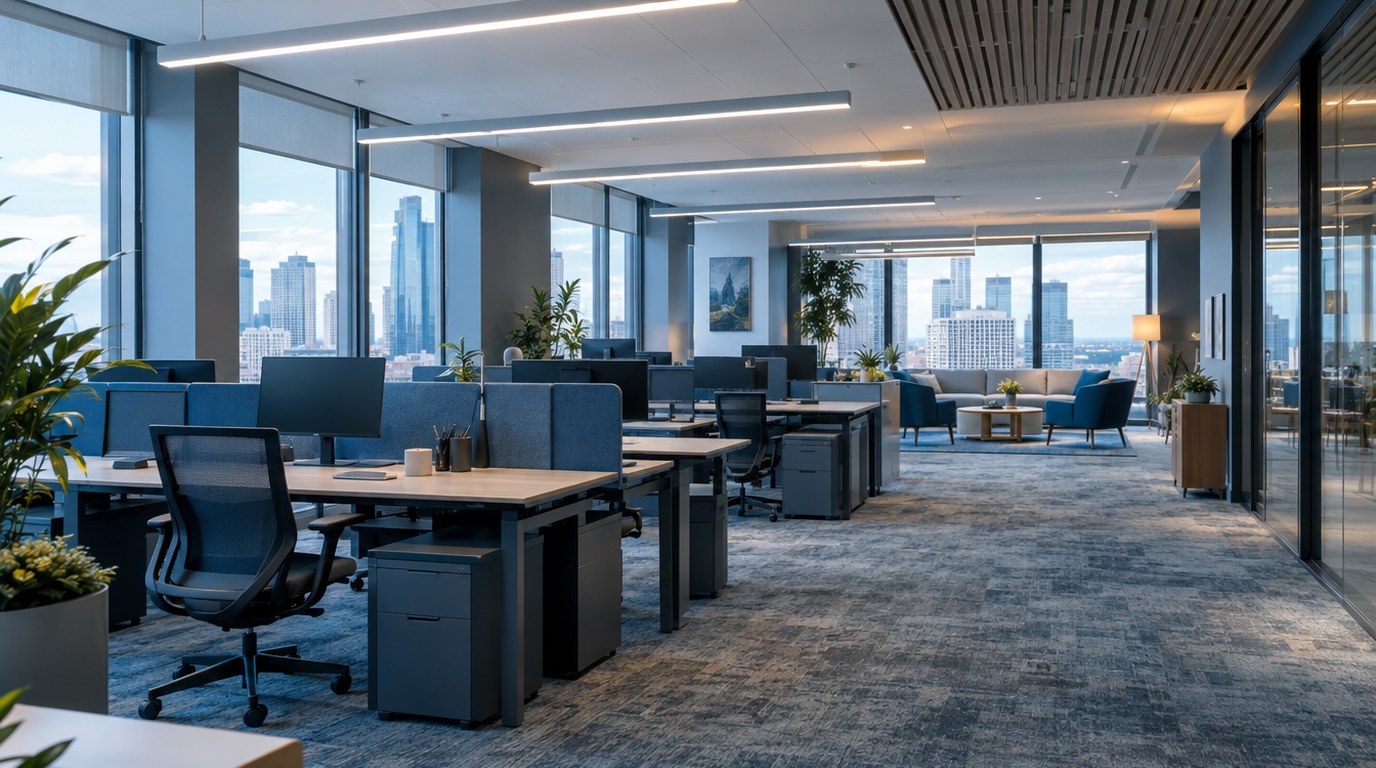
- Human-centric lighting designs for biology, comfort and task performance together, not only for footcandles on a desk.
- Circadian effect depends on the spectrum and the light reaching the eye, so designers use melanopic metrics measured on a vertical plane.
- Tunable white fixtures help, but they do nothing alone without schedules, daylight coordination and calibrated targets.
- Hospitals, senior living, schools, interior offices and 24-hour facilities offer the clearest return on the added effort.
- California projects must still meet Title 24 Part 6 power and control rules, so circadian features need a documented compliance path.
- Commissioning should include measured light at the eye, not just a check that the fixtures turn on.
- What Human-Centric Lighting Means
- How Light Drives the Body Clock
- Metrics and Lighting Strategies
- Standards, Guidelines and Code Context
- Applications by Building Type
- Design Process and Deliverables
- Special Cases: Night Shifts, Dementia Care and Daylight
- How to Specify Circadian Lighting and What It Costs
- Best Practices, Mistakes and Commissioning
- Where Budlong Delivers This
- Related Reading
- Frequently Asked Questions
Light does more than let people see. It sets the timing of the body clock, influences alertness and shapes how comfortable a room feels at the end of a long day. Human-centric lighting takes that science seriously, and our architectural lighting design services team works with architects and owners who want lighting that supports the people inside, not just the schedule on the drawings.
The idea is easy to oversell. This guide separates what the research supports from what marketing claims, explains the metrics that matter, and shows how to turn design intent into fixtures, controls and commissioning that a facility team can run. Our firm has a history dating to 1958, and our electrical engineering services group coordinates power, controls and lighting so these systems work together.
Also Read: Architectural Lighting Design for Commercial Buildings
1. What Human-Centric Lighting Means
Human-centric lighting is a design approach that treats light as an input to health, mood, alertness and visual comfort. Traditional lighting design asks whether a task has enough light and whether glare is controlled. Human-centric design adds questions about timing, spectrum and the amount of light that reaches the eye over the course of a day.
Circadian lighting as one part of the whole
Circadian lighting is the portion of human-centric design that targets the body clock. It sits beside visual comfort, color quality, glare control and flicker. A project that delivers a strong circadian signal but a glaring, flickering room has failed on the other dimensions that people notice first.
Why owners ask for it
Owners usually raise it for one of three reasons: occupants spend long hours in spaces with little daylight, schedules are irregular, or a rating program such as WELL or a health-focused brief asks for it. Knowing which reason applies sets the scope. A brief that wants a feature for marketing needs a different approach from one where staff work overnight shifts. Our architectural lighting design practice starts by pinning down that purpose.
2. How Light Drives the Body Clock
Besides rods and cones, the human retina contains intrinsically photosensitive retinal ganglion cells. These cells use a photopigment called melanopsin and respond most strongly to short wavelengths, with a peak near 480 nanometers in the blue-cyan range. Their signals travel to the brain region that regulates the circadian clock, which in turn influences melatonin timing, sleep and alertness.
Why spectrum, level, timing and duration all matter
The effect depends on four things together. Spectrum determines how much of the light is effective for melanopsin. Level determines how much reaches the eye. Timing decides whether the signal advances or delays the clock. Duration decides whether exposure is long enough to matter. A bright, blue-rich source late in the evening can push the clock in the wrong direction, while the same source mid-morning supports alertness.
The eye, not the desk
Because the receptors are in the retina, the relevant quantity is light arriving at the eye. That is usually measured on a vertical plane at eye height, facing the direction of gaze. Illuminance on a horizontal desk can be adequate while vertical light at the eye is low, particularly under downlights in a large open room.
3. Metrics and Lighting Strategies
Three families of metrics appear in specifications. Understanding them prevents the common error of copying a number from one system into another.
Common circadian metrics
Melanopic equivalent daylight illuminance, defined in the CIE system and often abbreviated melanopic EDI, weights the spectrum by melanopsin sensitivity and compares it with daylight. Circadian stimulus, developed at the Lighting Research Center, estimates the effect on the clock as a value between zero and about 0.7. Older documents used equivalent melanopic lux or similar terms, and these should be translated carefully before use.
| Metric or term | What it describes | Where it is used |
|---|---|---|
| Melanopic EDI | Melanopsin-weighted light at the eye compared with daylight | International practice and rating systems |
| Circadian stimulus | Predicted effect on the clock, scaled from zero to about 0.7 | Research and some design guidelines |
| Correlated color temperature | Apparent warmth or coolness of white light | Appearance only, not a circadian measure |
| Vertical illuminance | Light arriving at the eye plane | Measurement point for circadian targets |
A day-long strategy
Most strategies follow a simple arc. Deliver higher melanopic light from morning through early afternoon, taper through late afternoon, and keep evening and night lighting warm, dim and low in melanopic content. Daylight does much of the work in rooms near windows, so electric light is tuned to supplement it. Where the room has no daylight, the electric system carries the whole load.
Strategies beyond tunable white
Tunable white is the most visible tool, but not the only one. Designers also raise vertical illuminance with wall washing and indirect light, choose sources with higher melanopic ratio, add luminous ceilings or sky-like panels, and use controls that shift levels without changing color. Each has trade-offs in glare, energy and cost.
4. Standards, Guidelines and Code Context
No single code mandates circadian lighting in California buildings. Instead, projects meet energy and life safety codes, then layer voluntary guidance on top. That layering is where design teams sometimes get into trouble.
Guidelines and rating systems
UL Solutions publishes a design guideline for promoting circadian entrainment with light for day-active people. Rating programs such as WELL and LEED reference circadian targets and daylight access, and the Lawrence Berkeley National Laboratory daylighting research community provides measurement methods and data on how windows and shading shape indoor light. The U.S. Department of Energy has also published technical summaries on lighting and health that help set realistic expectations.
Flicker and quality
IEEE recommended practice 1789, available through IEEE, addresses flicker from LED sources, which matters because dimmed multi-channel systems can introduce modulation if drivers are poorly matched.
California energy and building codes
Title 24 Part 6, administered by the California Energy Commission, sets lighting power and control requirements, and the 2025 edition applies to permits filed from 1 January 2026. Circadian systems must satisfy the same rules for area controls, dimming and shut-off. Our guides to what Title 24 is and the Title 24 compliance process explain how to document that path, and CALGreen requirements affect daylight and lighting controls on many projects.
Also Read: Title 24 Compliance Guide
5. Applications by Building Type
Benefit is highest where people are indoors for long periods, where daylight is limited or where schedules do not follow the sun. The table summarizes typical approaches.
| Building type | Main goal | Typical approach |
|---|---|---|
| Hospitals and clinics | Support recovery, staff alertness and sleep | Tunable patient room lighting, low night orientation light, staff station tuning |
| Senior living and memory care | Stabilize sleep and daytime activity | High daytime vertical light in common areas, warm dim evening scenes |
| Schools and universities | Alertness and visual comfort | Daylight-first classrooms with schedule-based tuning for interior rooms |
| Offices | Comfort and daytime alertness | Daylight harvesting with vertical illuminance and user override |
| 24-hour operations | Shift-worker alertness and recovery | Role-based schedules, controlled night levels, glare control |
Healthcare and senior living
In health facilities, lighting supports patients who may sleep poorly and staff who work nights. Projects such as Cedars-Sinai Medical Center show the complexity of coordinating lighting with life safety and clinical needs, and our healthcare MEP design guide covers wider system context. Assisted living communities, including Belmont Village, benefit from stable daytime light and calm evenings.
Education, offices and 24-hour sites
Education buildings such as the Jordan High School modernization must balance daylight, glare and budget. Interior offices without windows gain the most from tuned electric light. Aviation and transit control spaces run around the clock, and the Centers for Disease Control and Prevention through NIOSH publishes guidance on shift work and fatigue that informs the schedule design.
Planning Lighting for People, Not Just Tasks?
Our lighting designers and electrical engineers can test whether a circadian scheme fits your program and budget before you specify it.
6. Design Process and Deliverables
The process begins with a brief that states who occupies the space, when and for how long. From there the team moves through daylight analysis, target setting, fixture selection and controls design.
Steps
- Define occupants, schedules and the purpose of the circadian feature.
- Analyze daylight by orientation, shading and depth of room.
- Set targets at the eye for each zone and time of day, using the chosen metric.
- Select luminaires using spectral data, dimming range and color consistency.
- Design control zones, schedules, overrides and building system links.
- Document compliance with Title 24 Part 6 and any rating program.
- Plan commissioning with measurement points and calibration records.
Deliverables
Expect a lighting concept narrative, calculations at the eye plane, a luminaire schedule with spectral data, control zone drawings, a sequence of operations and a commissioning plan. The electrical package, described in our note on construction document packages for electrical design, must carry the circuit and control details, and early energy studies from energy modeling show the effect on consumption.
7. Special Cases: Night Shifts, Dementia Care and Daylight
Night shift and critical staff
Shift workers face a conflict: they need alertness at night, yet strong blue-rich light can delay recovery after the shift. Designers often use brighter light at the start of the shift, then taper, with glare control and a quiet recovery environment for breaks. The approach should be defined with the facility’s operations team, not set by the lighting vendor alone.
Memory care and elderly occupants
Older eyes transmit less short-wavelength light, so the same room delivers less circadian stimulus to an older occupant. Common areas in memory care are often designed for stronger daytime vertical light and calm, low evening scenes, with night orientation lighting that avoids startling residents.
Daylight and shading
Daylight is the strongest circadian source available. Automated shading, covered in our overview of implementing smart building technologies, protects against glare without cutting off daylight. Facades with deep floor plates still need electric tuning at the core.
If the room has good daylight, reduce the electric circadian ambition and spend the budget on glare control and shading. Electric light should fill gaps, not compete with the sun.
Creative and retail spaces
Hospitality and workplace interiors, such as Patagonia corporate offices, use warm evening scenes for atmosphere while preserving higher daytime levels. Here color quality and mood often carry as much weight as biological metrics.
8. How to Specify Circadian Lighting and What It Costs
What to put in the specification
Require spectral power distributions and melanopic ratios, multi-channel dimming range, color consistency across luminaires, driver and controller compatibility, flicker performance and firmware support. Define the schedule logic and override limits in the sequence of operations. Include measurement at the eye as an acceptance criterion.
Write the circadian goal into the owner project requirements, so every later substitution is judged against measured light at the eye and not against a catalog claim.
Cost drivers
The premium comes from multi-channel luminaires and drivers, controllers and gateways, programming time, commissioning with spectral measurement and additional design effort. Savings from daylight harvesting can offset part of it, but energy savings are not the reason to choose circadian lighting. Our guide on estimating MEP engineering costs helps with fee and budget planning.
| Cost driver | Effect | How to control it |
|---|---|---|
| Multi-channel luminaires | Higher unit price than single-channel fixtures | Limit tunable fixtures to zones where they matter |
| Control network and programming | Added hardware and labor | Define scenes and schedules in design |
| Measurement and calibration | Specialized instruments and time | Specify test locations and tolerance in advance |
| Maintenance | Firmware, spare parts, retuning | Choose open protocols and train staff |
The National Renewable Energy Laboratory and the Department of Energy both publish building technology research that helps weigh energy impact against occupant benefit.
9. Best Practices, Mistakes and Commissioning
Practices that work
Set targets at the eye, coordinate with daylight, keep control logic simple and give occupants a bounded manual override. Choose luminaires with good color rendering and low flicker, and train facility staff on what the schedule is meant to do.
Mistakes to avoid
- Treating color temperature as a circadian metric.
- Measuring only horizontal illuminance on the desk.
- Installing tunable fixtures without a schedule or daylight inputs.
- Letting evening light stay blue-rich and bright.
- Overlooking glare from high-output sources.
- Ignoring how fixtures will draw power at each setting for code compliance.
Commissioning and maintenance
Commissioning should confirm that scenes, schedules and overrides work and that measured values at the eye match design intent at representative points. Our commissioning services include functional testing that can be extended to lighting. Plan a recheck after occupants settle in, since furniture and use patterns change the light that reaches the eye. A broader view of sustainable lighting choices appears in sustainable lighting design for brighter spaces.
Also Read: Sustainable Lighting Design for Brighter Spaces
- Define the purpose first, then choose metrics and equipment to match.
- Measure light at the eye, not only at the desk.
- Use daylight as the foundation and electric light as the supplement.
- Pair tunable fixtures with schedules, overrides and calibration.
- Document Title 24 Part 6 compliance for every operating mode.
- Present benefits as research-supported design intent, not guaranteed results.
10. Where Budlong Delivers This
Our lighting designers work from Glendale, downtown Los Angeles, Camarillo and Fremont, serving Los Angeles, Ventura, Orange, San Bernardino, Riverside and Santa Barbara counties and the Bay Area.
11. Related Reading
12. Frequently Asked Questions
What is human-centric lighting?
Human-centric lighting is a design approach that treats light as an input to human health, alertness, mood and visual comfort, not only as a way to see tasks. It combines quantity, spectrum, direction, timing and control so that the lighting supports the people using a space across the day.
How is circadian lighting measured?
Designers use metrics such as melanopic equivalent daylight illuminance and circadian stimulus, calculated from the spectral power distribution of the light and measured at the eye, usually on a vertical plane. Ordinary lux on a desk and correlated color temperature are not adequate substitutes for these metrics.
Does tunable white lighting automatically make a space circadian effective?
No. Tunable white changes color temperature, but circadian effect depends on the spectrum, the light level reaching the eye, the duration and the time of day. Without a defined schedule, calibrated levels and daylight coordination, a tunable system may look different without delivering a measurable circadian benefit.
How bright does light need to be at the eye for circadian benefit?
Targets depend on the metric and the program chosen, and they are defined at the eye during daytime hours rather than on the work surface. Common guidance asks for substantially more melanopic light in the morning and midday than in the evening, so confirm the target with the rating system or guideline the project follows.
Where does circadian lighting make the most sense in buildings?
It makes the most sense where people spend long hours indoors with limited daylight or irregular schedules, such as hospital units, senior living, classrooms, interior offices, control rooms and facilities with shift work. In spaces occupied briefly, the benefit is small and the added cost is hard to justify.
How does circadian lighting affect energy code compliance in California?
Circadian systems must still meet Title 24 Part 6 lighting power and control requirements, including area controls, dimming and shut-off provisions. Because tunable luminaires can draw different power at different settings, the designer should document the compliance basis for the adopted edition and confirm acceptance testing with the plan reviewer.
What controls are needed for circadian lighting?
A typical system needs two-channel or multi-channel drivers, a controller with time-based schedules, daylight and occupancy inputs, manual override with limits, and a clear interface to the building system. Networked protocols such as DALI-2 or a digital addressable system make fine adjustment and later recalibration practical.
Is there proof that circadian lighting improves productivity or health?
Research supports the biological basis for light affecting circadian timing, and some studies show benefits for sleep and alertness in specific settings. Evidence for broad productivity gains in ordinary offices is still developing, so claims should be framed as design intent supported by research, not as guaranteed outcomes.
How much does circadian lighting add to project cost?
Added cost comes from multi-channel luminaires, more capable drivers, control hardware and programming, spectral measurement during commissioning and extra design time. The premium varies widely with project size and ambition, so price a base lighting scheme and a circadian alternate side by side during design.