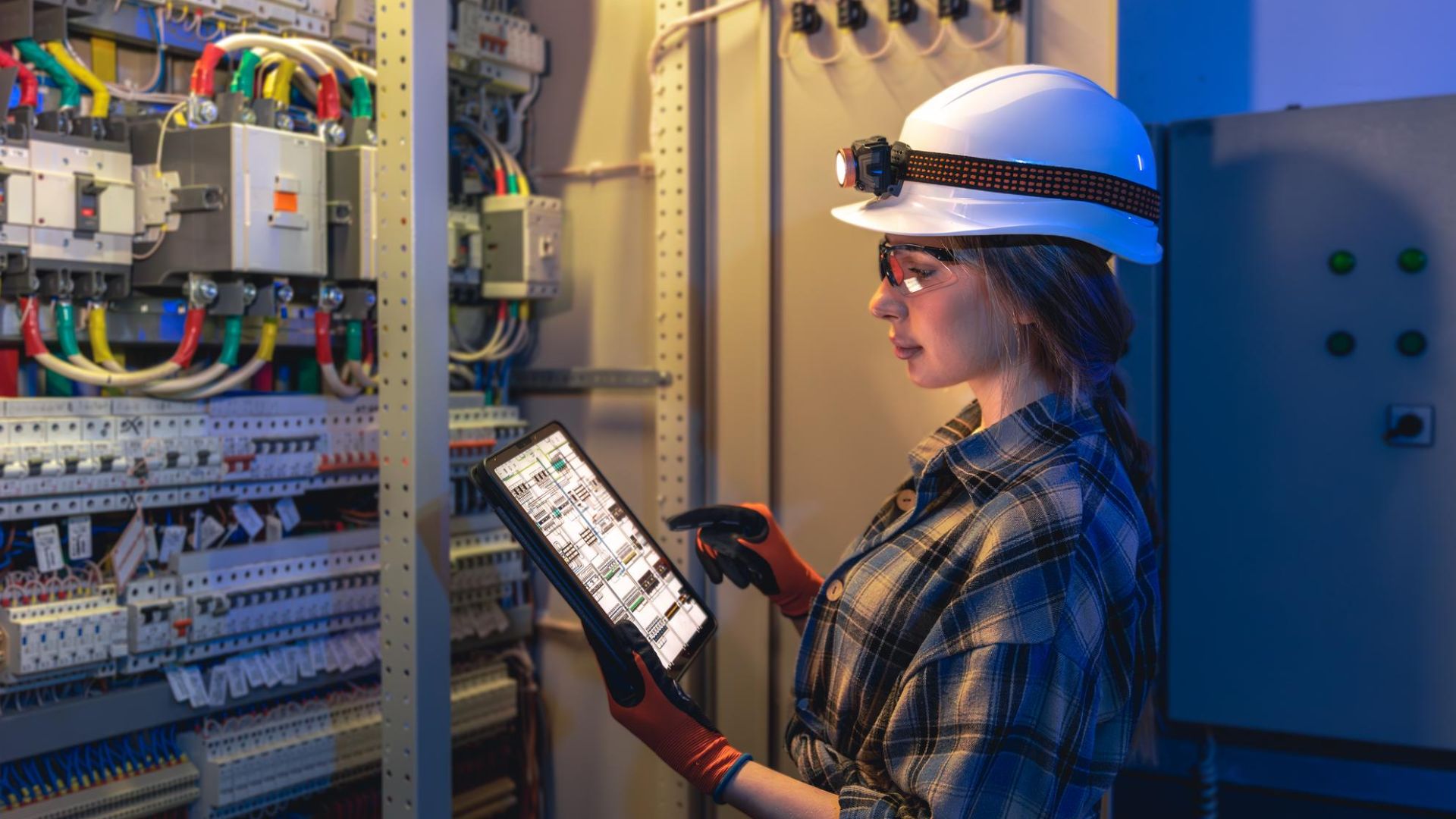
- Arc flash is an electrical explosion generating temperatures up to 35,000°F — it is one of the most severe electrical hazards faced by maintenance personnel and electricians.
- NFPA 70E requires employers to perform arc flash hazard analysis and provide appropriate PPE for all work on or near energized electrical equipment in commercial and industrial buildings.
- IEEE 1584 is the calculation methodology for arc flash incident energy analysis — it requires detailed electrical system data including fault current, protective device clearing times, and working distances.
- Arc flash labels showing incident energy, arc flash boundary, PPE category, and nominal voltage must be field-applied to all electrical equipment subject to energized work.
- NFPA 70E requires arc flash analysis to be reviewed every 5 years or whenever a major electrical system modification changes the arc flash hazard.
- Budlong’s electrical engineers perform arc flash analysis studies for commercial, healthcare, industrial, and institutional facilities throughout California.
- What Is Arc Flash?
- NFPA 70E and Its Requirements
- IEEE 1584 Arc Flash Calculation Method
- Incident Energy and Arc Flash Boundaries
- PPE Categories and Selection
- Arc Flash Labeling Requirements
- Energized Work Permits
- Arc Flash Mitigation Strategies
- Who Needs Arc Flash Analysis?
- Who Uses Arc Flash Analysis Services?
- Related Reading
- Frequently Asked Questions
Every year in the United States, an estimated 30,000 arc flash events occur in the workplace, resulting in approximately 7,000 burn injuries, 2,000 hospitalizations, and 400 fatalities. Unlike electrical shock — which most people understand as a hazard — arc flash is a less-known but often more devastating hazard that can injure or kill workers who are standing several feet away from the arc source without any direct contact with energized conductors. Building owners, facility managers, and employers who fail to properly analyze and communicate arc flash hazards face serious safety, regulatory, and legal liability.
At Budlong, our electrical engineers perform arc flash analysis studies for commercial office buildings, healthcare facilities, industrial plants, and educational institutions throughout California. This guide explains what arc flash is, what NFPA 70E requires, how incident energy analysis is performed, and what building owners must do to protect their personnel and meet their compliance obligations.
1. What Is Arc Flash?
An arc flash event occurs when an electric current ionizes the air between conductors, creating a sustained arc plasma that generates extreme heat, pressure, and light. The arc is initiated by a fault condition — a tool slip, insulation failure, contamination, or equipment failure — that creates a low-impedance path through the air between energized conductors or between a conductor and grounded metal.
Unlike electrical shock injuries — which require contact with an energized conductor — arc flash injures workers at a distance. A worker standing three feet from a switchgear panel when an arc flash occurs may receive incapacitating burns without ever touching the equipment. This is why arc flash hazard analysis — which calculates the hazardous energy at defined working distances — is essential for protecting electrical workers. Electrical engineering for safety and reliability at Budlong treats arc flash analysis as a fundamental component of facility electrical safety programs.
2. NFPA 70E and Its Requirements
NFPA 70E (Standard for Electrical Safety in the Workplace) is the principal standard governing safe work practices for energized electrical work in the United States. It is published by the National Fire Protection Association and updated on a 3-year cycle. OSHA does not directly adopt NFPA 70E as a federal regulation, but OSHA frequently cites NFPA 70E under the general duty clause (29 CFR 1910, Section 5(a)(1)) when employers fail to protect workers from recognized electrical hazards.
Who NFPA 70E Applies To
NFPA 70E applies to all employers and employees who perform work on or near electrical equipment in commercial, industrial, and institutional facilities. This includes building owners who employ in-house maintenance personnel, contractors who perform electrical work, and facility managers who direct electrical maintenance activities. The standard applies regardless of whether the electrical work is performed by licensed electricians or by other maintenance staff who routinely interact with electrical equipment.
Core NFPA 70E Requirements
NFPA 70E Section 130.5 requires employers to perform an arc flash risk assessment before any worker approaches electrical equipment at energized voltages above 50V. The risk assessment must identify the hazard, estimate the likelihood of occurrence, determine the severity of the potential injury, and identify the required risk controls — including the appropriate PPE. The risk assessment may use either the incident energy analysis method (IEEE 1584) or the NFPA 70E PPE category method (Table 130.5(G)) to determine PPE requirements. Most professional electrical engineers and safety consultants use the IEEE 1584 incident energy method as it produces more accurate equipment-specific results.
NFPA 70E’s first principle is that the safest approach to electrical work is to de-energize equipment before working on it. Energized electrical work is permitted under NFPA 70E only when the employer demonstrates that de-energizing would create greater hazard, or when de-energizing is infeasible due to equipment design or operational limitations. Building owners should review their maintenance procedures to maximize the proportion of electrical work performed in a de-energized state.
3. IEEE 1584 Arc Flash Calculation Method
IEEE Standard 1584 (Guide for Performing Arc Flash Hazard Calculations) provides the empirical calculation methodology for determining arc flash incident energy and arc flash boundaries at electrical equipment. It was most recently updated in 2018 (IEEE 1584-2018) with significantly improved accuracy based on an extensive laboratory testing program.
Required Input Data
IEEE 1584 calculations require the following input data for each piece of electrical equipment to be analyzed: available bolted fault current at the equipment terminals (from short-circuit analysis), the clearing time of the upstream overcurrent protective device (from the device’s time-current characteristic curve), the working distance (from the worker’s face and chest to the potential arc source), the equipment configuration (open air, box, switchgear, motor control center), the bus gap between conductors, and the system voltage. This data must be obtained from the electrical system’s as-built drawings, equipment nameplates, and utility coordination — not assumed from design documents that may not reflect the current installed configuration.
Short-Circuit Analysis as a Prerequisite
The arc flash calculation requires accurate available fault current data at every piece of equipment in the study. This data is produced by a short-circuit analysis (also called a fault current study) that calculates the maximum bolted fault current at each bus in the electrical distribution system based on the utility transformer impedance, conductor impedances, and transformer impedances in the distribution system. For existing buildings without a current electrical study, the short-circuit analysis must be performed as part of the arc flash study — making the two analyses a natural package. Advantages of hiring expert electrical engineers for building safety include the integrated capability to perform both short-circuit and arc flash analyses as a single coordinated study.
Protective Device Coordination Study
Reducing arc flash incident energy often requires changes to protective device settings — specifically, reducing the clearing time of upstream breakers or fuses so that they interrupt the fault current faster, limiting the duration of the arc and therefore the total energy released. A protective device coordination study (also called a time-current curve study or TCC study) analyzes the overcurrent protection hierarchy to verify selective coordination (lower devices trip before higher devices for downstream faults) while also minimizing clearing times for arc flash mitigation. This three-part analysis — short-circuit, arc flash, and coordination — is typically performed as a single integrated power systems study.
4. Incident Energy and Arc Flash Boundaries
The primary output of an IEEE 1584 arc flash analysis is the calculated incident energy at each piece of equipment, which is then used to establish the arc flash boundary and determine the required PPE.
Incident Energy Calculation
Incident energy (IE) is calculated in calories per square centimeter (cal/cm2) at a defined working distance — typically 18 inches for panelboards and switchboards, 24 inches for motor control centers, and 36 inches for medium-voltage switchgear. The calculation uses the arc flash current (approximately 85 to 100 percent of the bolted fault current for systems above 1 kV), the protective device clearing time, the working distance, and equipment configuration factors. A lower clearing time produces lower incident energy; a higher available fault current produces higher incident energy (up to a point where higher current causes faster protective device operation).
Arc Flash Boundary
The arc flash boundary (AFB) is the distance from the arc source at which the calculated incident energy equals 1.2 cal/cm2 — the onset of second-degree burns on unprotected skin. Anyone within the arc flash boundary during energized work must wear arc-rated PPE appropriate for the calculated incident energy at their working distance. The arc flash boundary for common commercial electrical equipment ranges from less than 1 foot for a small 120V branch circuit panelboard to 10 to 30 feet for large medium-voltage switchgear lineups.
5. PPE Categories and Selection
NFPA 70E provides two methods for determining arc flash PPE requirements: the incident energy analysis method and the PPE category method (Table 130.5(G)).
| PPE Category | Minimum Arc Rating | Typical Equipment | Required Clothing and Equipment |
|---|---|---|---|
| Category 1 | 4 cal/cm2 | 120/240V residential and light commercial panels | Arc-rated long-sleeve shirt and pants, safety glasses, hard hat |
| Category 2 | 8 cal/cm2 | Commercial panelboards, switchboards under 600V | Arc-rated FR shirt, FR pants, arc-rated face shield, leather gloves |
| Category 3 | 25 cal/cm2 | Medium commercial switchgear, large MCCs | Arc-rated suit (25 cal/cm2 minimum), arc-rated hood, leather gloves |
| Category 4 | 40 cal/cm2 | Medium-voltage switchgear, large industrial equipment | Arc-rated suit (40 cal/cm2 minimum), arc-rated hood, leather gloves, leather boots |
The PPE category method uses conservative assumptions about equipment configuration and may specify overly conservative PPE for some equipment while being inadequate for others. The incident energy analysis method provides equipment-specific results that can reduce unnecessary PPE requirements where equipment poses lower-than-assumed risk, while accurately identifying high-risk equipment that requires more than Category 4 protection. For commercial and industrial facilities with significant electrical infrastructure, incident energy analysis is the preferred and more accurate approach.
6. Arc Flash Labeling Requirements
Arc flash warning labels are a critical communication tool that provides electrical workers with the hazard information they need to select appropriate PPE before opening electrical equipment enclosures.
NEC and NFPA 70E Labeling Requirements
NEC Section 110.16 requires arc flash warning labels on electrical equipment likely to require examination, adjustment, servicing, or maintenance while energized. NFPA 70E Section 130.5(H) specifies the required content of these labels: nominal system voltage, arc flash boundary, incident energy and working distance (or PPE category), and date the study was performed. Labels must be durable, legible, and field-applied directly to each piece of equipment — laminated printouts affixed with adhesive or metal-tag fasteners are common.
Label Maintenance Requirements
Arc flash labels reflect the hazard at the time the analysis was performed. If the electrical system is modified — new loads are added, protective device settings change, the utility changes its transformer, or conductors are replaced — the analysis must be updated and new labels applied to affected equipment. Outdated labels that understate the current arc flash hazard expose workers to unrecognized risk and expose the employer to OSHA citation and liability. NFPA 70E requires review at a maximum interval of 5 years and whenever major system modifications occur. Workplace fire and life safety strategies include current arc flash labeling as a fundamental element of the electrical safety program.
7. Energized Work Permits
NFPA 70E Section 130.2 requires that energized electrical work above 50V be performed only when justified by one of two conditions: de-energizing the equipment would create greater hazard than working energized (rare), or de-energizing is infeasible due to equipment design or operational necessity.
Energized Electrical Work Permit
When energized work is justified, NFPA 70E Section 130.2(B) requires an energized electrical work permit (EEWP) that documents: a description of the work to be performed, identification of the electrical hazards, justification for working energized, a description of the safe work practices to be employed, the arc flash and shock hazard analysis results, the PPE to be used, the qualifications of the workers, and authorization signatures. The EEWP is a risk management tool that forces deliberate planning before energized work begins, reducing the likelihood of rushed decisions that lead to incidents.
8. Arc Flash Mitigation Strategies
Reducing arc flash hazard through engineering controls is always preferable to relying on PPE alone. The most effective arc flash mitigation strategies reduce incident energy by reducing the arc duration — the time the arc persists before the upstream protective device operates.
Zone-Selective Interlocking (ZSI)
Zone-selective interlocking is a feature available on many modern electronic trip circuit breakers that allows breakers to communicate with each other. When a fault occurs, the breaker closest to the fault signals upstream breakers to hold their normal (slower) clearing time, while the closest breaker operates at its fastest possible speed. This provides selective coordination for normal overloads while minimizing arc flash duration for fault conditions — achieving both coordination and arc flash reduction simultaneously.
High-Resistance Grounding
High-resistance grounding (HRG) systems limit ground fault current in three-phase systems to a very low level (typically 1 to 5 amperes), preventing the ground fault from developing into a sustained arc. HRG systems are used in industrial and healthcare applications where continuity of power during a ground fault is important and where the fault can be located and corrected without immediately shutting down the system.
Arc Flash Detection Relays
Arc flash detection relays use light sensors to detect the intense flash of light produced by an arc event and signal the upstream breaker to trip in 2 to 4 milliseconds — faster than any overcurrent relay can respond. At these speeds, the arc duration is limited to essentially zero from a thermal injury standpoint, dramatically reducing incident energy. Arc flash detection systems are standard in medium-voltage switchgear in healthcare and mission-critical applications. Data center power systems and their failure modes highlight arc flash as one of the most disruptive failure mechanisms in critical infrastructure.
Arc Flash Analysis Studies from Budlong’s Electrical Engineers
Our licensed electrical engineers perform complete arc flash incident energy analysis, short-circuit studies, coordination studies, and arc flash labeling services for commercial, healthcare, and industrial facilities throughout California.
9. Who Needs Arc Flash Analysis?
NFPA 70E applies to all workplaces where electrical equipment operates above 50V and where workers may interact with that equipment while energized. In practice, the facilities with the highest arc flash analysis need are those where:
Energized electrical work is routine — facilities with frequent electrical maintenance, troubleshooting, or operations tasks on live equipment. Healthcare facilities, data centers, industrial plants, and large commercial buildings with 24/7 operations cannot de-energize all systems during normal maintenance windows, making energized work a regular necessity.
Available fault current is high — the higher the fault current at a given bus, the more energy available to sustain an arc and the higher the incident energy. Large commercial service entrances and industrial electrical systems typically have high available fault current that creates significant arc flash hazard levels even at lower distribution voltages.
Medium voltage systems are present — medium-voltage switchgear (above 1 kV) stores dramatically more energy than low-voltage equipment and produces correspondingly higher incident energy levels. Any facility with medium-voltage distribution should have an arc flash study regardless of the frequency of energized work.
10. Who Uses Arc Flash Analysis Services?
- Healthcare Facilities — Hospitals and medical centers with 24/7 operations requiring energized maintenance capabilities
- Data Centers and Mission-Critical Facilities — High fault current levels and critical uptime requirements make arc flash analysis essential
- Industrial and Manufacturing — Motor control centers, large switchgear lineups, and high fault current industrial services
- Universities and Research Facilities — Large electrical infrastructure serving labs, research buildings, and central utility plants
- Commercial Buildings with On-Site Maintenance Staff — Any facility where employed maintenance personnel may interact with energized switchgear or panelboards
11. Related Reading
- Electrical Engineering for Safety, Reliability, and Efficiency
- Fire and Life Safety Essentials: Top Strategies for Workplace Safety
- Advantages of Hiring Expert Electrical Engineers for Building Safety
- Why Data Center Power Systems Fail — And How to Prevent It
- Code-Compliant Fire Safety Engineering in California
- Arc flash generates plasma temperatures up to 35,000°F — injuries occur at a distance without direct conductor contact, making PPE and hazard analysis non-negotiable for electrical workers.
- NFPA 70E requires arc flash risk assessment before any energized electrical work above 50V — enforced through OSHA general duty clause citations.
- IEEE 1584-2018 is the current calculation methodology for arc flash incident energy analysis, requiring fault current, protective device clearing times, working distance, and equipment configuration data.
- Arc flash boundaries and incident energy must be calculated and labeled on all equipment subject to energized work — labels must show nominal voltage, arc flash boundary, incident energy, and working distance.
- NFPA 70E PPE categories range from Category 1 (4 cal/cm2) for light commercial panels to Category 4 (40 cal/cm2) for medium-voltage switchgear.
- Arc flash analysis must be reviewed every 5 years and whenever major electrical system modifications change the available fault current or protective device configurations.
- Mitigation strategies (zone-selective interlocking, arc flash detection relays, high-resistance grounding) reduce incident energy through faster fault clearing — engineering controls are always preferable to PPE alone.
For technical reference, consult NFPA 70E Standard for Electrical Safety in the Workplace, IEEE 1584-2018 Guide for Performing Arc Flash Hazard Calculations, OSHA electrical safety standards and enforcement resources, NEC Article 110.16 arc flash warning labeling requirements, and the IEEE Power and Energy Society technical resources for power systems studies.
12. Frequently Asked Questions
What is arc flash?
An arc flash is an electrical explosion that occurs when an electric arc forms through air between energized conductors or between a conductor and ground. The arc generates plasma temperatures up to 35,000°F, pressure waves, and molten metal projectiles. Arc flash injuries — severe burns, blindness, hearing loss, and death — can occur at significant distances from the arc source without direct contact with energized conductors.
What is NFPA 70E and who does it apply to?
NFPA 70E (Standard for Electrical Safety in the Workplace) establishes requirements for safe work practices involving electrical hazards including arc flash and shock. It applies to all employers and employees who work on or near electrical equipment above 50V — including building owners with in-house maintenance staff, electrical contractors, and facility managers. OSHA enforces arc flash safety through the general duty clause using NFPA 70E as the recognized industry standard.
What is incident energy and how is it used in arc flash analysis?
Incident energy is the thermal energy generated at a specific working distance from an arc flash event, expressed in calories per square centimeter (cal/cm2). It is calculated per IEEE 1584 using available fault current, protective device clearing time, and working distance. Incident energy determines the arc flash boundary and the minimum arc-rated PPE required for safe work at that equipment. Budlong’s electrical engineering services include full IEEE 1584 incident energy analysis.
What is the arc flash boundary?
The arc flash boundary is the distance from the arc source at which incident energy equals 1.2 cal/cm2 — the onset of second-degree burns on unprotected skin. Anyone within this boundary during energized electrical work must wear arc-rated PPE appropriate for the calculated incident energy. The boundary ranges from inches on a small residential panel to tens of feet on large medium-voltage switchgear.
What are NFPA 70E PPE categories?
NFPA 70E Table 130.5(G) defines four PPE categories: Category 1 (4 cal/cm2 minimum arc rating) for light commercial panels; Category 2 (8 cal/cm2) for typical commercial switchboards and panelboards; Category 3 (25 cal/cm2) for larger switchgear and MCCs; Category 4 (40 cal/cm2) for the highest-energy equipment including medium-voltage switchgear. The incident energy analysis method produces more accurate equipment-specific results than the category method.
What arc flash labels must be placed on electrical equipment?
NFPA 70E Section 130.5(H) and NEC Section 110.16 require labels on equipment subject to energized work showing: nominal system voltage, arc flash boundary, incident energy and working distance (or PPE category), available short-circuit current, and the date of the study. Labels must be field-applied to each piece of equipment and updated when system modifications change the hazard.
How often does arc flash analysis need to be updated?
NFPA 70E requires arc flash analysis to be reviewed at a maximum interval of 5 years and whenever a major modification changes the electrical system — including new loads, protective device changes, utility service changes, or conductor replacements. Outdated labels understating the current hazard expose workers to unrecognized risk and expose employers to OSHA citation and liability. Contact Budlong to discuss your facility’s arc flash study update schedule.
What is the difference between arc flash analysis and short-circuit analysis?
Short-circuit analysis calculates maximum fault current at each distribution point, primarily used to verify protective device interrupting capacity. Arc flash analysis uses short-circuit data — along with protective device clearing times and working distances — to calculate incident energy and arc flash boundaries. Short-circuit analysis is a prerequisite for arc flash analysis; both are typically performed together as a coordinated power systems study by Budlong’s electrical engineering team.