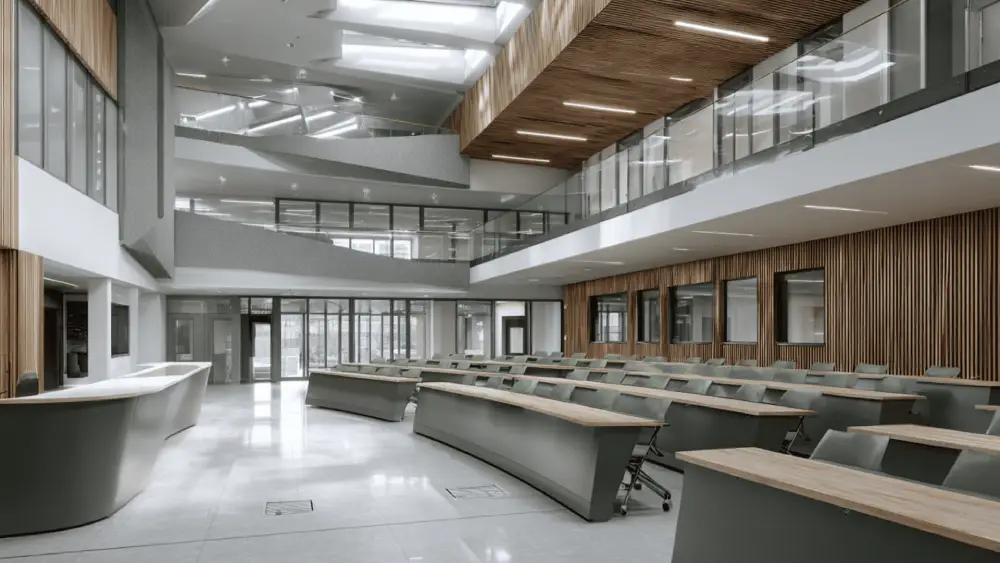
Educational facilities are more than just buildings—they are dynamic environments that shape the learning experience, influence productivity, and promote well-being. From classrooms and labs to dormitories and auditoriums, schools and universities require high-performing MEP Design (Mechanical, Electrical, and Plumbing) systems that ensure safety, comfort, and sustainability. A K-12 retrofit example is Budlong’s auditorium seismic upgrade, demonstrating how engineering considerations are applied to existing educational facilities.
Designing MEP systems for these institutions is a balancing act between functionality, efficiency, and adaptability. Every decision—from lighting layouts to ventilation strategies—affects how students learn and how campuses operate.
Here’s an in-depth look at the key MEP design considerations that make modern educational spaces smarter, safer, and more sustainable.
Understanding the Educational Building Ecosystem
Unlike standard commercial structures, educational facilities serve multiple functions within one space—academic, residential, administrative, and recreational. This diversity creates unique design challenges, including:
- Variable occupancy patterns (full classrooms by day, vacant halls by night)
- Noise sensitivity in learning environments
- High ventilation demands for labs, cafeterias, and lecture halls
- Strict safety and accessibility codes
MEP engineers must design systems that adapt dynamically to these variables while maintaining operational efficiency and budget discipline.
1. Mechanical Systems: Comfort and Air Quality for Learning
Indoor air quality (IAQ) is directly linked to student concentration and performance. Modern HVAC design focuses on optimizing temperature, humidity, and ventilation in classrooms and common areas.
Key Mechanical Strategies:
- Demand-Controlled Ventilation (DCV): Adjusts airflow based on CO₂ levels to maintain air freshness without energy waste.
- Displacement Ventilation Systems: Deliver conditioned air at low velocities, minimizing drafts and improving air quality.
- Dedicated Outdoor Air Systems (DOAS): Provide consistent fresh air for classrooms and labs.
- Zoned Temperature Control: Allows flexible comfort management for different building zones.
In laboratories or science blocks, MEP engineers incorporate fume hood exhausts, HEPA filtration, and airflow balancing to meet health and safety standards.
2. Electrical Systems: Safety, Flexibility, and Smart Integration
Modern education relies heavily on technology—projectors, smartboards, lab equipment, and charging stations—all demanding reliable, flexible power delivery.
Electrical Design Considerations:
- Distributed power systems with capacity for future expansion.
- Smart lighting controls with occupancy sensors and daylight harvesting.
- Emergency backup systems for life-safety and digital continuity.
- Data and low-voltage infrastructure for Wi-Fi and AV systems.
Energy-efficient LED lighting systems not only reduce utility costs but also improve visual comfort in classrooms and libraries.
3. Plumbing Systems: Hygiene, Conservation, and Sustainability
Water plays a vital role in campus operations—from drinking fountains and restrooms to cafeterias and laboratories.
Plumbing Design Best Practices:
- Low-flow fixtures and sensor-based faucets to minimize waste.
- Greywater recycling systems for irrigation or toilet flushing.
- Anti-scald valves and thermostatic mixing for safety.
- Centralized hot water generation for dormitories and cafeterias.
In science labs, plumbing systems are designed with chemical-resistant piping, special waste collection, and backflow prevention to maintain safety and compliance.
4. Energy Efficiency and Sustainability
With many schools committing to net-zero energy goals, sustainability is now a design prerequisite.
Key initiatives include:
- Solar photovoltaic (PV) systems to offset energy demand.
- Geothermal heating and cooling loops for long-term efficiency.
- Building automation systems (BAS) to optimize HVAC and lighting performance.
- Smart metering to track and reduce energy and water consumption.
Incorporating renewable energy sources and advanced controls helps institutions reduce operating costs while meeting sustainability targets and LEED certification standards.
MEP Design Priorities by Facility Type
| Facility Type | Primary MEP Focus | Design Challenges |
|---|---|---|
| Classrooms | Lighting quality, air ventilation, acoustics | Balancing comfort and energy efficiency |
| Laboratories | Ventilation, safety systems, chemical drainage | Strict code compliance and contamination control |
| Dormitories | Water heating, HVAC zoning, power access | Varying occupancy loads and user comfort |
| Auditoriums & Gyms | Sound control, temperature regulation, lighting | High occupant density and heat gain management |
| Libraries & Study Areas | Quiet ventilation, glare-free lighting | Maintaining comfort without distraction |
This table highlights how each building type within a campus presents its own MEP challenges—and how careful engineering ensures every environment supports its purpose effectively.
5. Safety and Code Compliance
Educational buildings must comply with rigorous local and national codes, including:
- NFPA 101 (Life Safety Code)
- ASHRAE 62.1 (Ventilation for Acceptable Indoor Air Quality)
- ADA Accessibility Guidelines
- Title 24 (California Energy Code) for energy efficiency
MEP engineers coordinate with fire protection, structural, and architectural teams to ensure full compliance while maintaining system efficiency.
Budlong Insight: Designing for the Next Generation of Learning
At Budlong, we believe educational MEP design isn’t just about infrastructure—it’s about creating environments that inspire learning, creativity, and well-being.
Our MEP engineers work closely with architects and school administrators to design systems that combine efficiency, comfort, and adaptability. Whether it’s a K–12 school or a multi-building university campus, we use advanced modeling, sustainability strategies, and technology-driven solutions to ensure every system supports the institution’s educational mission and long-term vision.
Conclusion
Schools and universities are more than academic spaces—they are communities that shape future generations. Effective MEP design ensures those communities thrive by providing safe, efficient, and inspiring environments for students and educators alike.
Through smart mechanical systems, efficient power distribution, and sustainable plumbing design, engineers create campuses that stand as models of environmental responsibility and human-centered design.
As education evolves, MEP engineering will remain at the core of designing smarter, healthier, and more resilient learning environments.